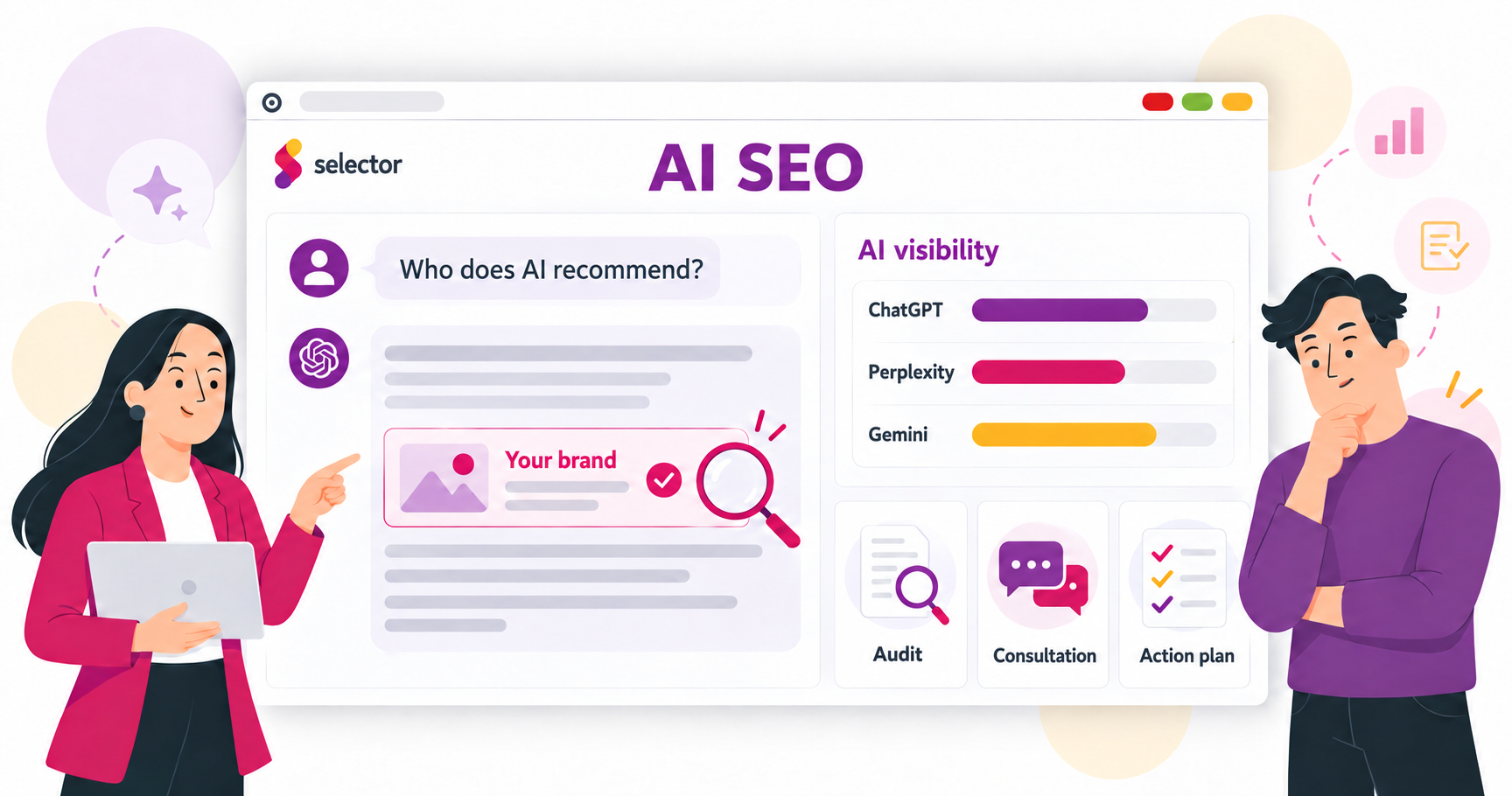
The search experience is undergoing a revolutionary transformation: keyword-based searches are increasingly being replaced by more complex questions phrased in full sentences.
This is closely linked to the rapid rise of AI search engines – such as ChatGPT, Perplexity and Google AI Overview – whose market share is growing month by month.
If you don't align your marketing strategy with AI SEO requirements, your competitors could overtake you in this new, untapped landscape.
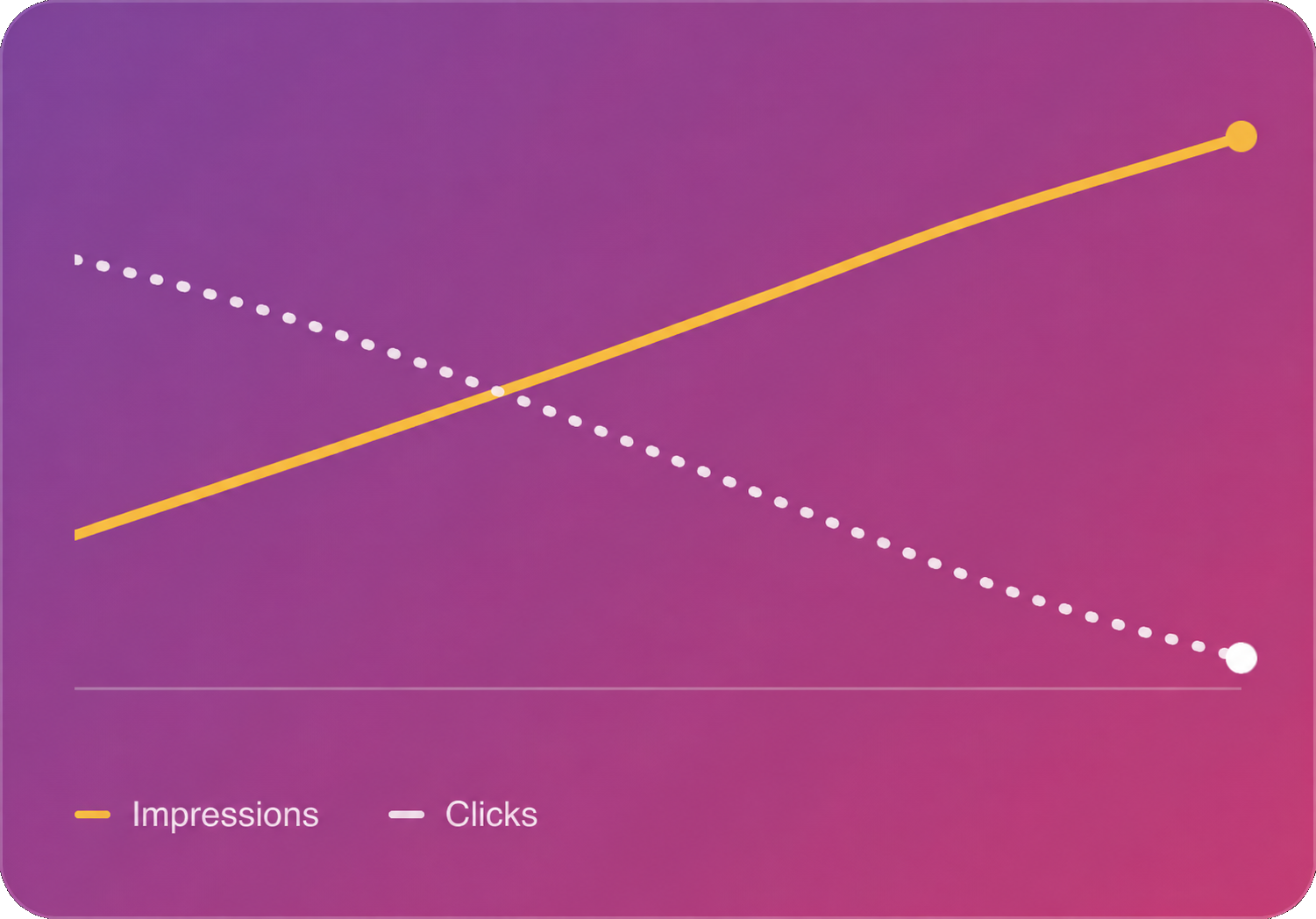
The industry calls this the "Great Decoupling": your brand visibility increases while clicks to your website decrease.
This doesn't mean you've lost ground – it just means that "clicks" alone are no longer a reliable measure of your success.
What matters is whether you appear within the actual answer the AI provides to your potential customer – even if they never click through to your site. This is what our AI SEO audit assesses.
Source: Google I/O 2026 announcement (AI Mode user numbers) · SparkToro, early 2026 analysis (zero-click rate)




While others just send a generic report, we support you from the initial audit through to continuous monitoring – this isn't a one-off check, but a complete AI visibility system.


Our analysis reveals exactly how ChatGPT, Perplexity, and Google AI perceive your brand. You will also receive a prioritised action plan, which you can discuss in detail with our SEO expert to determine the next concrete steps.
Request a free auditThis brand achieves its strongest AEO score in the very AI model where its visibility in the competitive landscape is at its weakest (Gemini) – it is precisely these data-backed gaps that an AI SEO audit uncovers, which would be almost impossible to spot based on intuition alone.
The company name and competitor data have been anonymised; the metrics and ratios are taken from the actual report.
AI visibility is driven by more than just the text on your website. AI models monitor your brand's entire digital footprint: what independent sources say about you, your presence on social media, and the volume of relevant press coverage and customer reviews you have. This is where a pure AI audit firm stops – but we are just getting started.
We have put together a list of the questions our clients ask us most frequently, in the hope that these answers might be helpful to you too.


For decades, classic SEO was all about ranking in the top three Google search results to drive clicks. AI SEO, by contrast, focuses on ensuring that AI—such as ChatGPT, Perplexity, Gemini, or Google’s AI Overviews—considers you a reliable source and incorporates or cites you within its summary responses. You are no longer just competing for a position; you are competing to be included in the list of sources behind the generated answer.
All three serve the same purpose, just from different angles. AI SEO is the umbrella term for the entire field. AEO (Answer Engine Optimization) focuses on ensuring a specific piece of your content appears as a direct, featured answer – this includes featured snippets, "People also ask" boxes, and responses read aloud by voice assistants like Siri and Google Assistant. GEO (Generative Engine Optimization) is broader: it examines how your brand can be consistently integrated as a reliable source within the synthesised responses of generative AI engines such as ChatGPT, Perplexity, and Gemini. In practice, these three areas are closely intertwined, and a sound AI SEO strategy covers all of them.
Many people confuse the two, but they are not the same. AI Overview is a brief, automated summary that appears above or within the classic link-based search results, and it is still fundamentally built upon that list of links. In contrast, AI mode is a standalone view where the search transforms into a genuine conversation: it provides longer, more detailed answers, explores subtopics, and suggests follow-up questions—much like talking to a built-in research assistant. It is worth optimising for both, but the underlying logic remains the same: you can gain visibility by providing structured, quotable, and reliable content.
The most important ones are ChatGPT, Perplexity, Gemini, Google AI Overview and AI mode, Microsoft Copilot, as well as the AI-powered search features on TikTok and YouTube. It is also worth considering voice assistants (Siri, Google Assistant), as they are increasingly reading out AI-generated responses.
AI systems do not view your page as a single block of text; instead, they break it down into segments—headings, paragraphs, lists, and highlighted blocks—to determine which part provides the most accurate answer to a user's query. They also assess the credibility of the source (checking for a visible author, professional background, and citations) and evaluate how much relevant, up-to-date information the page contains. The goal of optimisation is to ensure that all these factors point directly to you.
Use structured, question-and-answer-based content with clear entity labelling (who you are, what you do, and where you are based), and ensure that your claims are backed up by other reliable sources, such as industry portals, reviews, and press coverage. This last point is the most frequently underestimated factor: AI doesn't just look at your own website; it also considers what others are saying about you.
The basics: ensure your robots.txt allows AI crawlers (e.g. GPTBot, ClaudeBot, PerplexityBot), consider adding an llms.txt file to your domain, and ensure your content is provided with machine-readable, structured data (schema.org) so that AI can clearly distinguish between articles, FAQs, and product pages. It is also important that content does not rely solely on JavaScript to render, as most AI crawlers do not execute it – meaning visitors see everything, while the AI sees only an empty shell. We map these settings during our audit and prioritise them in our recommendations.
You may see visible shifts within 1–3 months, but continuous optimisation is the key to lasting results, as AI search engines are constantly updating what they consider to be a reliable source.
No. AI search engines are constantly updating their databases and models, which means content and data must be refreshed regularly to ensure you stay ahead of the curve. This is why continuous monitoring is essential, rather than just a one-off audit.
Yes. As a local business—whether you are a restaurant, service provider, or healthcare practice—the most important factor in the AI era is not your website design, but the "data ecosystem" surrounding you: how complete your Google Business Profile is, the quality of your reviews, and how consistent your data is across various platforms. For online shops, the quality of your product feeds and structured product data (stock levels, pricing, delivery information) is the primary factor in determining whether you appear in AI-driven shopping recommendations.
Yes, it is completely free and carries no obligation. Once the audit is complete, we will get back to you within one working day with the results and a prioritised action plan, followed by an informal consultation to discuss the opportunities together. Based on this, we will provide a proposal for carrying out further AI SEO tasks – including the option for us to work alongside your own team in a consultancy capacity.
Nothing - you receive the analysis and the consultation, and any further steps are entirely your decision.
Send us your question, and we'll do our best to respond within one business day.
If it's urgent, please call us.