

For us, it's the business needs of our Clients that we focus on when planning a campaign. Based on our accurate measurements, we optimize our ads to maximize profits. When managing your campaigns, our primary goal will also be to achieve the highest possible return.

Our Google Partner status guarantees that our clients truly receive the highest level of digital marketing support from us. One of the biggest advantages of Google Ads is that, thanks to keyword-based campaign targeting, we can show our ads to users who are definitely interested in the topic and display personalized messages based on where they are in the purchasing and decision-making process. In addition, the diversity of display ads across the internet allows us to reach our potential customers.

Search ads in Google's search results, visual display campaigns, YouTube video ads, and retargeting

Google Shopping ads are a great way for web stores to sell their products. They also provide customers with a picture, short description, and price of the product as opposed to simple text ads. As a result, those who click on your ad are more likely to become paying customers because they already know the most relevant information.
Shopping & smart shopping campaign management and the configuration of Merchant Center & Product feed

With properly set up Facebook campaigns, you can effectively reach your target audience registered on the social media platform. Your ads can appear in a creative and varied form, making the most of Facebook's capabilities. From branding to sales, a wide range of tools are available to your customer base.
News Feed Ads, Video Ads, Facebook Stories, Messenger Ads and Lead Generation

On Instagram, you can easily blend into the organic content, making it the best option if you want to convey your brand’s values through visual content. The platform is perfect for branding, but it also helps direct sales a lot.
Instagram Feed Ads, Instagram Stories and Followers

LinkedIn campaigns can be used to boost sales in the B2B area and to enhance the effectiveness of recruitment, as we can reach the most experienced professionals with our ads on the world's largest professional business network portal. As a result, business decision-makers can be more accurately targeted on this platform than through other social media platforms.
News Feed ads, Text ads, Sponsored message ads, Dynamic ads, Lead Generation ads, Job postings

Twitter is primarily recommended for international campaigns, especially if you want to target the U.S., England, or Western Europe. Since this is the preferred platform in these areas, with Twitter ads we can achieve even better results than with Facebook ads.
Reach, Video views, Pre-roll views, App installs, Website clicks, Engagement, Followers and App re-engagements

Users don’t just use Pinterest for inspiration, many of them decide here whether to buy a product or not. With the right content and targeting, you can achieve outstanding results. In addition you can run a campaign with much lower advertising costs than on other platforms.
Brand awareness, Video view, Traffic, App install, Conversions and Shopping Catalogs

On YouTube, you can reach users with a wide range of interests around the world and by your video ads you can reach them with the right message at every point of your sales funnel. The advantage of the platform is that you can get the full attention of the viewers during your video spot, while you only have to pay for those impressions when users actually viewed your ad.
TrueView ads, Bumper ads, Overlay ads

With TikTok ads, you can place your brand on the map of a social platform that puts social content production in a whole new light.
On this platform, you can reach users who might be ignoring traditional online advertising.
Video and Spark Ads on TikTok's "For You" feed
We evaluate the performance of our campaigns together with you, primarily based on return on investment, to ensure that it’s worthwhile for you in the long run.

We’ll keep an eye on your campaigns even when your contact person is on vacation; we’ll always arrange for a replacement.

Our goal is to generate additional revenue for you that more than compensates for our campaign management fee.

We're not asking you to make a long-term commitment; we want to prove to you, month after month, that it's worth working with us.

We work as a team, so we can handle multi-platform campaigns, creative projects, and even tighter deadlines.

In addition to campaign management, we’re also well-versed in a number of related areas, whether it’s creative design, landing page development, search engine optimization, or A/B testing.


"Thanks to the business development and optimization efforts that followed the Google Ads audit—with the help of our new partner—we were able to multiply the number of bookings generated through our ads within a year."
.jpg)
“Selector is the most capable and agile PPC agency I’ve ever worked with. I recommend them to anyone looking not just for an executor, but for a partner who thinks along with them. In short: they make our lives easier.
#weloveworkingwiththem”

"By paying close attention to our users, relying on objective data and our many years of experience, and keeping up with the latest trends, we have always achieved valuable results together."
.jpg)
"Selector manages our campaigns across 7 countries, and it’s not just one person—it’s an entire team working on our campaigns. They document everything, measure everything, explain everything, and are open to our ideas. They’re by far the best Google Ads team I’ve ever worked with."

"It is of the utmost importance to us that we make the most of Google's advertising network to increase traffic to our online store and promote our related services. Selector goes a step further, as it also creates and optimizes our landing pages to achieve the best possible results."

"The most effective way to optimize our resources is to have Selector manage our Google Ads campaigns. Only a specialist with their level of expertise can keep pace with the channel's continuous development, provide the necessary knowledge, and dedicate the required time to ensure the effectiveness of our ads. We see their success confirmed in the growth of our traffic."

"Tamás and the Selector team tripled our product sales in two years with a well-tailored website and Google Ads optimization. Thanks to him!"

"We enjoy working with Tamás's team; our collaboration is based on a shared vision, which they help foster with insightful questions. Since we've been working together, we've felt secure, and Selector's support has had a direct impact on our business results."

"Working with you is always inspiring. I am grateful that you have contributed wholeheartedly and with excellent ideas to making our professional dreams a reality."

"We've been working with the Selector team for several years. They know exactly what we need to achieve our goals. They also know how to make that happen using the latest technologies and creative ideas. Their work is precise and creates measurable business value. Plus, they're really great people."

"It was great working with Selector. They are a reliable and professional team with a results-driven approach. They apply their excellent SEO expertise across multiple languages. If you need a real competitive edge to grow your business, the Selector team is definitely the best choice."

"We greatly appreciate the precision, proactivity, and friendly attitude with which the Selector team helps the Medve Matek team get our message out to as many people as possible. Thank you for everything!"

"I recommend Selector because Tamás and his team listen to their clients, work with exceptional precision, and establish a structured process for each project. This not only guarantees successful campaigns but also spares us the stress of dealing with the agency: your ad is in good hands."


A few figures to demonstrate our expertise:
We've gathered the most common questions our clients have asked, hoping the answers will be helpful to you too.


PPC is an abbreviation for the term “pay-per-click,” the three-letter abbreviation has become more widely used. PPC is a form of online advertising in which advertisers only have to pay when a user clicks on one of their ads; simply displaying the ads does not incur any cost.
The most common form of PPC advertising is search ads, which can be managed through Google Ads, but PPC campaigns can also run on social media platforms such as YouTube, Facebook, Instagram, and TikTok, and this category also includes ads that appear on websites.
While marketers often use these three-letter acronyms interchangeably, there's an important distinction between SEM (Search Engine Marketing), SEO (Search Engine Optimization), and PPC (Pay-Per-Click advertising).
SEM, or Search Engine Marketing, is an umbrella term that encompasses PPC but is not limited to this advertising format. It refers to activities aimed at improving a website's visibility in search engines, which in Hungary primarily means Google. Search engine marketing includes both paid (PPC) and unpaid, or organic, traffic (SEO).
SEO, or Search Engine Optimization, is a method used to optimize website content and technical settings, with the goal of making it more visible to search engines. The goal of SEO is to improve a website's organic (unpaid) search rankings and drive traffic to the website through organic search results.
PPC is an online advertising model where advertisers pay when – and only when – a user clicks on one of their online ads. PPC is a component of SEM: this advertising model first emerged in the realm of search advertising, but today it is no longer exclusively tied to search engine marketing, as PPC ads can also be found on other platforms (Google Display, YouTube, Facebook, Instagram, etc.).
With PPC ads, advertisers can bid on specific keywords or phrases they want to appear in Google’s search results. When a user searches for one of those keywords or phrases, the advertiser’s ad appears among the organic results. In the Ads Manager, you can configure settings so that ads are shown only to users who meet specific targeting criteria, such as specific geographic locations, languages, demographic characteristics, interests, etc. Google then uses a complex algorithm to determine which ads to display and in what order. The algorithm takes into account factors such as the advertiser’s bid amount, the ad’s relevance to the keyword, the ad’s quality, and the landing page experience. The PPC advertising format works similarly on social media platforms such as Facebook and Instagram.
PPC campaigns can be particularly useful for companies that want to quickly drive traffic to their website or online store, as opposed to search engine optimization, which can take many months or even years to yield results. Based on feedback from visitors, PPC campaigns allow us to test our business ideas and concepts by creating a landing page without having to work out every detail. PPC ads can work well even for those with smaller advertising budgets, since there’s no need to reserve ad space in advance for a fixed period. Many people choose PPC campaigns because they value flexibility—the ability to adjust campaign settings on the fly based on results, including targeting strategies, ad copy, placement, budget, and so on.
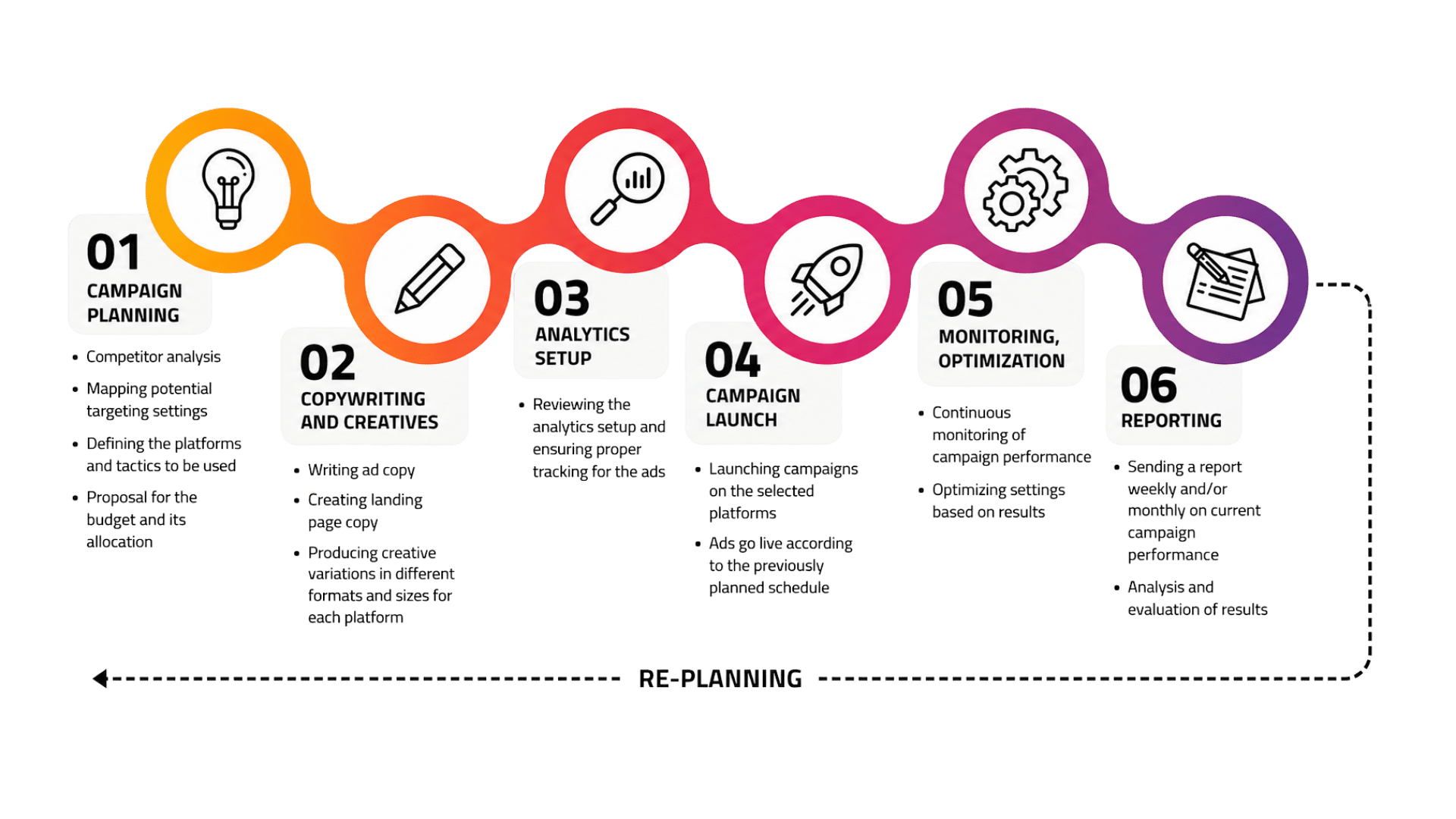
At Selector, we break down the tasks related to PPC ad management into the following phases, during which we work closely with our clients:
1. Campaign Planning: competitor analysis, mapping out potential targeting options, selecting applicable platforms, defining tactics, and recommending budget size and allocation.
2. Copywriting and creative assets: writing ad copy, creating image and/or video creatives, and producing variations in different formats and sizes tailored to each platform.
3. Analytics setup: configuring and verifying measurement settings to accurately track ad performance.
4. Campaign Launch: Launching campaigns on each platform and displaying ads according to the pre-planned schedule.
5. Monitoring and Optimization: Continuously monitoring campaign performance and optimizing settings based on the results.
6. Reporting: Sending weekly and/or monthly reports on the current performance of the campaigns; jointly evaluating the results through consultations.
7. Consultations: Depending on the complexity of the task and the size of the campaigns, we coordinate operational tasks related to the current campaigns on a weekly, biweekly, or monthly basis.
8. Re-planning: After the campaign ends, we jointly draw conclusions and compile suggestions for adjustments for the next campaign and/or advertising period.
Before we get started, we always make sure that not only your ads but also your landing pages are in top shape so that we can get the most out of your PPC campaigns.
It’s no longer really worth planning with a monthly advertising budget of less than 100,000 Ft, because the systems need data to test different campaign settings or variations of ads, as well as for the machine learning process. At Selector, we can currently only accept client projects where the monthly advertising budget is at least 830 euros, or a minimum of 1,000 euros for international campaigns. With budgets smaller than this, the agency costs associated with setting up and managing campaigns generally cannot be recouped, though this may of course vary depending on the industry, target market, and specific products or services.
In every case, we prepare a customized proposal for our clients, taking into account the number of advertising platforms managed, the size of the available budget, the complexity of the PPC campaign strategy, copywriting and creative production tasks, the estimated time required for campaign management, the necessary coordination and consultations, and the scope of related services requested. At the start of our collaboration, it may also be necessary to perform one-time tasks such as verifying analytics tracking settings, auditing ad accounts, optimizing campaign landing pages, or creating a custom online reporting dashboard, all of which can also affect costs. We work with the majority of our clients on an ongoing basis and perform campaign management tasks under a monthly fee structure. It is also possible to pause PPC ad management (e.g., during the off-season); in such cases, we do not charge an agency fee. We review campaign management fees annually, taking the rate of inflation into account.
Unfortunately, we cannot undertake campaigns on short notice. For one thing, our team members are working according to pre-planned tasks, and we do not want to take on new assignments in a way that compromises the quality of our previous projects. On the other hand, online marketing agencies follow a well-established process for preparing PPC campaigns, in which each phase builds on the previous one and includes checkpoints. Typically, this requires coordinating the work of multiple team members, and approval rounds with the client may also be necessary. We can take on new campaigns depending on our available capacity and our colleagues’ current workload. If we’ve worked together before, or if you come to us with well-developed ideas, you can expect a faster launch.
For most of our clients, we continuously run PPC campaigns, which include both permanent and seasonal ads. A typical example of “always-on” PPC ads is a brand campaign or an ad for products in your permanent lineup, while seasonal campaigns may focus on specific promotions or rapidly changing products. Depending on the campaign’s duration, it’s necessary to update ad creatives and copy to prevent them from becoming stale. At Selector, we don’t typically run campaigns that last just for a few days, as it’s important to wait until the end of the so-called learning phase to optimize performance.
Fortunately, in online marketing, everything is much easier to measure thanks to analytics. We know exactly how many visitors we’ve driven to your website through ads and what actions or conversions they’ve completed. We most commonly use the following metrics to evaluate the success of campaigns:
Conversion rate: It’s not just clicks that matter, but also how many visitors become actual customers. This metric identifies how many visitors perform a desired action on your site, such as making a purchase or contacting you.
Cost per Acquisition (CPA): This refers to how much it cost you to achieve a specific conversion—that is, a desired event. In an effective campaign, the CPA will be lower than the profit you realize from the conversion.
Return on Investment (ROI): This is the metric that ultimately tells you whether your campaign was worthwhile. You can compare advertising costs with the revenue generated by the campaign.
Innovative analytics tools, such as Google Analytics 4, allow you to track and analyze the metrics mentioned above in detail, along with a wealth of other useful data. Conversion tracking tools provide a realistic picture of the direct and indirect (cross-channel) impact of advertising costs.
At the start of every collaboration, if there has been any prior online marketing activity, we at Selector always recommend conducting an audit in order to identify proven, effective solutions, uncover areas for improvement, and establish a baseline against which to measure future results. During the audit, we not only identify past mistakes and shortcomings but also formulate recommendations for more effective online marketing communication. Once the audit is complete, you can decide whether to implement the necessary changes yourself based on our ideas or entrust us with carrying out the recommendations.
Basically, yes, but for us, building a website itself is not a challenge; rather, we strive to establish strategic partnerships and long-term collaborations with our clients, which may include creating a website or landing pages, as well as optimizing online platforms for UX and conversion. If a website of such complexity or with such unique functionality is required that we lack the capacity to handle it or that it requires specialized development expertise, we prefer to refer our clients to one of our partners specialized in website development.
Send us your question, and we'll do our best to respond within one business day. If it's urgent, please call us.
Write to us





.png)


