Remember the days when all you had to do was set your target audience, upload a nice image with a short caption, and Meta would practically deliver results on its own? If you try that same strategy in 2026, you’ll likely find your costs skyrocketing while your results plummet.
Meta’s advertising system has undergone a behind-the-scenes transformation in recent years that renders everything we previously knew about Facebook and Instagram ads obsolete. This change is none other than the introduction of Meta-Andromeda.
In this article, we’ll walk you through this new technological era step-by-step, explaining why it has reached its peak now and how it has redefined the role of creatives.
.png)
Meta-Andromeda in a nutshell
Meta-Andromeda isn’t a new button or a flashy menu item in Ads Manager. Andromeda is the latest generation of the algorithm responsible for ad delivery, auctions, and display, which Meta rolled out behind the scenes in late 2024.
So why are we talking about it so much only now, in 2026?
There are two main reasons for this:
- For one, Meta never rolls out new features across the entire system all at once. Changes of this magnitude always appear in the US and larger markets first, reaching us only gradually.
- Secondly, a machine learning model of this scale needs time. Initially, Andromeda ran in parallel with the old technology, collecting user data, testing hypotheses, refining its visual and semantic models, and gradually taking control of the auction engine. Today, that process is complete; the old targeting and bidding logic has been fully replaced by the Andromeda era.
Andromeda
What can it do?
- It learns from complex user behavior patterns. It no longer just looks at whether someone liked a page or clicked a link; it analyzes their entire digital behavior pattern.
- It considers deeper engagement. It evaluates interactions, click-through rates, video watch times, the sentiment of comments, and emotional reactions.
- It optimizes for semantic meaning. It is capable of understanding the true content and context of images, videos, and text at a deeper level.
- It identifies the potential target audience based on the creative. Instead of you manually telling it who to reach, Andromeda deciphers who the offer is for based on the visual and textual message.
- It decides which ad "gets put on the shelf." In the very first stage of the auction process, Andromeda selects the ads that have any chance of making it onto the virtual shelf from which they are served to users.
And what is GEM?
If Andromeda is the engine that understands ads and organizes the inventory on the shelves, then GEM (Generative Ads Recommendation Model) is the super-intelligent recommendation model that knows exactly what the shopper will pick off that shelf.
Meta has been running the GEM model live since Q2 2025, and it has become the second essential pillar of Andromeda.
What can it do?
- It learns from temporal patterns. GEM doesn't look at snapshots; it tracks the entire customer journey. It understands the patterns of the days or weeks leading up to a purchase and the user's current stage in the decision-making process.
- It learns what the shopper will take off the shelf. It continuously analyzes which of the offered ads a specific type of user will respond to with a meaningful conversion.
- It handles Facebook and Instagram data together. For example, if a user watches a video on Instagram Reels, GEM immediately uses this information to optimize the ads shown in the Facebook feed.
Creative is the new targeting
For years, the foundation of ad management was setting up detailed interests and demographic filters in the ad manager. In the reality of 2026, this approach is completely obsolete. The Andromeda model is built on creatives.
#m1-y#Important! Every creative must be completely distinct and different!
If creatives are made with only minimal changes, Meta perceives them as a single creative.##
Why is this the case?
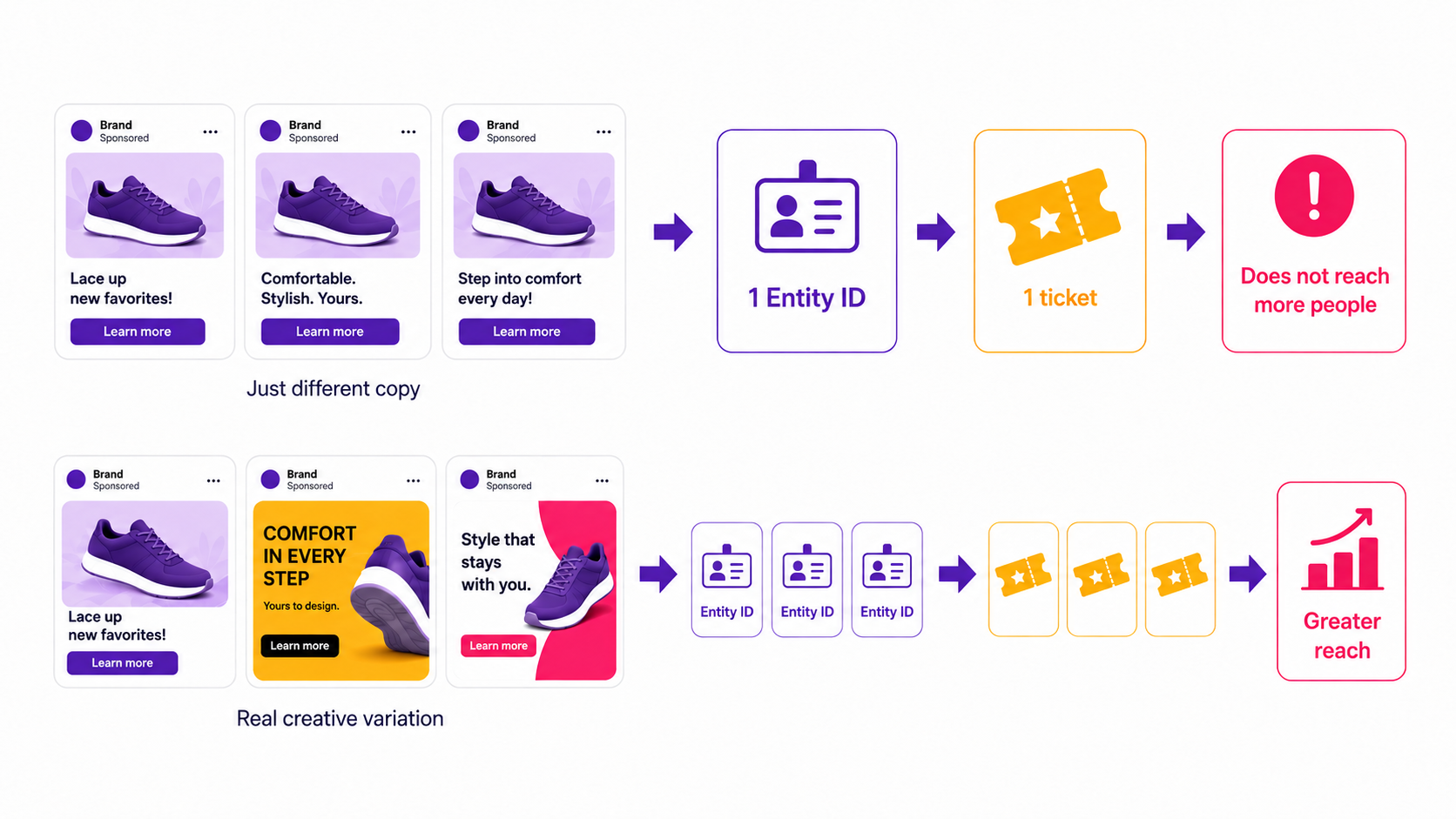
Meta assigns a so-called Entity ID to every unique creative. If you have 10 ads, but they all have the same background and identical visual elements, and only the copy (text) is different, the algorithm sees the whole thing as a single creative. This means you only get 1 ticket in the auction. You won't reach more users. You need real, noticeable changes, not minor tweaks.
What makes a good creative in 2026?
- For video content: The first 3 seconds are crucial (the Hook). If you don't grab attention here, the user will scroll past.
- For static creatives: A clear message and strong visuals are essential. Put the main message on the creative itself, as many people won't even read the ad copy.
- Authenticity: Avoid looking like an ad. Steer clear of staged, artificial stock photos. Natural, trust-building visual elements perform the best.
The creative defines the target audience
Instead of experimenting with manual targeting, create 3 completely different creatives. Here is an example:
- A family –> Andromeda shows this to those looking for family activities.
- A group of friends –> The algorithm delivers this to young adults.
- A couple –> The ad is shown to couples looking for date ideas.
You have already reached 3 different target audiences from the same ad set. Plus, Advantage+ audience includes remarketing, so the algorithm knows exactly when to show the right ad to a previous visitor or a brand-new prospect.
What does Andromeda like?
- UGC content: Product demos and reviews recorded by real customers build trust.
- Hook variations: Create 3-4 different opening scenes for the same video.
- Format mutations: Use a mix of formats, including vertical Reels, square images, and swipeable carousel ads.
#m1-y#If you only have 3-5 creatives, don't run them all at once. You will burn out your audience quickly. Rotate them, switching between active and paused states every few days. This way, you can get the most out of your existing creatives.##
What is the ideal campaign structure?
The global, high-budget ideal:
Before we look at the specific settings, it is worth clarifying one important thing: Meta does not design its system for the Hungarian market or for the advertising budgets of small businesses. The algorithm is calibrated for massive global markets and brands working with million-dollar budgets.
- This is why there is a so-called "textbook" example that Meta recommends: A simple, streamlined campaign setup.
- Campaign-level Advantage+ budget optimization.
- 1 ad set per campaign.
- Ideally 8-10 creatives.
- One test campaign and one evergreen campaign with the winning creatives. (The test campaign is our space for experimentation, where we upload new creatives and let the algorithm pit them against each other. The creative that performs best here is declared the winner and is then moved into our active, always-on campaign.)
- Advantage+ targeting
#m1-y#This global ideal of 10 creatives works perfectly above 50 conversions per week. In this range, the algorithm receives enough data for rapid optimization.##
But what about Hungarian SMEs?
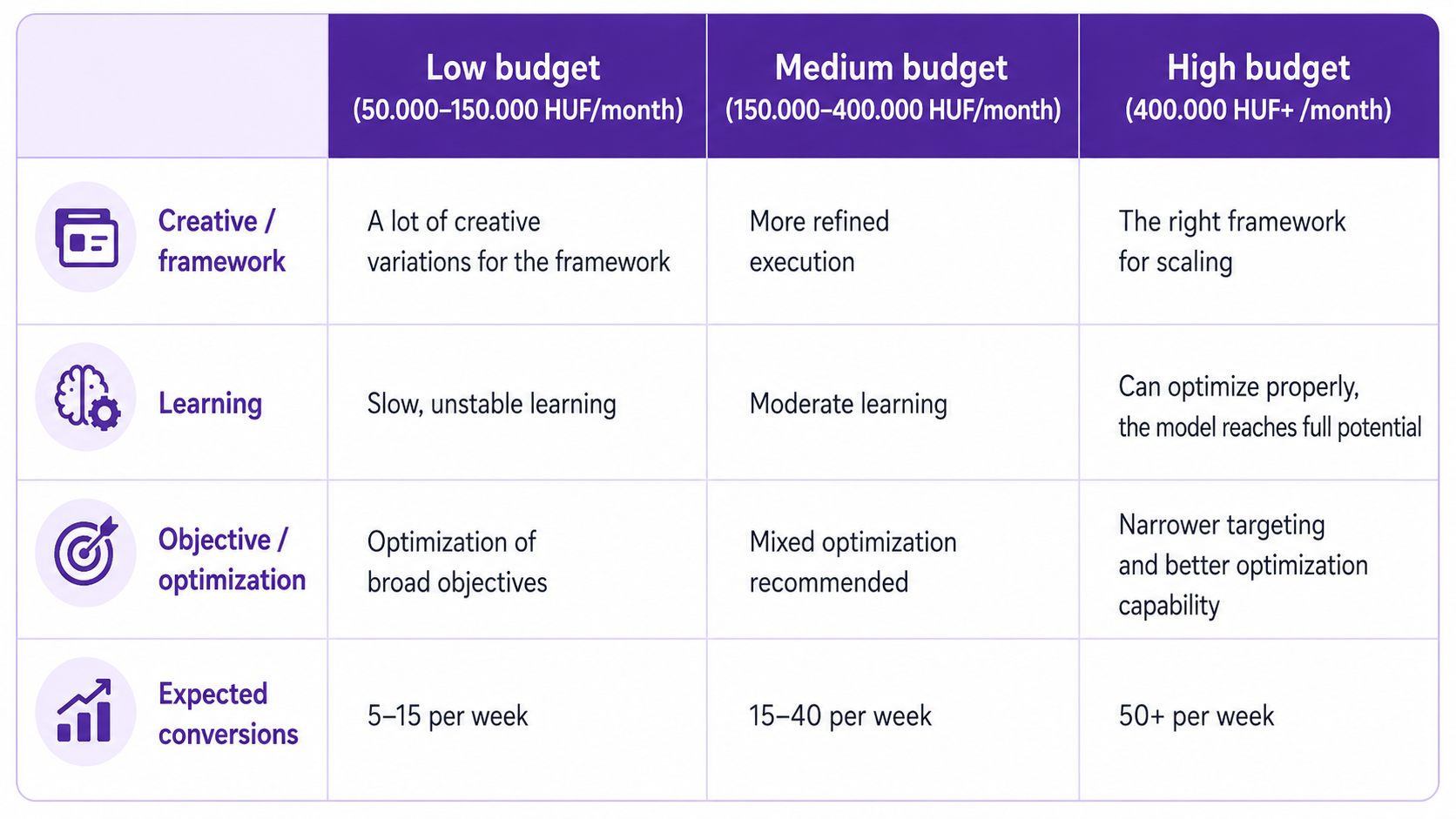
With a small budget, too many creatives fragment the data. At 50,000–150,000 HUF per month, pure Advantage+ targeting can be risky. In such cases, Andromeda can be slow and unstable, and the expected number of conversions may remain low.
Based on our experience so far—which you can read more about in the case study—the following structure may work for Hungarian SMEs:
- If you don't have the capacity for 8-10 creatives, 3-4 are enough; just rotate them.
- A single campaign that embodies both the active and test campaigns simultaneously.
- Using Adv+ targeting with targeting recommendations (Audience Suggestions).
Budget
We have summarized what you can expect based on the size of your budget below. It is important to note, however, that the following chart is for illustrative purposes only. The actual number of conversions is influenced by many factors, such as your industry, the price point of your product, seasonality, and even the conversion rate of your website, which can significantly alter the final results.
What is actively hurting performance today?
Many advertisers may find that what used to work is now actively harmful. Here are the most common mistakes:
- Targeting-based mindsetManual interest settings and defining narrow segments. By over-narrowing, you prevent the Meta algorithm from using its own data points to find the most valuable prospects.
- Remarketing in a separate campaign: Advantage+ targeting already includes remarketing. If you place your remarketing audience in a separate ad set, it is highly likely that the ad sets will bid against each other in the background, fragmenting your data and preventing the AI from dynamically allocating budget to where engagement and purchase intent are highest.
- Complex campaign structure: Too many ad sets fragment the budget.
- Sudden budget changes: Increasing budgets by more than 20% per day knocks the algorithm off its learning path.
- The one image, ten texts tactic: It’s the exact opposite! On social media, visual stimuli are responsible for grabbing attention. If you only change the text, your target audience will quickly get bored of the single image and scroll past it, causing your click-through rate to plummet and your ad performance to drop drastically.
One more important thing that can trip up Andromeda: Pay attention to accurate data
Andromeda, which is built on machine learning, can only learn and function effectively with accurate data. The traditional browser-based Pixel loses 20-30% of conversions due to iOS restrictions and ad blockers. With incomplete data, the algorithm learns incorrect patterns, which can drastically increase your advertising costs (CPA).
In contrast, CAPI (Conversions API) provides server-side data flow, sending purchase and activity data directly from your website's server to Meta.
#m1-y#CAPI is not just a setup trick; it is the clean fuel without which Andromeda cannot deliver maximum ROI.##
If you would like to read more about the mysteries of CAPI, click here to read our detailed guide!
Case study
Below, we demonstrate how we use Meta Andromeda in practice through the example of our client in the private education sector, as a marketing agency. In this case, the primary goal of the ads was to collect leads.
1. The starting situation and the 2025 low point
Our client manages a monthly advertising budget of approximately 150,000 HUF. By 2025, their previous advertising methods had completely failed:
- Lead generation stalled: Neither visitors driven to the website were converting into sign-ups, nor were the Meta Instant Forms working.
- Skyrocketing costs: Even when conversions did occur, the cost per lead exceeded 10,000 HUF, which was unsustainable for this business model.
- Incomplete data tracking: In 2025, only the browser-based Meta Pixel was running, causing the Meta system to miss out on a significant amount of data.
2. The 2026 transition - What worked and what didn't?
In 2026, we began a complete redesign based on Meta-Andromeda principles, but adapted to the reality of Hungarian SMEs.
What didn't work:
We tested the textbook Andromeda structure, creating separate test and active campaigns. In our case, with this monthly budget of ~150,000 HUF, this approach did not work at all. The budget was spread too thin, the algorithm learned slowly, and lead costs did not decrease.
What brought the breakthrough:
- Implementing server-side tracking (CAPI): As a first step, we integrated CAPI so that Andromeda could access more data and stop searching for leads based on guesswork.
- Merging test and active campaigns: We now run both active ads and testing within a single campaign. With this consolidation, the model received enough data for optimization.
3. Creative insights
In the area of creatives, the machine learning model revealed a surprising but clear pattern:
- Static images vs. video: The performance of static images dropped whenever video content was included in the ad set.
- Polished vs. authentic: Beautiful, carefully crafted static images using brand elements performed poorly. In contrast, the algorithm favored direct, live-action videos, even those with minor imperfections.
4. Results
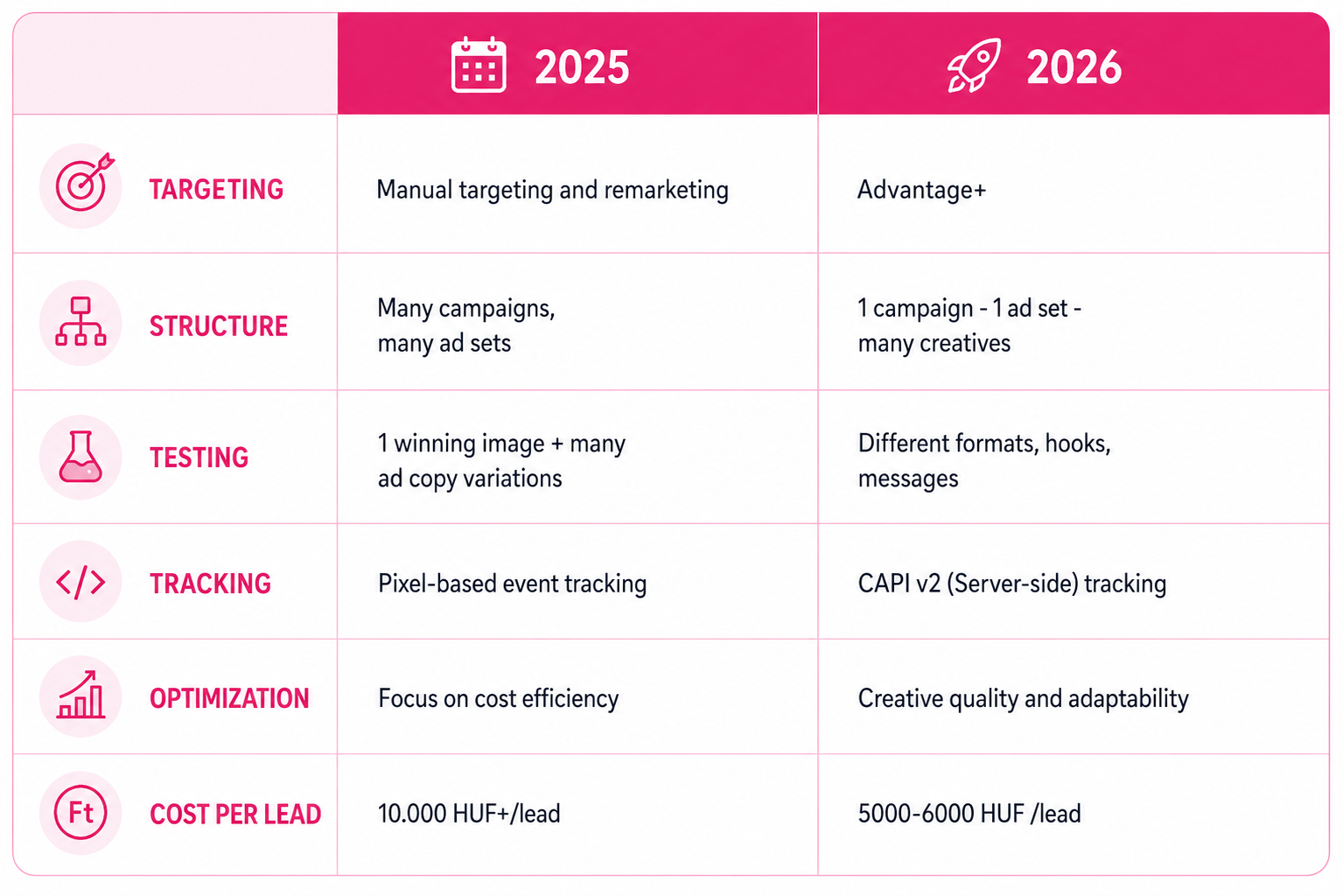
Andromeda is not a magic wand; it is a system that learns continuously and requires skill to operate effectively. By introducing a new strategy, we successfully cut lead costs nearly in half—down to 5,000–6,000 HUF—which is a massive improvement compared to the 2025 low. Without implementing server-side tracking (CAPI) and a creative-focused, consolidated campaign structure, we likely wouldn't have had a chance to achieve similar results in 2026.
But the work is far from over.
At this ad spend level, flexibility is the key to success, as results naturally fluctuate with stronger and weaker periods. To maintain our growth trajectory, we are building on the following steps:
- Continuous creative refreshing: Regular creative rotation is our most effective weapon for keeping lead costs low.
- Testing new formats and copy: We are experimenting with even more direct, live-action videos, new hooks, and varied copy to provide the algorithm with constant fresh stimuli.
- Refining the conversion path: Beyond the ads themselves, we are continuously testing our landing pages and lead forms to extract the highest volume and quality of conversions from our existing budget.
Anyone who understands the system's logic and is willing to experiment can build a stable, high-yield system even with a smaller budget.
Summary
The Meta advertising system has undergone a radical transformation by 2026. Previous manual targeting and browser-based tracking have been replaced by the machine learning-driven Meta-Andromeda and GEM algorithms. In this new era, technical hacks have given way to visually distinct, powerful creatives; from now on, the content itself determines who you reach.
A well-chosen hybrid campaign structure, the integration of CAPI, and the use of diverse formats have proven to be effective. Those who understand the logic of this new system and tailor it to their own resources can continue to build successfully on Meta platforms in 2026.
#promobox-en#Not sure how to apply the Andromeda strategy to your company?##



.jpg)