
Isn't it great to browse the internet undisturbed, finding answers to all our questions? But who or what determines these answers, and how? One of the biggest transformations in recent years is that search engines are now driven not just by keywords, but by artificial intelligence-powered models. The world has already changed dramatically for us, yet we are likely only at the beginning of this process.
.png)
Let's take a quick look back! According to classic SEO, content optimized for specific keywords, along with backlinks, ensured good rankings for websites in search results. Users would type in a search term, and links to the most optimized content, according to the search engine, would appear neatly in order on the search results page. From there, they would immediately click on the link, or website, where they could perform various types of conversions. Essentially, it was a predictable and controllable process, even with frequent search engine algorithm changes constantly posing new challenges for professionals.
In contrast, generative search engines, such as ChatGPT, Perplexity, or Google's AI Overview, no longer just display links; they provide summarized answers to specific questions, right at the top of the search results page, eliminating the need to visit a specific website for information. And that's a significant difference.
This raises a valid concern:
#m1-y#What happens to classic search engine optimization efforts, content, and especially revenue models, if users no longer even click on our site?##
The Impact of AI on Organic Clicks
According to various studies, the proportion of "zero-click" searches reached 60–76% by the end of 2024 – meaning that most searches do not result in a click because the answer is provided by the search engine itself (or the AI engine).
Following the introduction of Google AI Overview, the click-through rate (CTR) for organic results approximately fell by 20–40%.
News portals are the biggest losers. For example, Business Insider's organic search traffic decreased by approximately 55% between April 2022 and April 2025, according to Similarweb data.
What's more, the trend appears to be accelerating. The SEMRush and other industry forecasts suggest that by 2026–2028, traffic from AI-powered searches could surpass that from classic search engines.
The Revolution of Generative Search Engines
Alongside classic search engines, an increasing number of generative search-based platforms now operate, generating real-time AI answers and citing sources. Here are a few examples of these platforms:
- Perplexity.ai – live web search + source listing
- You.com – question-based search engine, with frequent citations
- Phind.com – developer-focused search engine, optimized for technical content
- Brave AI Search – AI summaries with references
- ChatGPT (in web browsing mode) – Bing-based real-time answers, with cited links
At the same time, classic search engines (like Google, Bing) have also started integrating AI-based features alongside search results, meaning both models are currently available on the same search interface.
GEO: source instead of ranking
According to classic SEO logic, the goal was to achieve a top 3 position so that users would click on our link. However, GEO requires a completely different approach; here, success means our content appears as a quote or source in AI-generated answers. It no longer matters what position we appear in on the search results page, but whether the AI incorporates our content into its answers and cites us as a source.
#m1-y#The new type of competition is therefore no longer about ranking, but about citability.##
Well-structured, reliable, and contextually relevant content has a higher chance of being included in an AI's answer, even if it doesn't appear at the top of the first page. Thus, the "source" status mentioned by AI can now be more valuable than a classic first-place ranking in a search engine.
AI vs. classic search engines: the main differences
Let's look at the differences in more detail!
If we type a query into the search bar of Perplexity or ChatGPT, we don't get a traditional list of links, but rather a summary of which companies are the most well-known, what services they offer, and often a specific list with references.
If we perform the same search on Google, the results page starts with paid advertisements, followed by organic results – these are often the websites of companies that have optimized their SEO strategies well, but are not necessarily the best or most up-to-date players.
The difference, therefore, lies not only in the format but also in the goal. This creates an entirely new kind of competition in the field of online visibility.
#promobox-szolg-ai-seo-en#It is time to stop missing out on AI-driven searches and answers!##
Let's look at this with some specific examples!
The GEO's goal is therefore to provide accurate and personalized answers to user queries.
For example, when someone searches for "cheap accommodation in Croatia" "directly on the beachfront". With the help of artificial intelligence, the system can recognize the intent behind the search – that is, the demand for affordable yet well-located accommodation.
In the background, GEO's intelligent algorithms analyze large amounts of data, to display results that truly meet expectations. In our case, beachfront apartments, campsites, or smaller guesthouses that offer direct waterfront access at an affordable price. As a result, they don't just display general links, but also specific, targeted recommendations as well. Instead of browsing through pages or reading reviews for extended periods, users find what they're looking for more quickly.
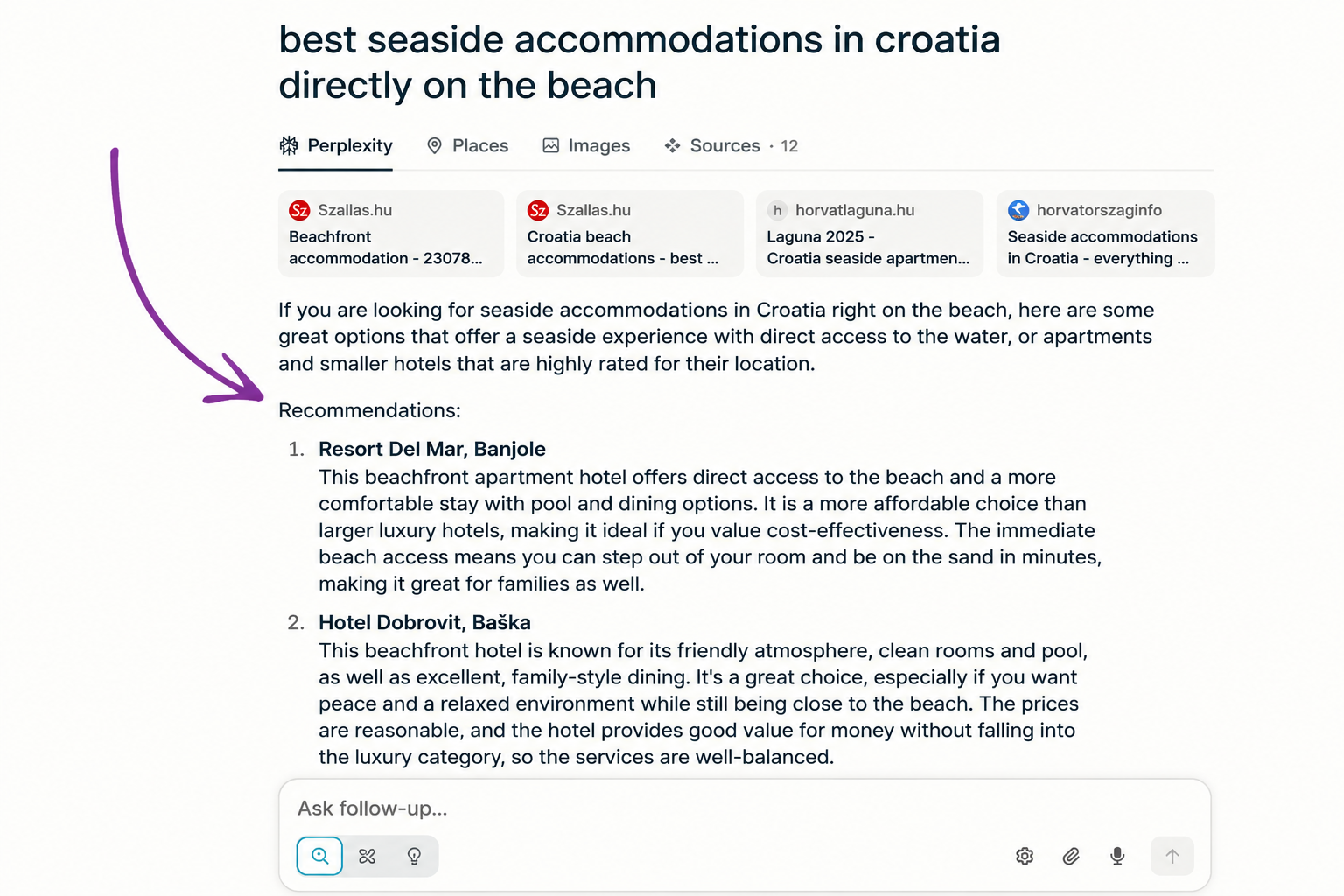
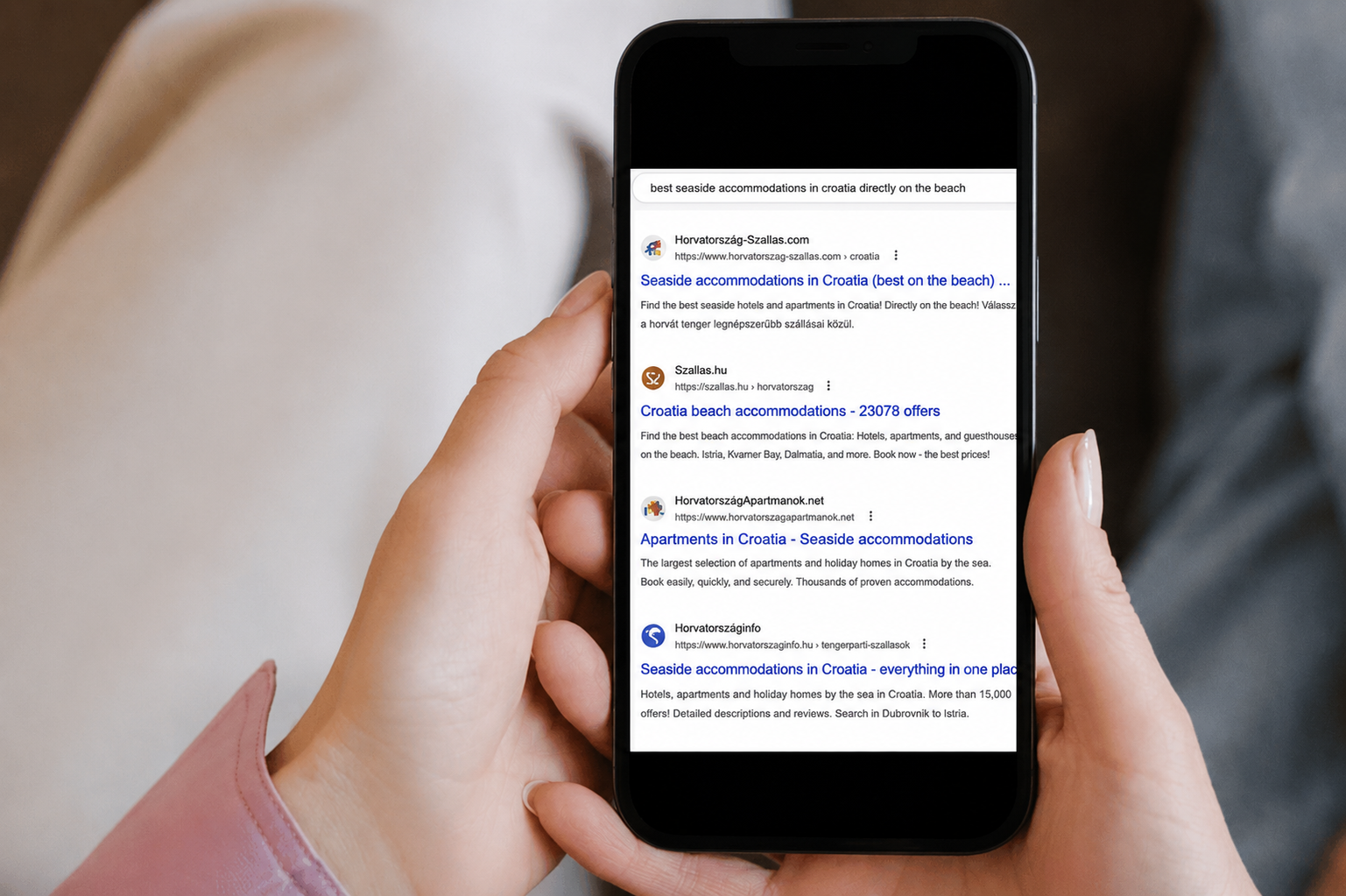
In contrast, a traditional Google search for the same complex keyword, "cheap accommodation in Croatia directly on the beachfront," displays a list of links.
Accommodation booking sites (like Booking.com, Airbnb, Szallas.hu), blog posts, travel portals. These results often too general, and don't always consider the searcher's precise intent – for example, that the accommodation should truly be directly on the beachfront and affordable.
So the user browses through various pages, manually filters out unsuitable results (such as expensive hotels or those not on the beach), and individually checks map locations, photos, reviews, and prices.
#m1-p#It's easy to see that this process is more time-consuming and less efficient.##
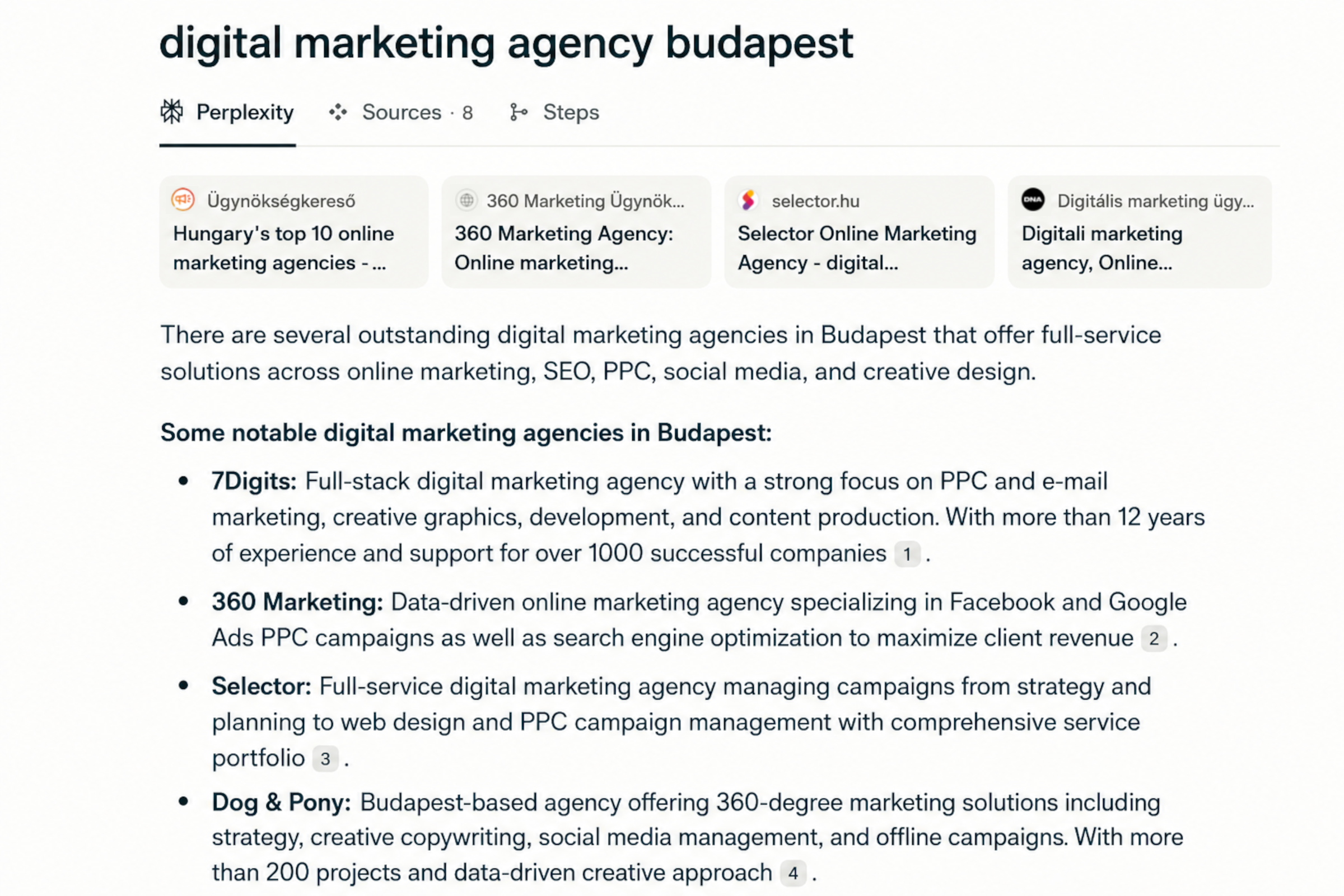
How does this look when we search for a service?
Let's see, for example, if we search for a digital marketing agency in Budapest. We can see that the generative search engine immediately presents concrete results and also displays a summary recommendation:
How does this look in the "traditional" Google search engine?
Using a classic search engine, we get similar results: in our example, we can see almost the same companies that Perplexity also listed:
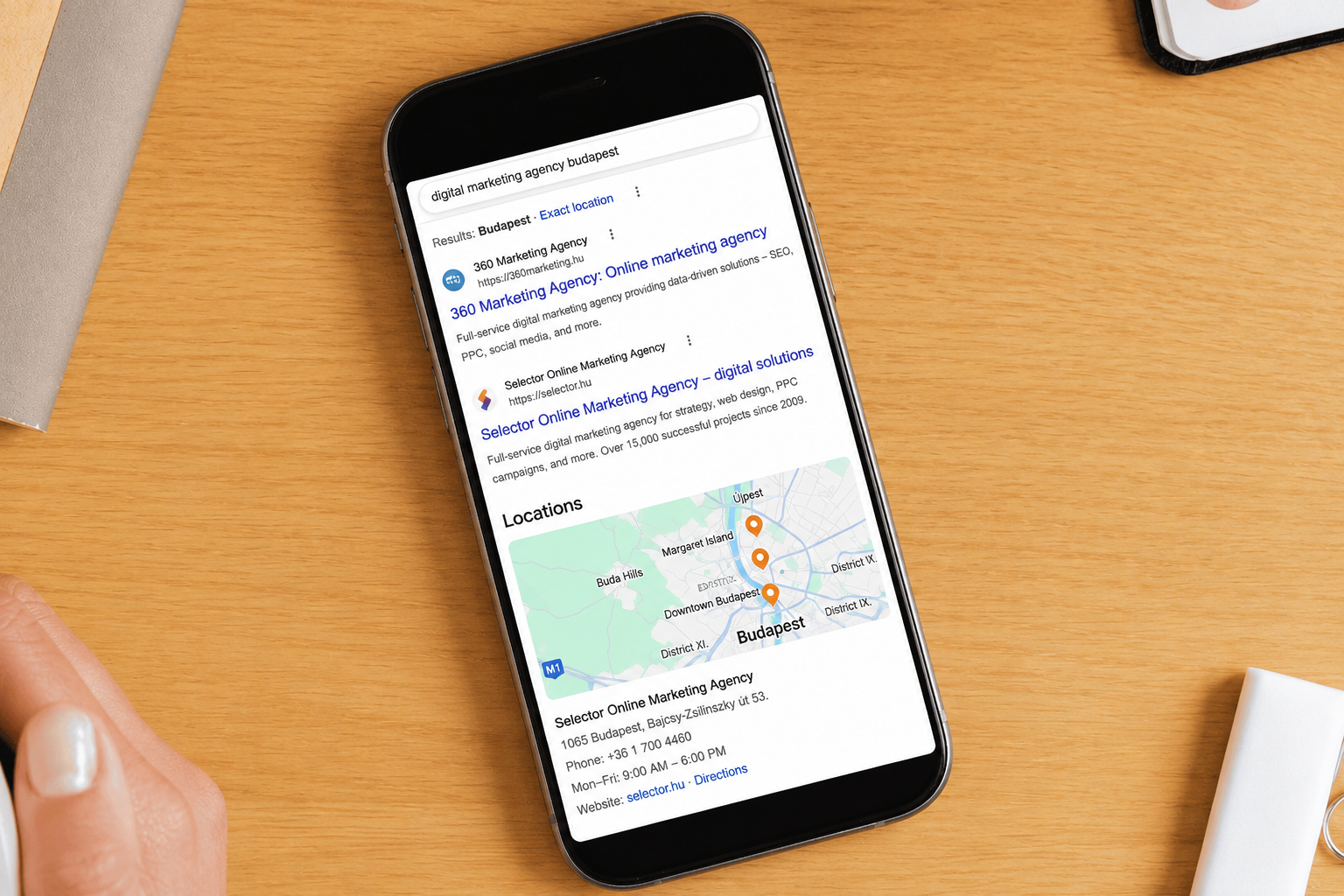
What's missing here, however, is a summary of what the company does (or doesn't) – instead, the search engine typically pulls in the websites' SEO meta descriptions.
As can be seen from the examples above, there are therefore rather differences in layout, but the specific results (the recommended pages) are similar.
How does all this look for an informational search?
Our third example will be a search for which some specific knowledge or informational content could be the answer.
#m1-y#For example: "How do you overwinter potted ginger?"##
Let's first look at the generative search engine's answers:
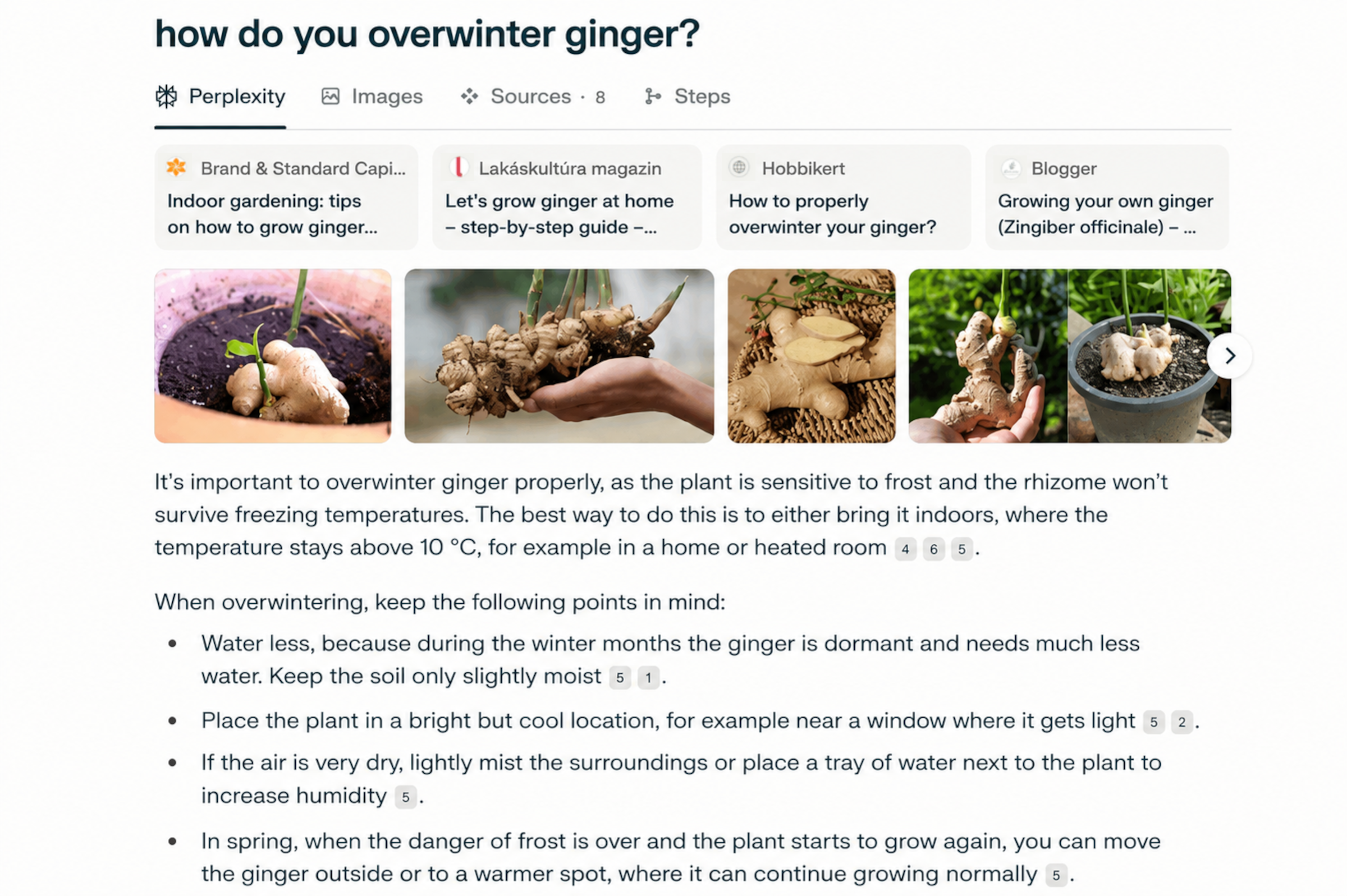
As you can see, while the generative search engine does mention sources, we receive a sufficiently detailed description to be satisfied with the answer provided by the search engine.
Here is Google's answer to the same specific question:
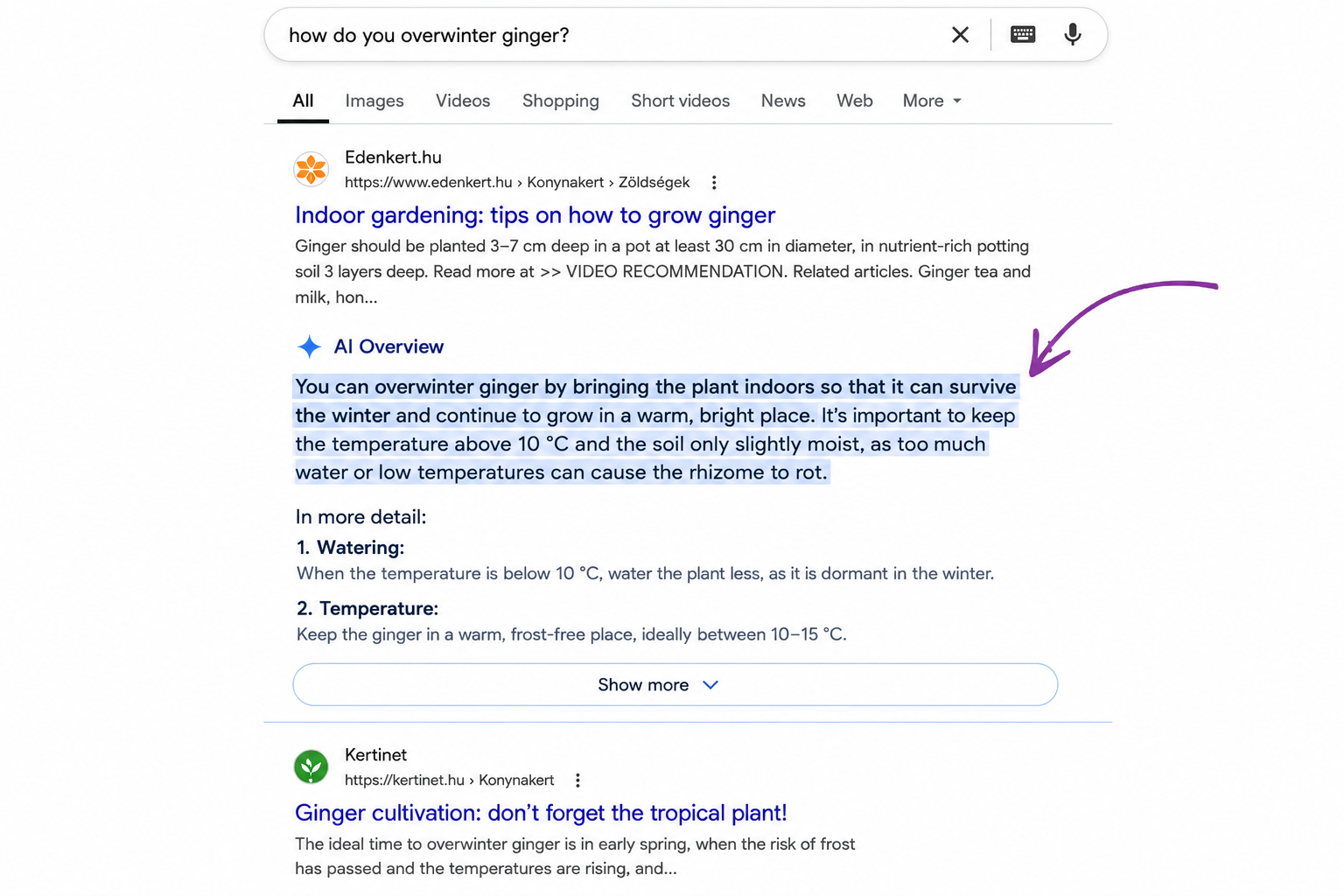
What's striking is that the links from ranked pages are also different from those in the generative search engine. The AI-powered answer also appears near the top of the traditional ranking. Here, I receive a sufficiently detailed answer to my question that I don't feel the need to click for more information.
What does it take to become a cited source in AI search engines?
We can see that the new goal is for our content to become a cited source.
Based on the source selection logic used by Perplexity, Bing Chat, and the browser-based version of ChatGPT, the following key factors elevate a page to be among the links cited by AI:
- Structure: AI models prefer clearly structured, logically organized content (e.g., headings, lists, Q&A format, definitions, tables).
- Professional relevance and timeliness: Pages that contain up-to-date information, preferably with a credible author profile or institutional background, are prioritized.
- Embedding relevance: AI models' "thinking" is not based on keywords but on text vectors (embeddings). If the content's vector is close to the user's query, the chance of it being cited increases.
- Integration into the source network: Content must "appear" in references from other reliable websites. This can be a direct link (e.g., Wikipedia, .edu, government site) or contextual presence.
- Clickability and UX Factors: Pages with fast loading times, mobile-friendly interfaces, and ad-free UX perform better in AI selections.
#promobox-newsletter###
What does it mean for a page to be strong in terms of "embedding relevance"?
This brings us to an important expectation.
Modern AI models don't just interpret keywords; they transform textual content into mathematical maps, known as vectors. These vectors are used to determine how conceptually "similar" two pieces of content are.
If content has "high embedding relevance," it means that the given text is closely related to the conceptual structure of the user's query. For AI, this content appears as a "natural choice" when answering a specific question.
In other words, the more structured, clear, professionally accurate, and contextually relevant the text is, the greater the chance that the AI model will consider it "quotable" – even if it's not the highest-ranking page in the search results.
How can we measure if we appear in AI search results?
The biggest shortcoming right now is that there is no "AI Search Console".
However, several methods are available for indirect measurement, although these currently only allow for less precise measurements:
- Perplexity.ai manual check: check if it cites us as a source.
- Google Search Console CTR signals: impressions increase, but clicks decrease → probable AI Overview presence.
- Referral analysis (GA4, Cloudflare, server log): chat.openai.com, perplexity.ai and similar sources.
- Unique link parameters: e.g., ?ref=ai, which we only use in AI sources.
- Mention monitoring: Google Alerts, Visualping, BrandMentions can help detect if you've been mentioned.
The future of ads and organic traffic
As marketing professionals, we are rightly concerned: if AI takes away traffic, will ads disappear too? Partially yes, but there's no need to worry, because the picture is more nuanced than that.
Those who pay will still appear in the future, the only change will be who we pay.
On AI-powered search interfaces, AdSense-like ads are gradually being replaced by new formats. Google AI Overview is already testing sponsored answers, and Perplexity.ai and other AI search engines are also starting to integrate embedded recommendations into the content. As an elegant solution, these ad formats become an integral part of the answer, so users no longer see them as separate advertisements, but as recommended solutions.
#m1-y#The change will likely hit organic traffic harder.##
As we could see in the examples above, the for informational searches it will become increasingly rare for users to actually click through to a website, as AI itself provides the detailed answer, so why would we spend more time researching than necessary? Furthermore, new types of contextual ads will also appear alongside these.
The question arises: who will ultimately benefit from our content, which has been meticulously crafted to meet SEO requirements more carefully than ever before? After all, at best, our site's link might humbly appear as a cited source somewhere below the question brilliantly answered by the generative search engine. However, someone else will reap the rewards.
In contrast, in the case of product or service-related searches the opportunity for clicks and conversions will remain. Making a decision will require details of a specific offer, for example, whether the desired apartment is available when we go on vacation, or in the case of a service, for instance, which platform and budget would be worthwhile for advertising. These answers will only be available from the supply side.
This is not good news for content creators, as it seems that traffic for informational content will decrease. However, sites specializing in transactional searches can still remain competitive, not at the top of search results, but as suggested options within AI answers.
Everything is interconnected: content as a credibility factor
While many rightly believe that the era of informational content is over, I think it can still play a significant strategic role – just serving a different purpose. Its value might not primarily come from attracting direct organic clicks, but because generative search engines are likely to treat websites that not only offer products or services but also publish substantial, relevant, well-structured professional content as more authoritative sources.
Even if generative search engines now provide answers for informational queries, visiting websites will still be necessary for searches related to specific products or services. In recommendations, sites that are backed by genuine expertise, a well-thought-out content strategy, and a reliable web presence stand. Therefore, well-structured professional content here might not primarily attract visitors, but rather build authority and algorithmic trust, which can lead to conversions in other types of searches.
The future of search will presumably no longer be decided by links, but by the depth of the answers themselves.
Those who still focus solely on classic rankings today could easily fall behind in the race for new types of visibility. GEO will hopefully not completely replace SEO, but it will transform the opportunities and goals. Therefore, it's worth considering now what role our site can play in AI-driven searches.
#promobox-szolg-seo-en#Curious how you can make your site visible in new-generation search engines? Request a personalized consultation! Let's discuss the possibilities!##
-min.png)




.jpg)
.png)