If you're a website owner, you've probably already experienced firsthand the impact Google's new AI-powered search results page has on website traffic. What happens to your traffic and revenue if users get the answer instantly from Gemini and don't click through to your site? We'll show you concrete steps you can take to ensure you don't disappear from your customers' radar in this changed environment!
.png)
As a user, it's incredibly convenient when Google no longer just provides links but gives concrete answers to our questions. It's as if everyone has their own personalized "magic mirror" they can ask anything they want – but unlike in fairy tales, here they get an unbiased answer. You no longer have to open and interpret ten articles for a single search. You just read the extracted answer to your question, and ideally, you already know what to do.
From a website owner's perspective, however, this magical answer-giving immediately raises an uncomfortable question:
#m1-y#What happens to your traffic and revenue if users get the answer instantly from Google and don't click through to your site?##
No one needs to close up shop just yet.
Let's look at your options and what you need to do differently so that your website also appears among the sources for AI answers!
Let's see, what exactly is AI mode?
AI mode can be imagined as a view in Google (and other search engines) where the user no longer sees a simple list of links, but a complete, summary answer: complete with explanations, often images, references, and further suggested questions.
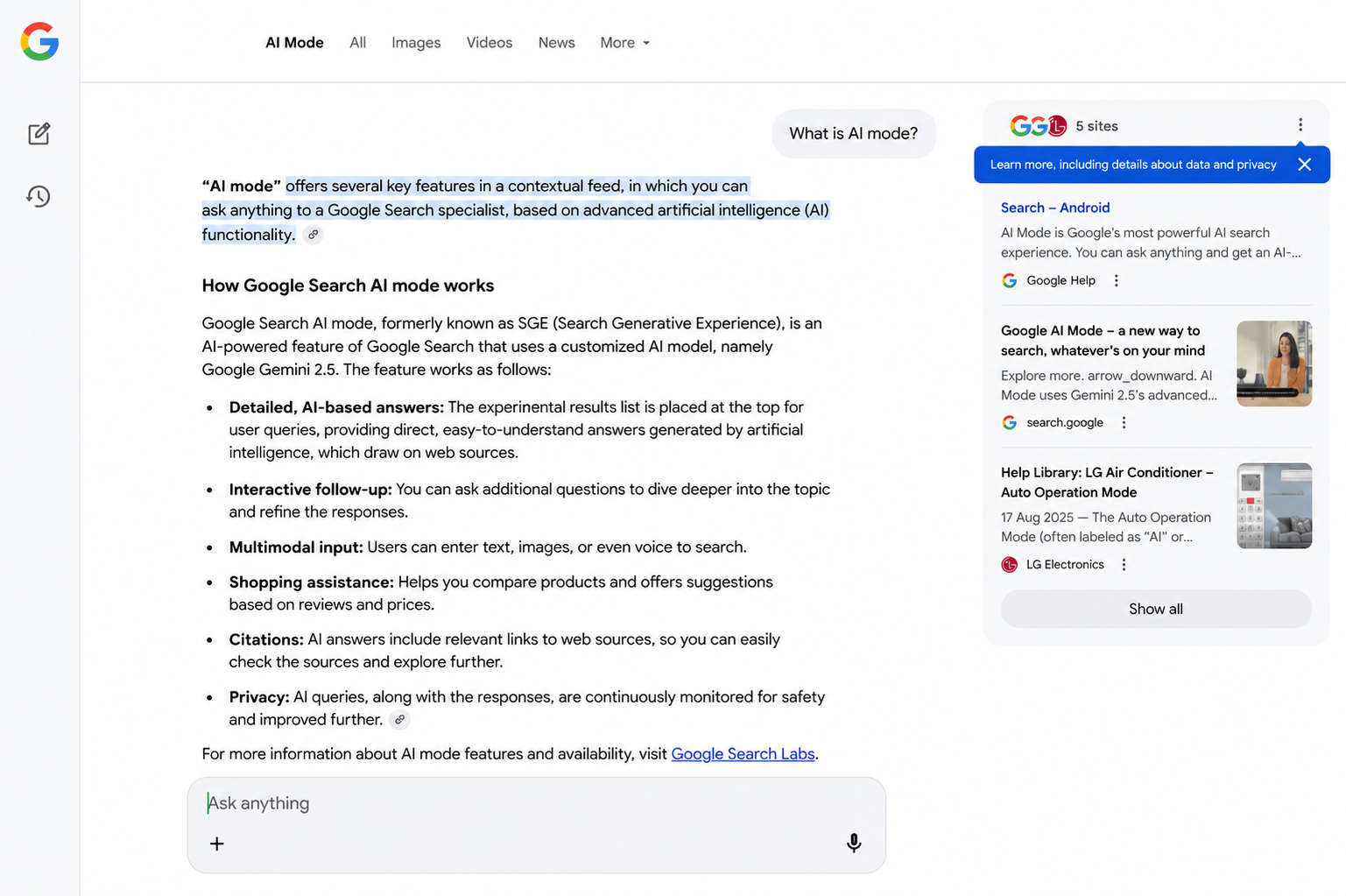
While the classic search engine receives keywordsand in return provides links and snippets, and the user clicks, reads, and decides based on these, whereas AI mode accepts natural language questions (even combined with voice or images), and attempts to understand the underlying intent.
After this, by analyzing and synthesizing content from multiple sources, it provides a well-structured, human-sounding answer at the top of the search results page. The source references, so valuable to us, only follow after this.
From a user's perspective, this sounds great. For a website owner, however, it means one thing: it's no longer just about search engine ranking, but also whether the AI chooses you as a source.
AI Mode vs. AI Overview
We're already getting used to the AI overview.
It appears as a short, automatic summary above or between the search results.
The main difference is that the AI overview appears on a classic search results page and fundamentally still relies on the link list.
#m1-y#The AI mode, in contrast, is a separate view where the search transforms into a conversation.##
It provides longer, more detailed answers, expands on sub-topics, suggests further questions, and acts like a built-in, private research assistant.
What changes in AI mode compared to classic search?
The not-at-all sympathetic zero-click phenomenon (when the user gets an answer without clicking on any result) has already been present in Google. We've seen it with knowledge panels, featured snippets, or local Maps blocks.
AI mode takes this a step further: it can provide complete, easily digestible answers to complex, longer questions. This way, the user remains entirely within the Google interface, and a significant portion of "quick info needed" type searches stays in-house.
#m1-p#Organic traffic to websites is clearly decreasing, but it is increasingly shifting towards deeper, more engaged searches.##
At first glance, this might seem quite frightening, but it also has an important positive aspect: those who do click through are likely much more valuable, as they are closer to making a decision, requesting a quote, or making a purchase.
In parallel, the nature of competition itself is transforming.
The classic SEO for decades was about "being in the top 3 so people click on us." The logic of AI mode, in contrast, can be summarized as "be such a reliable, easily understandable source that the AI builds its answer from our content and highlights our page as a reference."
So, we are no longer just fighting for position, but to become a quotable source in the generated answers.
How does AI mode "think"?
To know what to optimize for, it's worth roughly understanding what's happening behind the scenes. AI mode first tries to decipher the intent: it's not interested in keywords, but whether the user is looking for information, seeking a solution to a specific problem, or preparing for some action (e.g., looking for a service provider).
#m1-y#Increasingly, all that matters is whether your content provides a clear answer to the question someone started typing.##
It doesn't view your page as one large block of text, but breaks it down into pieces: chapters, paragraphs, lists, highlighted blocks. It converts these into a mathematical form and examines how well each part fits the asked question.
If an article is disorganized, illogical, and lacks proper headings, definitions, or FAQ sections, both readers and AI will struggle to find meaningful information within it.
Finally, the system compiles an answer from relevant details across various pages, writes its own summary, and appends a few highlighted sources. From an SEO perspective, the goal here is to get into this "source list." This "merely" requires high-quality, well-structured content, a visible and credible brand, authors, a strong link profile, and a technically stable, fast, mobile-friendly site is needed.
#promobox-szolg-ai-seo-en#It is time to stop missing out on AI-driven searches and answers!##
Searching in AI Mode: A Few Examples
1. Let's search for a local service:
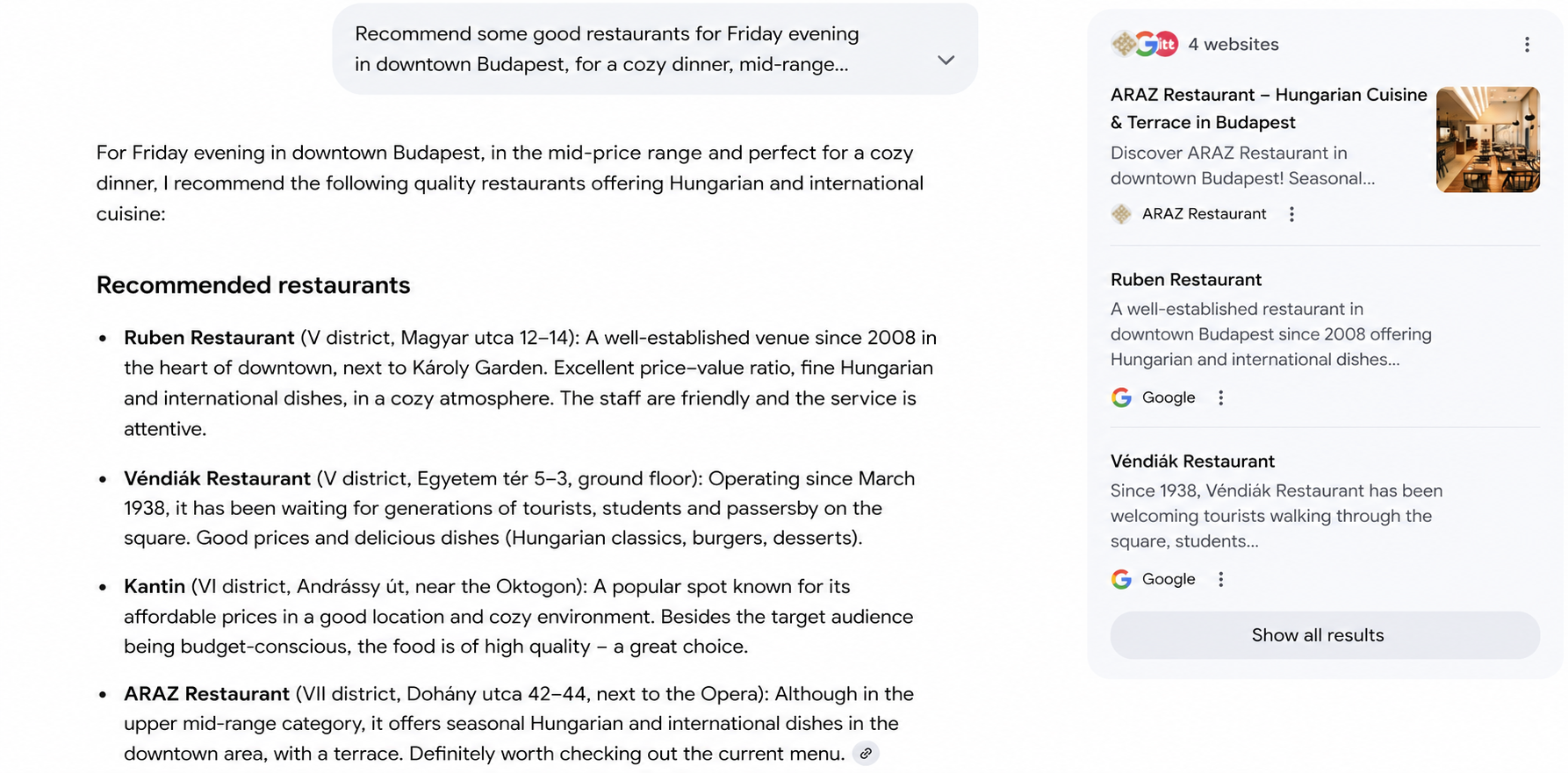
"Recommend good restaurants for a friendly dinner on Friday evening in downtown Budapest, in a medium price range."
What does the user see?
On the left, a complete, coherent text answer greets them, with an opening similar to this:
"For a friendly dinner on Friday evening in downtown Budapest, in a medium price range, I recommend the following cozy restaurants offering good value, where you'll find both Hungarian and international dishes." Below this, an "Recommended Restaurants" subtitle appears, followed by a list of places with brief descriptions.
Meanwhile, on the right side, separate cards appear for each restaurant in their own small box with a photo, brief description, rating, and a "Google" label, and at the bottom, a "Show all" button that leads to additional results.
#m1-y#As a user, you practically get everything in one place here: recommendations, specific names, and detailed profiles accessible with a single click.##
How can you get into the recommendations?
As a local service provider – whether a restaurant, hairdresser, dentist, or gym – in AI mode, it's primarily not your website's design, but the "data world around you," local SEO that matters.
#m1-p#The system relies very heavily on your Google Business Profile:##
how complete it is, what opening hours, price range, and photos it displays, and how you've categorized yourself. Equally important are the reviews, beyond just the average star rating, specifically what guests write about in the text of their reviews.
2. Let's look at an e-commerce search:
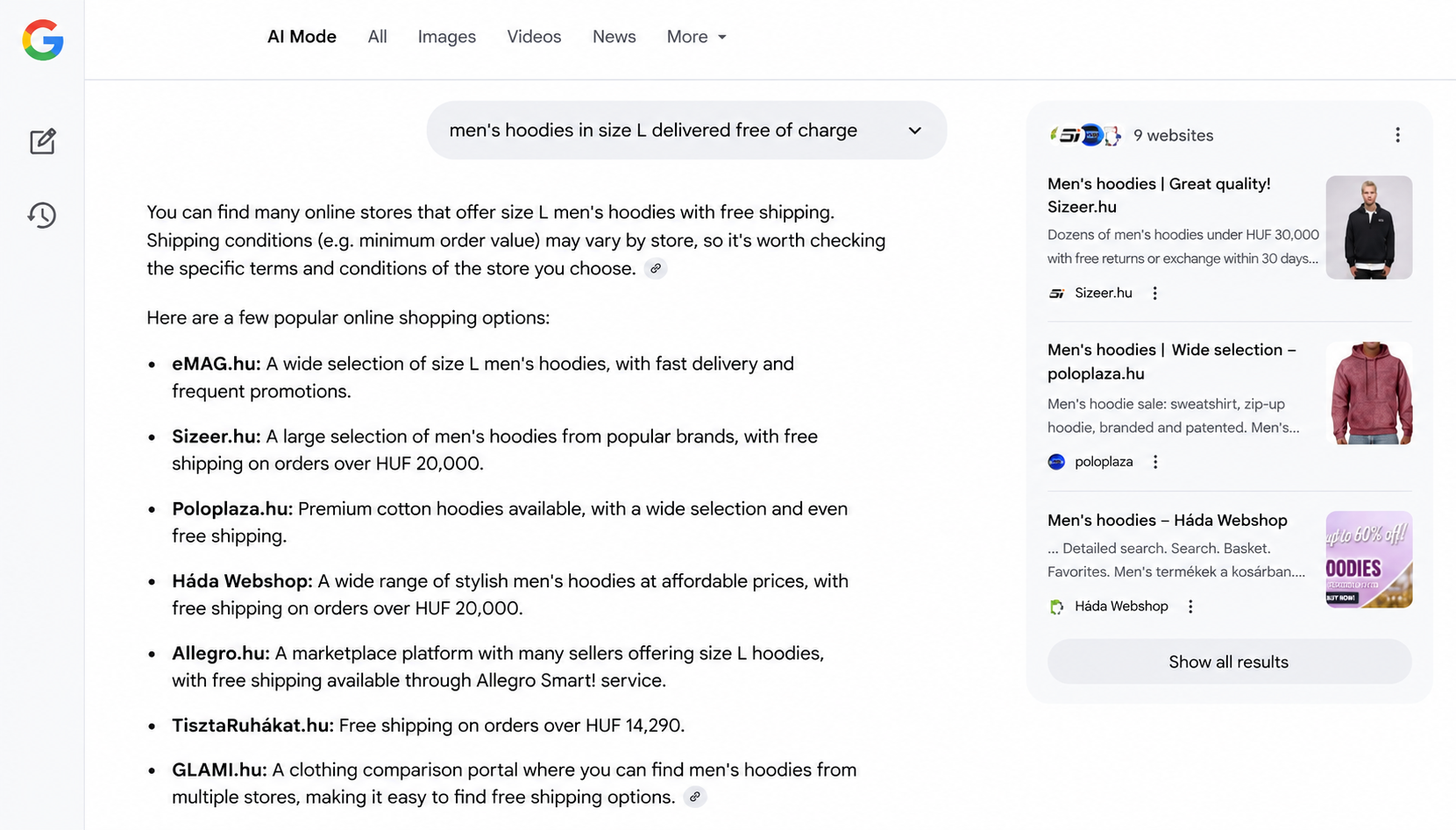
"Grey men's hoodie size L with free shipping"
What does the user see?
Here too, a coherent, ready-made answer greets them.
On the left, it starts with a brief explanation:
"You can find a grey men's hoodie in size L with free shipping at numerous online stores. Free shipping conditions, such as minimum order value, may vary by website, so it's worth checking the policy of your chosen store."
After this, a subtitle appears: "Some possible online shopping locations," and the AI systematically goes through the typical players.
Meanwhile, the featured webshops are displayed as separate cards in the right-hand panel.
With this, the user essentially receives a curated selection: they know where to look, what shipping conditions might apply to each, and with one click, they are already on the specific webshop.
How can you get your offers included?
It's no longer about what SEO text runs at the bottom of the category page – it's much more about how organized and rich your product data is.
#m1-y#AI relies on product feeds, structured data, and shipping information.##
It also matters how present you are on larger aggregator sites or marketplaces, and whether there are reviews for your store that lead the system to view you as a reliable player.
3. Now, let's consider an informational search:
“What to ask a marketing agency on the first ‘date’?”
What does the user see?
The AI mode starts on the left with a brief introduction: why the first meeting is crucial, and how to determine if the two parties are a good professional and personal fit. It then organizes the advice into thematic blocks.
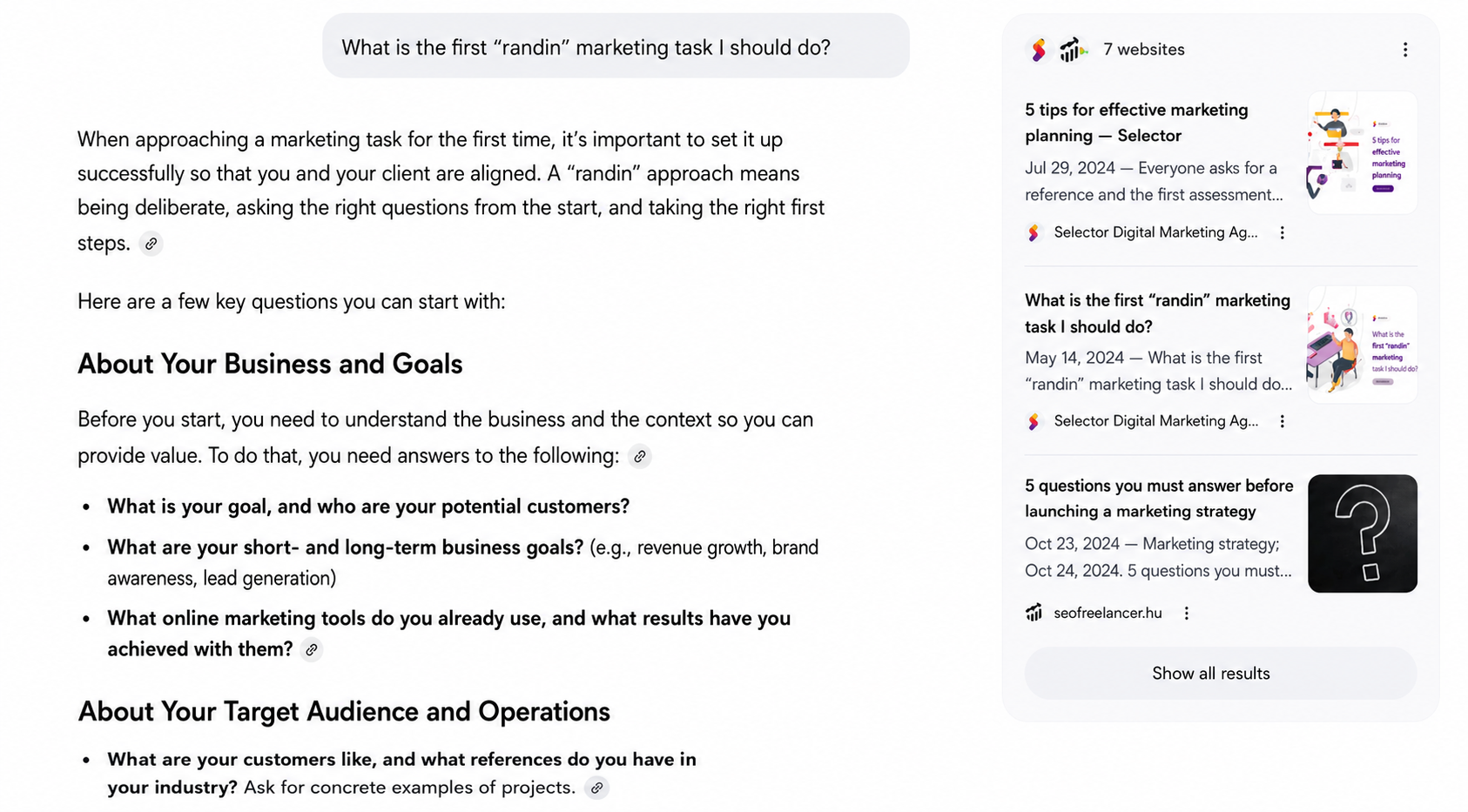
Meanwhile, specific article cards appear on the right-hand panel: for example, the Selector marketing agency two related posts and a guide from another professional site, complete with title, a short excerpt, and a “Show all” button for more results.
This way, the user gets a well-thought-out list of questions and immediately accessible, more extensive resources on one screen.
#m1-y#But how can your article be included among the sources?##
This query specifically expects a practical checklist, so the AI highlights Hungarian materials that guide users through the decision points in a topic-centric, well-structured, and understandable language.
If you have a structured guide broken down into subheadings, a visible author bio and references, and the site is technically sound, then you have a good chance of appearing as a source in this view.
#promobox-newsletter###
How to optimize your content for AI mode?
Think in questions instead of keywords
First, we need to shift from keywords to questions.
It's not about how many times a specific keyword appears on the page, but whether your content clearly answers the question the user is asking the AI mode.
The more specific the questions you organize your content around, the easier it is for the system to find quotable answers.
You need explanatory content written in human language.
AI learns from clearly explanatory texts written in a human voice. The article that will perform well is one that calmly explains the situation, provides examples, and then asks a follow-up questionabout what this means for you if you run a restaurant or a webshop, or perhaps you're a B2B service provider.
Build authority in topic clusters.
Appear knowledgeable in your field; don't just shine in individual articles.
As a local service provider, don't stop at an introduction: have separate, well-thought-out content on how to choose a restaurant for specific occasions, what value for money means to you, and how booking and cancellation work.
For a webshop, a knowledge base should be built alongside the mere product pages: sizing guides, clearly explained shipping and return policies, material and care information, and shopping advice.
In B2B/marketing topics, you should also elaborate on the basic concepts, practical steps, and provide useful lists.
If this content links to each other and forms a coherent whole, the system won't see scattered posts, but rather a credible thematic source, increasing the likelihood of it being included in AI responses.
Mark up your content: structured data and technical foundations
With the right technical setup, you help not only humans but also machines "read."
Structured data tells it this is an article, this is an FAQ, this is a guide, that's a service page, and over there is a product with prices, stock, and reviews. This way, the AI doesn't guess but gets clear signals when looking for relevant details for a given question.
Then come the technical fundamentals: if your site is slow, isn't responsive on mobile, or is full of intrusive pop-ups, that's not only bad for the user but also a weak signal in the AI's eyes that you would be a good source.
It's equally true for restaurants, online stores, and professional blogs that content can only perform well if the site behind it is also technically sound.
Be a recognizable, trustworthy brand
Trust is important: the AI doesn't read homogeneous, faceless websites, but specific brands and authors.
If it's clear that a real, professional background supports the content, that there's an author, references, if others also cite you, if you have a presence on professional platforms, in media, at conferences, then it will be logical for the AI too to use you as a reference point. Here, we're essentially talking about the mutually reinforcing effect of PR and SEO .
#m1-y#The goal is not just to be one of many, but a player who is "worth quoting".##
Pay special attention to AI-driven traffic
In analytics, you can specifically look at where the traffic comes from, which page users land on, how much time they spend there, how many subpages they view, and what percentage request a quote, book a table, or order a product. You can monitor how traffic coming from AI starts to behave differently compared to previous organic traffic.
The AI era actually steers SEO back to where it should have always been strongest: well-written answers to meaningful questions. The era of clickbait articles, keyword stuffing, and low-quality content made for robots is over. In the future, the winner will be the one who invests time and energy to explain their topic clearly, in a human voice.
#promobox-en#Don't wait until your competitor appears in AI answers. Request an AI-driven SEO quick audit, and you'll get a concrete plan on how to get among the recommendations.##
-min.png)




.jpg)
.png)