Google's new AI Max feature allows you to fine-tune your ads using artificial intelligence. But is it really that smart? We tested it on our own campaigns to find out how it performs in reality and what impact it has on costs, conversions, and campaign management.
.png)
What do we know about AI Max so far?
Google announced the AI Max feature in May 2025, developed specifically for search campaigns. The official blog post states that AI Max is a "comprehensive targeting and creative toolkit" that uses artificial intelligence to help improve campaign performance.
According to the Google Ads team advertisers who enabled this feature achieved 14% more conversions/conversion value with a similar target CPA/ROAS.
Where can you set it up?
The shortest path is this:
Campaign Settings → AI Max for Search Campaigns → Optimize campaign with AI Max
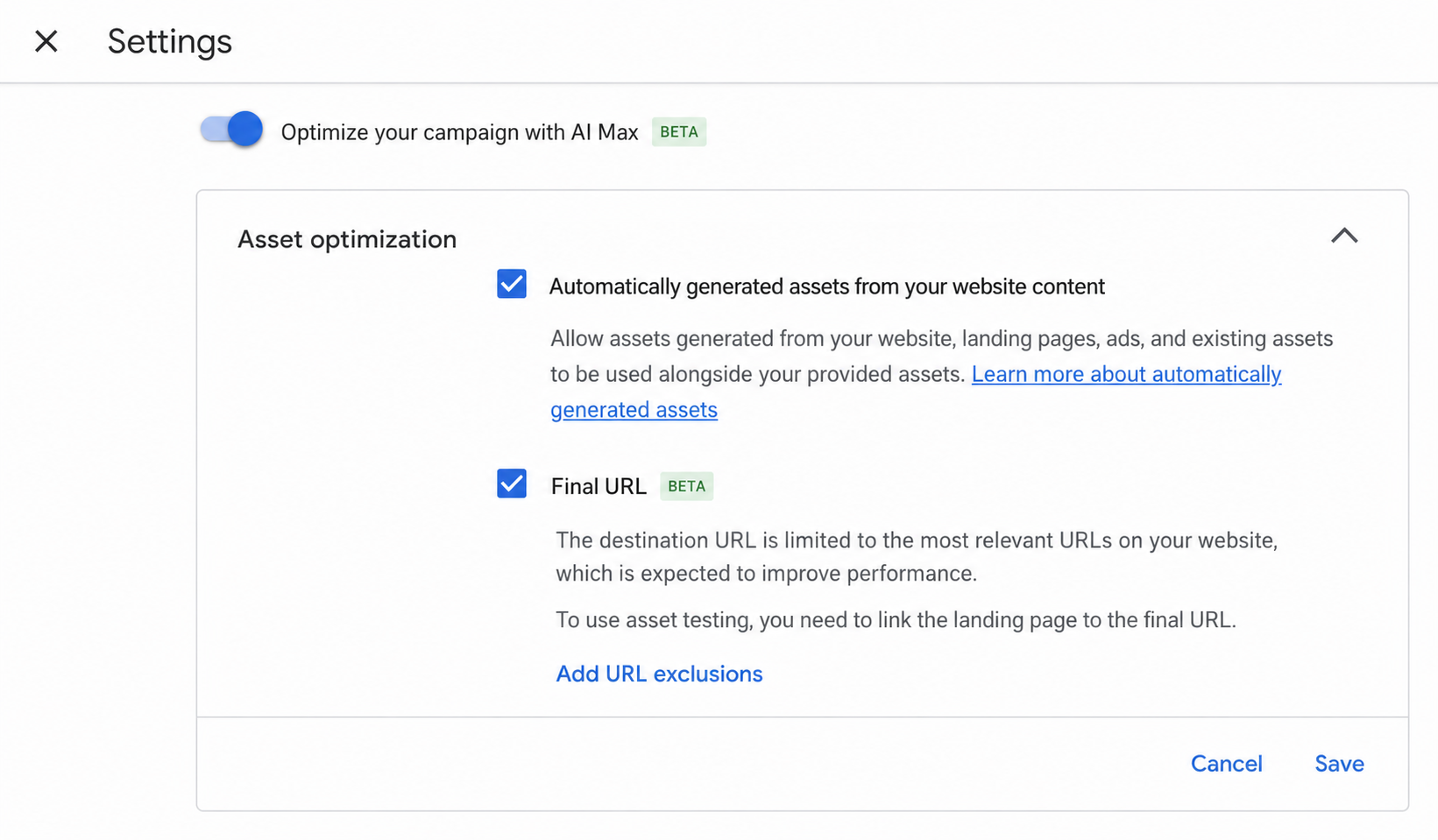
#m1-y#IMPORTANT: The AI Max feature is only available for search campaigns##
In this menu, you can also enable the asset optimization feature if you want more customized text or want to specify the target URL .
Let's see what it's good for:
- Text customization: With the help of AI, Google builds the best ad copy from your website text and your ads.
#m1-p#Important! You can only select this option if the “Text customization” option is enabled.##
- Final URL expansion: Automatically directs the visitor to the most relevant subpage if it is likely that this will result in better ad performance.
#m1-y#Tip: Only use these features if you want Google to create the texts and automatically direct to the page it deems relevant – not the one you set.##

How and when can it be used?
AI Max is currently available exclusively in Google Ads search campaigns, and although it is appearing in more and more accounts, it is still in beta .
The feature works best when the campaign goal is to maximize conversions or to maximize conversion valuewe set it. While it can technically be enabled for other objectives, it won't yield significant results because AI Max is tuned for conversion goals. If the bidding strategy isn't set for this purpose, the system won't receive the appropriate signals and thus won't be able to optimize effectively.
#m1-y#Tip: If you're trying the AI Max feature for the first time, always set a precise conversion goal (maximize conversions or maximize conversion value).##
It's also an interesting question exactly which search terms activate AI Max. This can be tracked in the Search Terms report, where a dedicated filter is available: “Search terms and landing pages from AI maximization”. This clearly shows what additional matches and landing pages AI brings in.
What can we expect from AI Max?
Here's the hypothesis
I was curious if enabling the AI Max feature in search campaigns would improve campaign performance metrics compared to manually set keyword ads. My assumption was that AI Max, using artificial intelligence, would "smartly" select who sees the ads and for what search intent, all while keeping costs lower.
#m1-y#At the beginning of the research, I asked the following questions:##
- Will the number of conversions and the conversion rate increase?
- What impact will it have on costs? Will the average CPC or cost per conversion decrease?
- Will the new search terms brought in by AI be more relevant and better match the landing pages?
I was also curious how the feature performs in Hungarian, whether it can bring in relevant searches and improve campaign effectiveness, or if it only works well for English-language ads.
This question interested me because Google's artificial intelligence primarily learned in English, meaning the algorithm can recognize patterns most quickly and accurately in this language.
#m1-p#So, can it perform effectively in Hungarian?##

What results did AI Max deliver?
AI Max results: at the keyword and target URL level
I want to clarify from the outset that the campaigns did not achieve their results under identical budgets during the test, the budget for the respective campaigns was continuously optimized, which may influence the results.
In my experience, the keywords used in campaigns are crucial in determining how AI Max expands search terms.
If we select the base keywords accurately and relevantly, the AI typically generates related, relevant searches. However, this doesn't mean supervision isn't necessary, as the system might still appear for competitor brands or less relevant terms.
Fortunately, these can be excluded just as with traditional keyword settings.
We also tested the function across various industries, and overall we observed positive results. For properly configured campaigns, the AI generated search terms that aligned well with the ad headlines and the content of the associated landing pages.
Among other applications, we also tested AI Max in a campaign offering leisure services:
For instance, if someone searched for „adventures in stockholm,” the system automatically displayed the most relevant headline for the search: “Escape Room in Stockholm | Open Daily for Adventure.” Similarly, for the search term “gruppaktiviteter stockholm,” it displayed the headline “1 Team. 1 Mission. 1 Hour.”
#m1-p#It was important that I introduced the feature gradually: we first tested it in just one campaign, and only after the encouraging initial results did I enable it in other campaigns.##
AI Max results: in terms of conversions and cost per conversion
During the period under review (June-August 2025), the number of conversions increased in most campaigns; where improvement was measurable, at least 20% more conversions were achieved than in the previous period. Additionally, the conversion rate also increased by at least +14%, and the cost per conversion decreased by at least 12%. This is already an encouraging result in itself, but it wasn't the only positive change.
#m1-y#For one of the campaigns that brought the biggest changes, the results of the first 30 days were truly convincing:##
- the number of conversions increased by 20%,
- and the cost per conversion decreased by 56%,
- the conversion rate improved by 39%,
- the click-through rate rose by 22%,
- while the CPC was 39% lower compared to the previous period.
#m1-y#After another 30 days (for a total of 60 days of observation), the improvement continued:##
- the cost per conversion further decreased by 12.5%,
- the total number of conversions increased by 65%,
- the conversion rate showed a further 14% increase ,
- however, the click-through rate at this time nearly decreased by 7%.
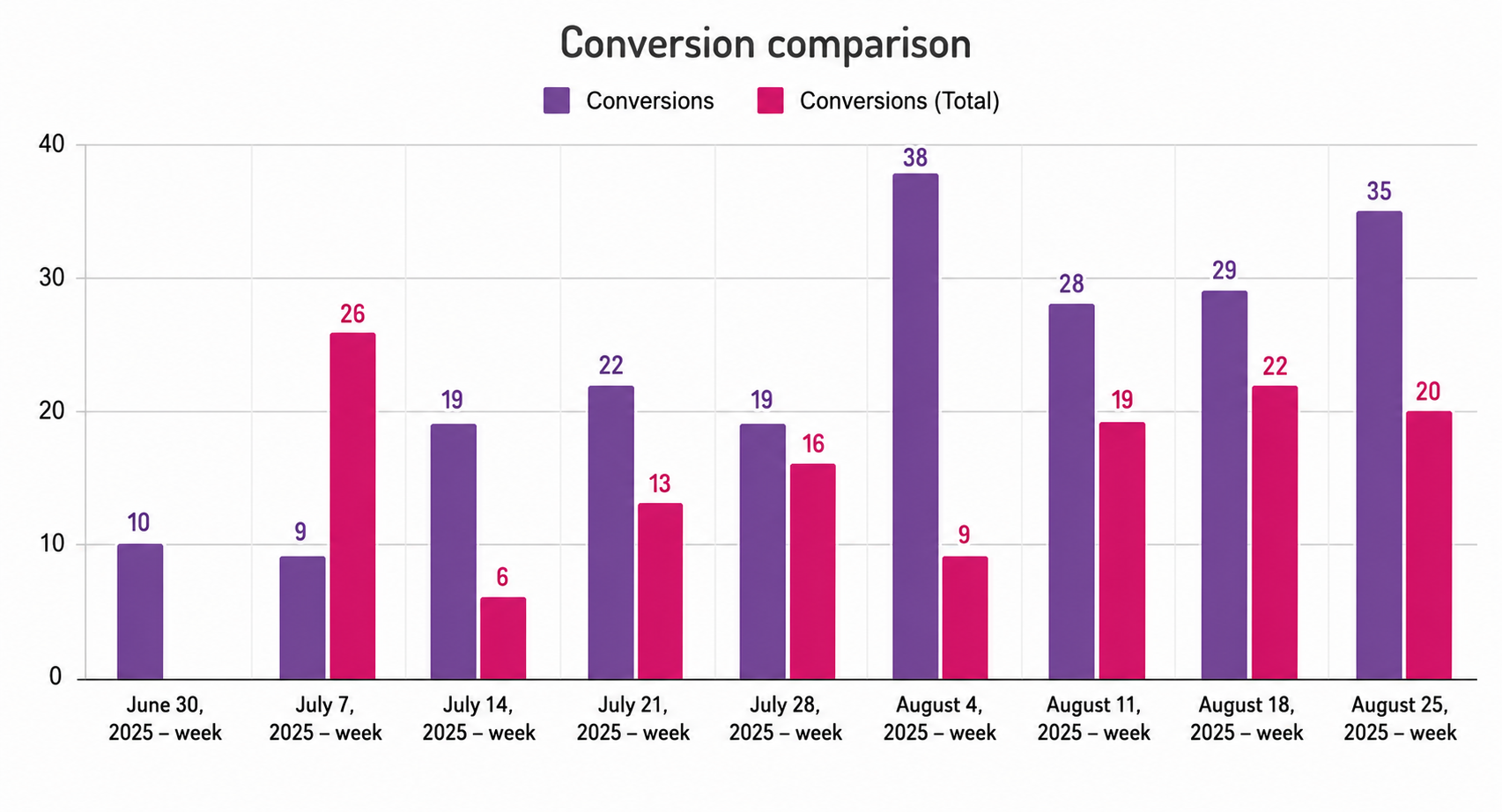
Following the activation of AI Max, the average CPC also decreased in most campaigns, as the cost per click was typically lower for search terms generated by AI, compared to manually set keywords. In addition, the click-through rate (CTR) also showed improvement, although the picture was more mixed here, increasing in about half of the campaigns examined, while stagnating or not improving at all in the other half.
#m1-y#Thus, in the case of CTR, we cannot speak of a clear and general performance improvement.##
In the campaign examined the cost per conversion decreased by 56% in the first month.
In practice, this means that with the same budget, nearly twice as many conversions could be achieved as before. This is particularly important for clients working with tight budgets, as it allows them to utilize their advertising spend more efficiently.
#m1-y#Tip: always examine how your cost/conversion metric is performing, as this is one of the best indicators of whether your advertising is truly paying off.##
Does it perform well in Hungarian too?
Many believe that Google's algorithms work most accurately in English and are less effective for smaller languages like Hungarian. However, our experience shows the opposite: in Hungarian campaigns, AI Max generated equally relevant terms as in English ones. This is particularly important because, due to the smaller size of the Hungarian market, every additional relevant search term can be invaluable for advertisers.
#m1-y#For the other top-performing campaign – where I only examined the August period – significant improvements were also observed:##
- the number of conversions increased by 71% compared to the previous period,
- the conversion rate rose by 51%,
- the click-through rate increased by 20.5%,
- while the cost per conversion decreased by nearly 41%, and the average CPC by more than 10%.
If you're using it in a Hungarian campaign, don't be afraid; AI Max doesn't just work well in English. In fact, it was able to bring in relevant searches in Hungarian too, which resulted in additional conversions.
#promobox-newsletter###
So, what are its advantages, and why is it worth using?
The numbers themselves are impressive, but perhaps even more important is how quickly these changes occurred. Normally, improving campaign performance to this extent often requires months of continuous testing and fine-tuning. However, after activating AI Max, tangible results appeared within a few weeks. This is one of its biggest advantages: it shortens the time it takes for a campaign to reach a stable and high-performing state.
One of the most important lessons for me was that AI Max doesn't replace the advertiser's work; it complements it.
The system can offer new insights, but the final decision and control remain with the advertiser. If someone thinks they can just turn it on and let the algorithm handle everything, they will be disappointed. However, if used consciously and with continuous monitoring, one can truly get the most out of it.
Conclusion
Based on the tests so far, the AI Max feature is clearly a useful feature and can be a suitable addition to Google Ads search campaigns. Although it is still in beta, and not without its flaws (for example, ads may occasionally appear for irrelevant searches), in most cases it brought measurable improvement in conversions, costs, and often in click costs as well.
My expectations were therefore partially confirmed: AI Max not only brought more conversions but did so at more favorable costs. Among the metrics mentioned, CTR was the only one where I didn't see a clear improvement, but overall, the picture is still positive.
Perhaps the biggest advantage is that AI Max can introduce new, relevant search terms that the advertiser might not have considered manually. In the long run, this can greatly help advertising strategies by ensuring that campaigns include search terms that truly deliver results.
Search terms generated by AI Max are clearly visible in the Search Terms Report as well, where they appear with a special label, making it easy to track which results came from the AI Max expansion. They are not automatically added to the keyword list, but can be manually added just like traditional search terms. This allows you to incorporate the best-performing AI Max searches into your campaign and optimize your ads even more precisely.
Overall, I believe AI Max is a feature worth trying in every search campaign, but only with supervision. While one might think that artificial intelligence "knows" everything nowadays, it yields the best results when the advertiser actively monitors, filters, and optimizes the terms suggested by the system.
#promobox-en#If you'd like a professional team to help optimize your campaigns, get in touch with us!##






.jpg)
.png)