The increasing adoption of AI is fundamentally changing user habits. In our last article, we wrote about the AI Max feature for you, and now we're delving into AI traffic measurement. Did you know that visitors using artificial intelligence exhibit completely different behavioral patterns than those coming from traditional search engines? What can you do to prevent your SEO results and campaign decisions from being skewed? Read our article to find out how you can achieve more accurate data analysis in the age of AI for better decision-making.
.png)
The Rise of AI Traffic: How and Why It's Transforming Analytics and Marketing
Introduction
As a marketing agency, we've had a front-row seat to how AI has revolutionized both the world of marketing and web analytics in recent years. While traffic channels could previously be categorized quite clearly, today a new factor has emerged: AI traffic.
Tools like ChatGPT, Google Gemini, Bing Copilot, or Perplexity not only provide information to users but often direct them to other sources, thereby generating measurable visits to websites. However, this traffic behaves differently from visitors arriving from traditional channels, and if not separated, it can easily distort the overall picture.
#m1-p#Clear data is the foundation of good decisions. ##
The question, therefore, is not "whether" it's worth treating AI as a separate source, but "how" we can do so before bad data leads to bad decisions.
Statistical Overview
The explosive growth in the popularity of AI-powered search tools became truly noticeable from the end of 2023. After its launch in November 2022, ChatGPT reached 100 million users in just two months, an unprecedented growth rate.
In response, Google launched its own AI assistant, Gemini (formerly Bard), while Microsoft integrated ChatGPT into its Bing search engine. Perplexity AI, on the other hand, opened up an entirely new category in AI-based answer searching by combining AI-powered text responses with real-time web search based on sources, so users receive not just simple results, but summarized, source-backed answers.
#m-y#This change is not merely a technological innovation – it represents a paradigm shift in user behavior. ##
People are increasingly turning to AI assistants with complex questions, and these tools often respond with links pointing to specific websites.
However, this new type of traffic has entirely different characteristics: it is highly targeted, high-intent, but often characterized by shorter sessions.
The strategic importance of AI traffic can be attributed to several factors:
- Firstly, it shows exponential growth – according to numerous analyses, the use of AI tools doubled in 2024, and this trend is expected to continue.
- Secondly, these visitors often arrive with higher purchase intent, as AI assistants have already pre-filtered and contextualized the information for them. And the future impacts could be even more significant.
Industry forecasts suggest that by 2026, the proportion of AI-based searches could increase to as much as 20-30% in certain sectors. This means that those who do not prepare for this change today may find themselves at a competitive disadvantage tomorrow.
Correctly measuring and interpreting AI traffic is therefore not optional – it's a crucial competitive factor.
Why is correct data management critical?
If we don't separate AI traffic from other channels, our analytics data will be skewed.
Imagine this: the average bounce rate for search engine traffic is 45%, while for AI-sourced traffic it can be as high as 70% – but in the latter case, this is not a negative indicator, but a natural consequence of targeted information seeking. If we mix these, neither our SEO nor our AI strategy will be effective.
Poorly segmented data leads to bad decisions. We undervalue channels that are truly working, overvalue underperforming ones, and ultimately allocate our budget suboptimally. Without separating AI traffic, we navigate blindly in the increasingly complex world of digital marketing.
What exactly is an AI traffic channel? What sources does it include?
When we talk about an AI traffic channel, we mean visitor sources that through some kind of artificial intelligence-based system direct users to our website. These sources fundamentally differ from traditional direct, organic, paid, or social media traffic.
What sources do we include under the AI traffic channel?
Let's look at some specific examples of where/how visitors might arrive through such channels:
- Generative AI-based search interfaces: Google SGE (Search Generative Experience), Bing Copilot, or other AI-based search assistants that don't just show links but generate summaries and answers, and within these, links pointing to our website may appear. (We wrote more about this in our blog post: Generative Search Engines, GEO: How AI is transforming search traffic and online revenue models?)
- Chatbots and virtual assistants: Users interact with a chatbot (e.g., ChatGPT) that gathers information from various websites and then includes a source link with its answer.
- Content summarization and generation platforms: AI tools that collect information from websites, summarize it, and potentially display source links there as well.
- AI-powered recommendations from news feeds and aggregators: Some news or content aggregator platforms use AI-based algorithms to select and recommend content to users.
#m1-p#IMPORTANT TO NOTE:##
Not all AI traffic is without value. Sometimes it's particularly useful – for example, if an AI assistant recommends our webshop for a specific query. But other times it's completely irrelevant, and if we don't filter it out, it gives a misleading picture of our analytics.
How do visitors arrive from an AI source?
The mechanism of traffic coming from an AI source fundamentally differs from that of traditional channels. When a user asks a question to an AI assistant, the tool processes the question, builds context, then searches for and recommends relevant sources. The user therefore does not choose from a search results list, but receives a curated, contextualized recommendation.
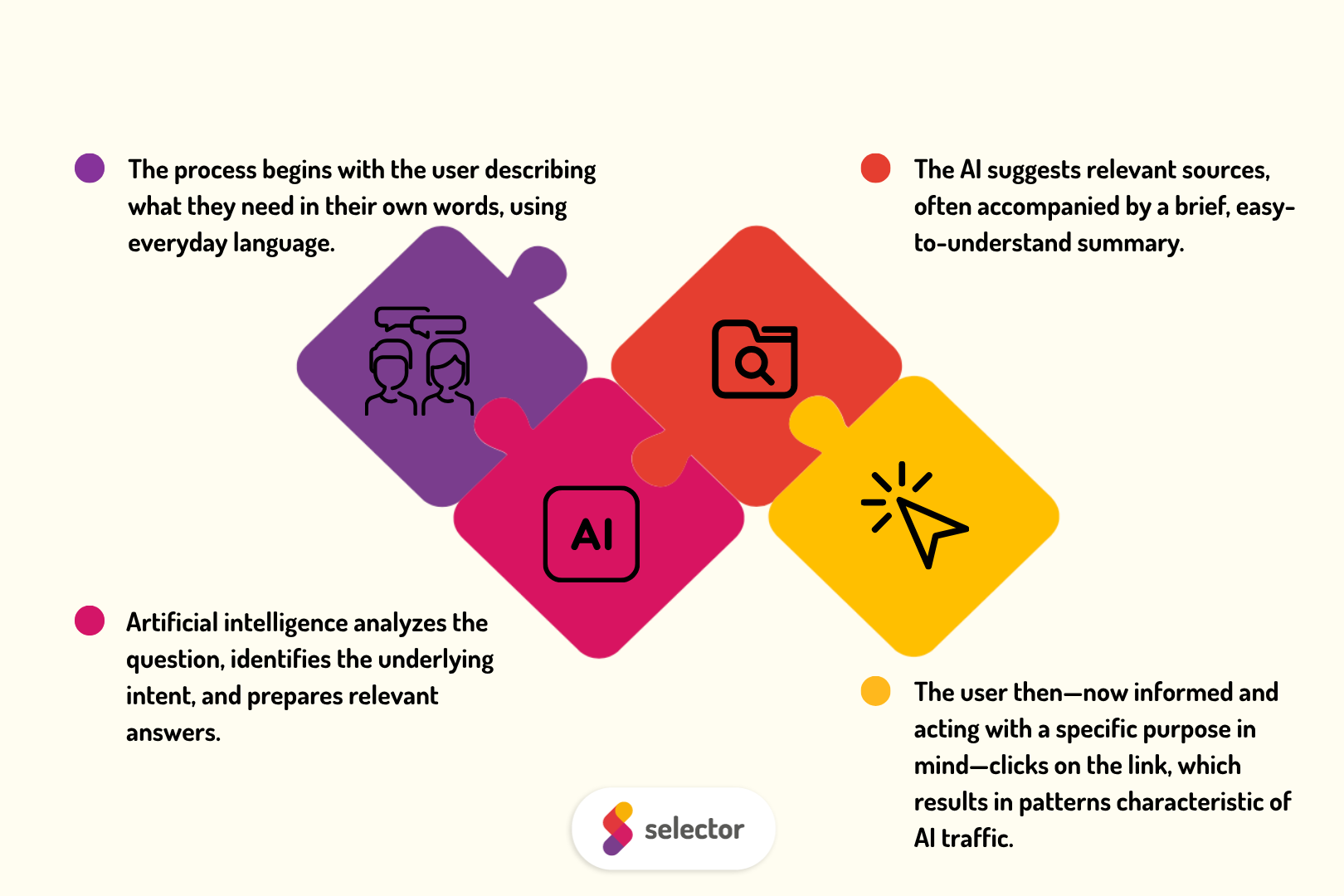
This is a multi-step process: first, the user articulates their need in natural language, then the AI interprets and processes it, and third, the AI recommends sources – often along with a brief summary. Finally, the user, already prepared for what they will find, clicks on the link. This mechanism explains the unique behavioral patterns of AI traffic.
How to filter out AI traffic in Google Analytics - methods and tools
Benefits and risks: why is separate handling critical?
And here are the specific benefits of separating AI traffic:
- More accurate campaign evaluation: If we handle AI traffic separately, we see how the true performance of our organic search campaigns unfolds, without a segment with completely different behavior getting mixed in.
- More realistic conversion data: Those coming from AI sources often follow a different conversion path. If we separate these, we get a more accurate picture of the true ROI of each channel (return on investment, ROI = ((Revenue - Cost) / Cost) * 100%).
- More targeted optimization: By understanding the unique needs of AI visitors, we can develop separate landing pages and content strategies for them.
- Future-oriented strategy: By following the growth trend of AI traffic, we can prepare for market changes in time.
- Competitive Advantage: Businesses that are already separately monitoring and optimizing their AI traffic can gain a significant advantage over their competitors.
Risks of NOT separating it:
- Distorted Metrics: Bounce rate, session duration, and pages/session metrics can all be distorted, leading to misleading evaluations.
- Poor Budget Allocation: If we don't understand which channel truly brings in what, we can't effectively allocate our marketing budget.
- Missed Opportunities: AI traffic often brings higher-value leads – if we don't recognize this, the potential remains untapped.
- Incorrect Conclusions: We might believe a campaign is performing poorly, when in fact, it's just the behavior of AI traffic dragging down the averages.
Methods and Tools for Separation
Separating AI traffic in Google Analytics is essential for accurate data analysis. Fortunately, there are several methods for this, from the simplest settings to more complex segmentations.
If you'd like, with our web analytics service, we can help with the setup and creating the right filters – we'll show you in detail how this works in practice.
Now, here are some best practices for separating AI traffic:
1. Creating a custom channel group in GA4:
Google Analytics 4 allows for the definition of custom channels. We need to create a new channel named "AI Traffic" and define its classification rules. This method is flexible but requires regular maintenance as new AI platforms emerge.
2. Using UTM parameters:
If we have the ability to influence how our content is linked (e.g., in our own AI tools, API integrations), we should use dedicated UTM parameters. This is the cleanest and most reliable method, but it only works in cases where we control the link.
3. Filtering based on referral source:
Google Analytics automatically records the referral source. Create segments or filters based on known AI platform domains.
4. Custom event tracking:
On our site, we can use JavaScript to detect the referrer and send a custom event to GA4 for AI traffic. This also allows for the collection of additional data, such as precisely which AI tool the visitor came from.
5. Using Google Tag Manager:
In GTM, create a trigger that activates when the referrer indicates an AI source, and send a custom event or modify the session source/medium values.
6. Looker Studio custom reports:
In Looker Studio (formerly Data Studio), we can create calculated fields that automatically categorize traffic as AI or non-AI sources, and then generate separate data visualizations based on this.
#promobox-newsletter###
How do visitors from AI sources differ?
The behavior of visitors from AI sources can differ significantly from those coming from "traditional" sources. This difference arises because AI-based systems often perform preliminary filtering and processing before directing the user to the page. During our analysis of client data, we observed the following key behavioral differences:
Shorter session duration and higher bounce rate:
Why? AI tools often specifically seek answers to a single question or problem. If the user directly finds the content they were looking for and quickly gets the information, they may not necessarily continue browsing the site. Additionally, the AI might only extract a short snippet from the page, and the user might click through merely "to verify," then immediately leave after confirming the information's relevance. Impact: This lower session duration and higher bounce rate negatively affect overall averages and can falsely suggest that our site is less relevant than it actually is.
Lower pages per session:
Why? Similar to the previous point, if a user arrives with a specific goal, they are less likely to view multiple subpages. The AI has already narrowed down the search, so the user is looking for a "quick solution" rather than in-depth browsing. Impact: In aggregated data, this also reduces the average number of page views.
Variable conversion rate (and potentially different conversion types):
Why? The conversion rate of AI traffic can differ in both directions from traditional traffic, depending on user intent and the AI tool's operation:
- Higher conversion rate: If the AI acts as a "qualifying filter" and directs the user to the page with a specific, well-defined intent (e.g., searching for a particular product, and the AI leads them to the most relevant product page), then the conversion rate can be exceptionally high. In such cases, the AI has already pre-filtered less relevant prospects.
- Lower conversion rate: In other cases, especially if the AI directs a user who is in a general information-gathering phase, or if the user has already received the answer from the AI and is only clicking to verify the source, then the conversion rate might be lower. It can also happen that users referred by the AI tool are less committed to our brand than those who search for us directly.
Impact: If the conversion rate of AI traffic differs (whether higher or lower) and we don't filter it out, it distorts our aggregated conversion rate and can lead to incorrect conclusions about the online marketing campaigns effectiveness. At the same time, it's worth observing if there are other types of micro-conversions (e.g., downloads, video views, newsletter subscriptions) that AI traffic performs better on.
What impact do these differences have on aggregated results?
If we don't treat AI traffic separately, our aggregated results become blurred, and we may experience various distortions.
Shorter sessions and higher bounce rates negatively affect aggregated averages, which can falsely suggest that our website provides a poor user experience or is less relevant than it actually is. Regardless of whether the AI traffic's conversion rate is lower or exceptionally higher, the difference can obscure the true performance of other sources.
But what does this mean in practice?
If AI traffic has a low conversion rate, it "drags down" the aggregated conversion rate, obscuring the success of other well-performing sources. Conversely, if AI traffic has a high conversion rate, it can "inflate" the aggregated conversion rate, painting a false picture of the website's overall effectiveness and suggesting that all sources are performing exceptionally, while traditional channels might actually be underperforming.
The problem is, we don't know what's really happening, and this is misleading.
Content preferred by AI traffic may be overrepresented among "best-performing" content, but this doesn't necessarily mean that this content leads to the most real business-goal conversions among human users.
If we run paid ads and don't understand (whether it's low or high) or isolate the conversion behavior of AI traffic, then we might make poor decisions regarding ad spend allocation. For example, we might unnecessarily spend on campaigns that perform well with AI traffic but poorly with the real customer segment, or vice versa.
Key Insights
Failure to separate AI traffic leads to multifaceted problems. On the one hand, it skews the assessment of existing channel performance: we cannot accurately measure the true effectiveness of organic search, referral traffic, and other sources if a segment with fundamentally different behavior is mixed in. On the other hand, we miss the opportunity to recognize and leverage the unique strengths of AI traffic - higher conversion rates, more targeted interest, and higher quality leads.
#m1-y#Traditional metrics - such as bounce rate or session duration - can be misleading for AI traffic.##
What would indicate poor performance for other channels might actually be a sign of efficiency and targeting for AI traffic. Those who don't understand these differences will draw incorrect conclusions and make poor optimization decisions.
Summary
The emergence of AI-based traffic is not a temporary trend, but a paradigm shift in digital marketing and web analytics. The exponential growth of the user base for artificial intelligence tools has created an entirely new visitor segment which possesses unique behavioral patterns, distinct engagement characteristics, and often higher conversion potential.
The goal of analytics has always been to provide a reliable basis for our decisions. With the emergence of AI traffic, this task has become more complex, but the challenge is also an opportunity. Those who now take steps to clearly and separately measure AI traffic will not only gain more accurate data but also prepare for the future of digital marketing.
#m1-y#THE FUTURE WON'T WAIT - VISITORS FROM AI SOURCES ARE ALREADY ON YOUR PAGES. THE ONLY QUESTION IS: DO YOU SEE THEM?##
#promobox-en#Don't let AI traffic remain invisible in your analytics data.##






.jpg)
.png)