
An SEO agency primarily focuses on search engine optimization—the process of optimizing online content for search engines—to help websites, blogs, or online stores achieve better rankings in search results. In Hungary, this effectively means Google, which holds a 97% market share.
.png)
The goal of agencies specializing in search engine optimization is to provide comprehensive SEO services that help their clients' online platforms achieve higher search rankings for the most relevant and/or highly searched keywords, thereby increasing traffic from organic search and, ultimately, growing the number of leads or customers.
The most common tasks for an SEO agency include keyword research, technical (on-site) optimization, content strategy development, link building, local SEO, and analyzing data, as well as benchmarking these against competitors. Beyond this, they may also provide advice on improving a website's UX/UI design to not only attract visitors but also keep them engaged longer by providing an exceptional user experience. Their work may also include optimizing website speed and mobile-friendliness, which are also important ranking factors. SEO agencies often work closely with web developers, content creators, and other marketing professionals to provide integrated digital marketing services for their clients.
What can an SEO agency offer—or lack—compared to a general online marketing agency?
Understanding the differences between an SEO agency and an online marketing agency clarifies what the former can offer more or less of. An SEO agency is specifically specialized in search engine optimization, meaning their experts generally possess deeper knowledge of how search engines work, how algorithms change, and every minute detail involved. In the constantly evolving SEO industry, up-to-date knowledge and extensive expertise are essential. For example, when implementing a complex technical SEO audit or a specific link-building campaign, an SEO agency can often utilize resources more efficiently simply because that is their sole focus and specialization.
Since there are many specialized areas within search engine optimization, a dedicated SEO agency usually has experts who focus on these specific fields, whether it be local SEO, international SEO, technical SEO, or e-commerce SEO.
In contrast, a general online marketing agency often offers a wider range of services, which includes SEO but also encompasses other digital marketing activities such as PPC ad management, email marketing, or social media management. Because they provide a more comprehensive service, they can more easily assist in related areas—such as web design or web development—allowing them to better leverage synergies between these fields. Meanwhile, the client does not need to maintain contact with multiple specialists or smaller agencies, nor coordinate and align the collaboration and division of tasks between them.

We often hear that someone who focuses on a narrower segment understands that area better, which may be true. However, it is impossible to generalize completely, as a marketing agency can also create a larger division or team specifically dedicated to SEO, which may exceed the capacity or capabilities of a small SEO boutique in terms of both headcount and expertise.
There is no foolproof choice, so it is always worth consulting with the agencies' SEO experts in advance and weighing your decision based on your impressions to determine who to build a long-term partnership with. In the rest of our article, we provide some tips for this! ;)
When should you turn to an SEO agency?
We generally reach out to an SEO agency when we encounter a problem with our website's search engine optimization that requires specialized expertise. In our experience, the most common cases are as follows:
- Insufficient ranking: If you notice that your competitors are achieving better positions in Google search and you simply want to reduce your competitive disadvantage, it is worth seeking the advice of an SEO agency to develop an appropriate strategy to improve your rankings.
- Declining organic traffic: If you find that the number of visitors to your website is consistently decreasing or has suddenly dropped and you want to find an explanation. An SEO expert can help identify the causes and suggest a solution to stop or reverse the trend.
- Website creation / redesign: When building a brand-new website or redesigning an existing one, it is also important to consider SEO factors to ensure the site is structured correctly and that you do not lose the positions you have already earned in search engines during the transition.
- Technical issues: If your website has slow loading speeds, isn't mobile-friendly enough, or you're experiencing other technical issues, an SEO agency or web developer can help you fix them.
- Entering international or local markets: If a company is expanding into new regions or countries, SEO is essential, as it needs to be localized for the local audience or adapted to international search trends.
- Content development consulting: If you aren't seeing the desired results from your content marketing, it's worth turning to an SEO agency that can help with on-site optimization of existing content and fine-tuning your future content strategy.
- Recovery after a penalty: If your website has dropped in rankings following a Google algorithm update, an SEO agency can help identify the problem quickly and restore your search positions.
- Recovering a hacked website: If your site has been hacked and its content overwritten—for example, with unwanted adult content that Google has indexed—it is highly recommended to consult an expert who knows how to remove these from Google's index so that users searching for you don't encounter this inappropriate material.

In any situation where you feel you lack the knowledge or capacity to handle an SEO issue in-house, it is best to contact an SEO agency or expert as soon as possible to ensure effective help, as the potential loss in business can far exceed the SEO consulting cost.
Of course, you don't have to rely on SEO agencies only on an ad-hoc basis; if you want to keep this area in expert, safe hands, you can subscribe to a monthly package that includes SEO consulting or online consultations in addition to standard tasks like monitoring, content development, and link building.
Should you hire an SEO agency or a freelance SEO expert?
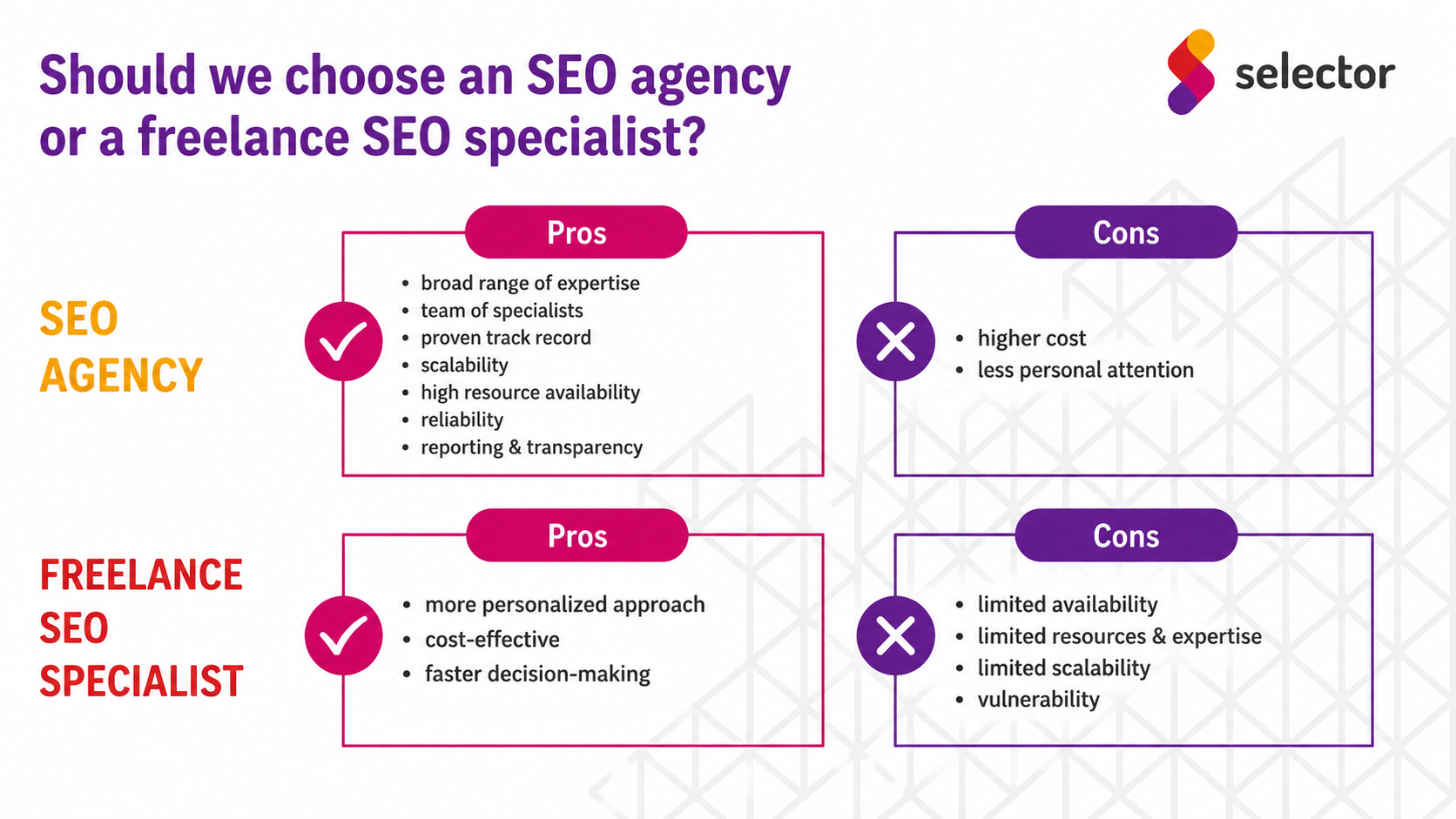
Choosing between an SEO agency and a freelance SEO expert depends on many factors, primarily your available budget, but the size and complexity of the project, as well as the expected level of service, are also important considerations. Let's take a closer look at when it makes sense to choose one over the other.
Working with an SEO agency
Advantages:
- Broad expertise: SEO agencies often have multiple experts specializing in different areas, allowing them to offer a more comprehensive approach and more complex methods, and they are also likely to place greater emphasis on staff training.
- Synergies: If you are looking for services beyond SEO (e.g., Google Ads management), they can better leverage and optimize the potential for increasing both organic and paid search traffic.
- Best practices: Thanks to a larger client base, they typically have more proven methods that have already been successfully applied to other clients. This is especially true for agencies with an international background.
- Resources: There is a greater chance that they possess the advanced tools (e.g., paid SEO software, applications) and partner networks (e.g., media partners) needed to achieve our search engine optimization goals.
- Continuity: Due to their corporate structure, their processes are better documented, making it easier to track completed tasks. Coverage is ensured if your contact person is on leave, and they will handle replacements if someone leaves the company.
- Measurability: Agencies often have more comprehensive reporting and analytical capabilities, which help in measuring performance and evaluating results.
- Accountability: Following from the previous point, their work is generally easier to monitor and hold them accountable for.
Disadvantages:
- Higher costs: SEO agencies typically charge higher fees for their services than freelancers, as they must also cover their own operational costs.
- Less attention: At large agencies, you may not receive the same level of individual attention that you would enjoy with a freelancer. However, an excellent account manager can bridge this gap.
Working with a freelance SEO expert
Advantages:
- Personal approach: Working with a freelancer often allows for a closer, more personalized collaboration, where they can better accommodate your unique needs and provide more tailored solutions.
- Cost-effectiveness: Freelancers often offer more competitive pricing due to their lower overhead costs.
- Fast decision-making: Communication and decision-making are often faster for projects handled by a single individual.
Disadvantages:
- Limited resources: A freelancer may not necessarily have access to the same paid SEO software subscriptions or the broad range of expertise that an agency provides.
- Limited capacity: For larger projects, a freelancer can easily become overwhelmed and may be unable to mobilize additional resources.
- Subjectivity: They make decisions or suggest solutions on their own, even for complex issues, whereas at an agency, these are based on team consensus.
Ultimately, the decision depends on the type of project, your budget, and the level of personal attention you require. For a small business or a simpler project, a freelancer can be a great choice, while for a larger company or a more complex project, an agency may offer a better and more reliable solution.
How to choose a competent SEO agency?
Selecting an SEO agency and assessing their expertise is a critical decision for your future success. Below, we have compiled some methods and tips based on our experience to help you evaluate the competencies of an SEO agency:
1. References and testimonials
Ask the agency for information about past or current clients so you can gauge how satisfied others are with their services. Reach out to these clients and ask them about the agency's performance, the results achieved, and their experience working together.
2. Presentation of past results
Ask the agency to present specific SEO projects they have worked on (e.g., case studies) and the associated results. This should include changes in search rankings, traffic growth, and conversions, as well as practical insights into the methods and SEO tools they utilized.
3. Personal or online consultation
Be sure to get to know the experts and get an impression of them during a 30- to 60-minute consultation, where you can ask about their SEO processes, proven methods, and the practical side of working together. Assess what kind of personalized ideas and advice they provide and how much attention they pay to you, as this can be of key importance during your future collaboration.
4. Test task
Give the agency a short test task. For example, ask them to perform a brief SEO audit of your website, or to put together a preliminary SEO strategy plan to solve a specific problem. At Selector, for instance, we offer a free SEO quick audit, the results of which we present to our clients during a personal consultation.
5. Professional expertise
Ask about the agency's methods and tools. If the agency only uses superficial methods that meet basic expectations and does not take into account deeper technical, content, and backlink elements, these are signs that they may not have sufficient expertise.
6. Continuous training and learning
SEO is a constantly changing field. It is worth asking the agency how they keep up to date with industry changes and search engine algorithm updates, or how they handle the challenges posed by artificial intelligence.
7. Ethical principles
Make sure the agency uses only white-hat SEO methods and techniques. Avoid agencies that promise quick and strikingly large positive changes, as they are likely using black-hat or dubious techniques.
Black-hat SEO includes search engine optimization techniques that violate the guidelines and rules of search engines like Google. Its goal is to manipulate search results to artificially improve a website's ranking, focusing on short-term results. These techniques are unethical and can have serious consequences, including a drop in site ranking or even complete exclusion from search engines. Google continuously updates its search algorithm and is becoming increasingly effective at identifying and penalizing black-hat SEO techniques.
With the help of the steps and advice above, you can better assess the expertise and reliability of an SEO agency. Always remember that it is important to thoroughly examine an agency's past results and attitude before committing to a long-term partnership.
#promobox-szolg-seo-en#Do you feel you would rather entrust the SEO of your website to experts?##
What is the ideal contract duration for an SEO agency?
How long does it take to see if it's worth working with an SEO agency? SEO, or search engine optimization, is considered a long-term investment. Many agencies recommend 6-12 month or longer contracts, as this period is usually necessary to demonstrate the positive results of SEO activities through metrics. In the first few months, the agency assesses the state of the site, optimizes content, and begins building a backlink profile. During this period, changes mostly happen in the background, and you may only experience minimal growth in traffic or rankings.
Real, measurable results often become clear starting from the 6th month, but this can naturally vary depending on regions, languages, and the topic of the website. Therefore, it is recommended to choose a collaboration period of at least six months to ensure there is enough time to objectively evaluate the results.

What results can be achieved with search engine optimization?
The results of search engine optimization depend heavily on the starting point, the intensity of the competition, the goals to be achieved, and the strategy applied. In most cases, however, there are general experiences that show what results can be expected over certain periods.
#m1-p#SEO results achievable in 6 months##
- Visibility: In the first few months, fixing technical issues and optimizing content can significantly improve a website's stability and visibility.
- Traffic growth: By optimizing for long-tail keywords and local searches, traffic can grow slowly but steadily.
- Improved conversion rate: Enhancing the user experience on the website keeps visitors on the page longer, which can lead to an increase in conversion rates.
#m1-p#SEO results achievable in 12 months##
- Competitiveness: By developing a backlink profile and implementing the right content strategy, the website can become more competitive and achieve better rankings in search results.
- Increased brand awareness: Through content marketing and strategically built SEO-optimized content, the number of impressions and brand awareness can also increase.
- Stable growth: Following the increase in impressions, a steady rise in clicks and conversions can also be expected if the strategy is working effectively.
#m1-p#SEO results achievable in 24 months##
- Market-leading position: If the SEO strategy has been applied consistently, the site can reach the first page for the most important keywords. For some keywords, this may happen sooner, or even the absolute top position can be achieved.
- Loyalty: A continuous presence (visibility) in search results can increase the number of returning visitors.
- Maximizing ROI (return on investment): After two years of investment and development, we can now enter the return phase as costs decrease and the website operates stably, effectively bringing in new clients or customers.
To achieve the results mentioned above, however, continuous monitoring, analysis, and strategy refinement are essential, including time-series comparisons and competitor tracking. Expected results and return on investment can vary significantly depending on the intensity of competition, market segments, topics, keywords, regions, and languages.
What KPIs should we define to measure SEO performance?
#m1-p#The primary purpose of Key Performance Indicators (KPIs) is to provide transparency regarding the effectiveness of search engine optimization and the factors that influence it.##
Tracking these can be done through a continuously updated online SEO dashboard or via classic monthly reports sent by an SEO agency. The following metrics should definitely be considered when evaluating the effectiveness of an SEO agency's work:
Number of impressions
The first positive sign can be an increase in the number of impressions in search engines, which shows that our website is appearing in search results more and more frequently. You can easily track this metric through your Google Search Console account.
Click-through rate (CTR)
The number of impressions and the click-through rate determine how many visitors will arrive at our website from search engines. If SEO tags are well-optimized, they can have a positive impact not only on search rankings but also on CTR: well-crafted page titles and concise, relevant descriptions can lead to a higher click-through rate.
Organic traffic
This shows how many visitors arrive at our website naturally from search engines. Increasing organic traffic can indicate that the site is becoming more recognized and relevant in the eyes of search engines and is being found by more potential leads. It is important to note that paid search or display campaigns can also influence how many people search for our company name, products, or services, so it is definitely worth separating branded and non-branded search categories during analysis.
Keyword rankings
Tracking the rankings of the most important keywords is essential. It is important that the selected keywords we monitor reflect our business goals and the topics in which we want to be strong. If the rankings for the selected keywords improve, it confirms that the SEO strategy is working. It is not worth tracking daily changes; instead, focus more on weekly or monthly changes and trends.
Visibility score
The combined, aggregated change in the positions of selected keywords is well represented by the so-called visibility score, which different SEO software tools calculate in various ways. Generally, the higher the percentage value between 0-100, the more favorable the search positions we have secured for the pre-defined and monitored keywords. Tracking these and comparing them with competitors also provides a good starting point for evaluating SEO activities.
Conversion rate
Conversions originating from organic traffic (e.g., contact form submissions, newsletter sign-ups, number of purchases, etc.) show how relevant visitors find our site. A high conversion rate suggests that the website's content and structure are properly optimized for the target audience.
Number and quality of external links (backlinks)
It is not just the number of links that matters, but also their quality. Links from high-quality, authoritative sites increase the website's authority and contribute to better rankings. Avoid offers that provide low-quality, bulk links.
Spam links, also known as low-quality links, are backlinks created for manipulative purposes to artificially improve a website's search engine ranking. These links provide no value to users and often violate search engine guidelines.
The listed KPIs provide an objective way to evaluate the performance of an SEO agency. However, it is important to note that SEO is a long-term process, and changes are not always immediately visible. For this reason, regular and long-term evaluation of results is recommended.
How can the results of SEO work be distinguished from the impact of other marketing activities?
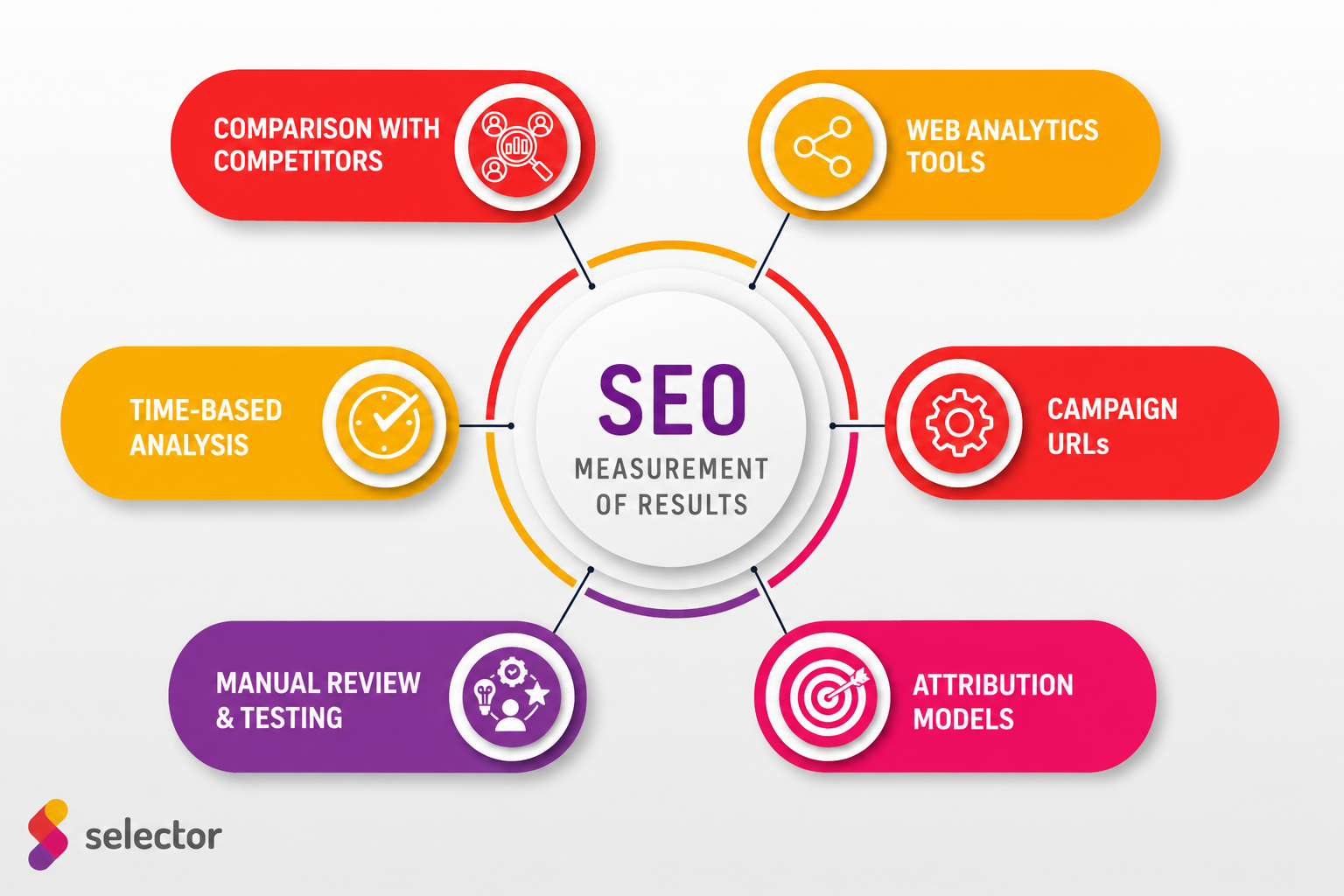
Separating the impact of SEO from other online marketing activities is not always a simple task, as different marketing channels often overlap and influence each other—ideally, reinforcing one another. However, there are methods and analytical tools that can help isolate these effects more effectively.
Web analytics tools
Most modern web analytics platforms (such as Google Analytics) offer the ability to track traffic sources precisely. With these tools, we can see which visitors arrived at the site via organic search (SEO), paid advertising (PPC), or other sources (e.g., other websites, social media, etc.).
Campaign URLs
For paid campaigns, email marketing, and other online advertising activities, use unique URLs and tag them with UTM parameters. This allows for the precise tracking and evaluation of individual campaigns. UTM parameters are special variables that can be added to the end of a URL. These parameters carry additional information about the traffic source, ad type, keywords, and campaign content.
Attribution models
Attribution models help us understand which touchpoints contributed to a conversion. For example, if a visitor first arrived at the site via a paid ad and later returned through an organic search to convert, the attribution model shows how much each touchpoint contributed to that conversion.
Experimentation and testing
If you want to introduce a new SEO strategy or change, it is worth designating certain pages as a control group where the change is not implemented. By comparing the results of the two groups, you can judge the effectiveness of the new SEO strategy.
Time-series analysis
Review the time series of traffic and conversion data. If a significant change is observed in organic traffic following an SEO activity, and there is no other explanation for the rise or fall, it can be assumed that it was caused by that specific SEO activity.
Competitor benchmarking
It is always worth comparing changes in the listed metrics against those of competitors. This can help determine whether a fluctuation in traffic or a drop in rankings affects only you or others as well. It could be the result of natural seasonal fluctuations that affect everyone, or, in a less fortunate case, you may be facing the unfavorable impact of a search algorithm update that specifically affected you.
Precisely isolating the effects of different marketing channels is never 100% accurate, but with the help of the methods and tools mentioned above, we can get closer to the reality and make better decisions regarding the planning of future marketing and SEO activities and the allocation of marketing budgets.
How does an SEO agency price its services?
Last but not least, let's look at the most common pricing models in the search engine optimization services market. SEO agency pricing depends on many factors, including the agency's experience and expertise, the client's industry, the size of the company, and the scope of the desired services.
#m1-p#The most common pricing models for search engine optimization (SEO) services are as follows:##
Hourly rate engagement: This is the simplest and most transparent pricing model. The agency charges a set hourly rate for SEO tasks, regardless of the specific work being performed. Clients are typically provided with time sheets, which allow them to see exactly how much time was spent on each task.
Project-based agreement: This model is suitable when the client can precisely define their needs, allowing for a specific project and implementation plan to be created (e.g., the SEO-optimized development of a new website). Pricing is essentially based on the agency's estimate of the time required, but it is the agency's risk to stay within that estimate during implementation. It can be advantageous for both parties if the tasks are clearly defined and the agency has sufficient experience with projects of similar size and complexity, enabling them to accurately estimate resource requirements. The main advantage for the client is paying a fixed price for the entire project, which can also be tied to a delivery deadline.
Monthly subscription packages: This model is beneficial when the client requires ongoing SEO services or consulting. The agency charges a fixed monthly fee for performing scheduled tasks (e.g., content development, on-site SEO optimization, link building, competitor analysis, rank tracking, etc.). Clients can typically choose from several pre-defined packages based on their needs and budget.
Performance-based model: This model is applicable when the client is only willing to pay for achieved results. The client and the agency set a specific goal together, such as having the client's website appear in the top 3 Google search results for certain keywords. If the agency achieves the goal, the client pays the agreed-upon fee.
The use of performance-based pricing has declined significantly in recent years, as unpredictable changes in the market environment (algorithm updates, competitor activity, the emergence of new AI technologies, etc.) have made SEO agencies increasingly reluctant to accept such engagements. This model only works effectively if it includes guarantees for both parties; therefore, it is most often combined with other pricing structures, with the performance fee appearing more as an additional bonus in agreements.
Summary
When choosing an SEO agency, it is crucial to proceed with due diligence, as you are ideally selecting a long-term partner for several years. Before making a decision, request quotes from multiple sources and weigh the different pricing models and options. Set realistic goals and regularly measure, analyze, and compare results. Be patient, as lasting and stable results can only be achieved through persistent and consistent work. Avoid market players who promise quick improvements using black-hat techniques at all costs.
#promobox-en#Would you like to get help from an SEO Agency for your website?##






.jpg)
.png)