When it comes to online marketing, would you choose slowly building, "free," authentic reach through content, or costly ads that deliver quick results? The answer, of course, depends on many factors, but the good news is you don't actually have to choose just one. In this article, we'll explore the golden mean between organic content and paid advertising, and with our checklist, we'll help you too – because we believe that by combining these two types of content, you can reach the top. If you're interested in finding the balance between these two strategies to maximize your potential, this article is for you!
.png)
Let's clarify the two concepts!
Organic Content
The power of organic content lies in its authenticity and community building – it's not about ads, but rather genuine value and interaction that drives it.
Since there's no paid promotion behind it, it spreads "naturally," reaching those who are genuinely interested. This is precisely what makes it credible and highly valuable for your brand in the long run.
The algorithms behind various platforms (social media sites, search engines, etc.) deliver your content to your audience based on a slightly different logic than with paid ads – here, we can assume a stronger interest from your target audience. For example, an organically appearing blog post in a search engine or a post that pops up without promotion indicates that they specifically searched for what you offer, or perhaps already follow you. It follows that it supports your growth with a different logic than paid advertising.
These posts, videos, or other organic content have several advantages. For instance, they don't incur extra costs beyond production, and they generally increase brand awareness in their own "slow and steady wins the race" way.
Of course, there are two sides to this coin, and since algorithms are constantly changing, you don't only reach your target audience with your organic content, making it often difficult to achieve dynamic growth.
Paid Content
In contrast, paid online content (or as we often refer to it, PPC campaigns) allows you to specifically target audiences who are particularly interested in your products or services. From this, you might have realized that paid content is specifically designed to increase reach.
Ads, promotions, and sponsored posts help you reach the audience for whom the content might be relevant more quickly and precisely.
We write a compelling text, and with paid advertising, our content magically appears to the target audience, who immediately jump on the offer... sounds good, right? However, for things to go so smoothly, it's essential to understand our target audience so we can communicate in their language.
When should you build on organic content?
To make the above definition more tangible and help you decide if you should prioritize organic content (among other things) right now, here are some typical situations where we recommend it:
- Your target audience actively searches for information on your topic
- You want to strengthen your brand's credibility and expert image
- Long-term, cost-effective growth is important to you
- You want to build a community that is committed to your brand
- With search engine optimization (SEO) you want to increase your website's traffic – with the help of blog articles
When should you use paid advertisements?
There are situations, however, where paid advertisements offer undeniable advantages. Let's look at scenarios where they can serve your goals better than organic content:
- You want to quickly increase reach and interest for a campaign or product
- You want to reach new markets and target groups
- You operate in a highly competitive industry where it's difficult to stand out using only organic methods
- Your promotions are time-sensitive and require an immediate response
- You focus not only on brand building but also on direct conversions (e.g., purchases or subscriptions)
The Digital Marketing Trinity: Reach, Traffic, Lead
To create the perfect social media strategy, we need to understand not only organic and paid content but also the three most important content focuses. Each serves different goals, and each has organic and paid versions.
#m1-y#But let's see what each strategy is good for and how to use them:##
The key? The golden mean!
Organic and paid content are not adversaries, but complementary tools. The key is finding the optimal mix of the two, which, of course, can vary depending on the industry and campaign goals.
For example, in the fashion and beauty industry, organic content – such as backstage moments and product showcases – continuously builds consumer trust, while paid advertisements provide quick, targeted visibility, especially during seasonal campaigns when consumer demand is highest.
For B2B services, expert articles on LinkedIn can work well, and case studies or customer testimonials can also become popular. This synergy can be perfectly supported by LinkedIn and Google Ads campaigns and remarketing ads.
The problem arises when marketing professionals fail to find a balance between the two methods.
#m1-p#TIP: If a particular organic or paid content type works well, it's worth using, but don't forget about other options that could perfectly complement your existing strategy.##

#promobox-newsletter###
Tips for striking a balance
See where you're competing!
First, it's important to thoroughly examine your target market and your industry's specifics.
What performs organically for a fashion brand might go unnoticed for a B2B software company without paid advertising. Our first tip, therefore, is to observe how your audience behaves: what captures their interest, which platforms they are active on, and how they react to different types of content.
Allocate your budget well!
Even if you know your target audience and where they are active, that's only part of the solution. You'll most likely find that you specifically need paid ads to get your brand's message to as many people as possible, as quickly as possible.
But don't rush, and don't immediately discard organic content. First, assess your budget and see what it will actually cover. When it comes to paid ads, it's worth considering cost-efficiency metrics: CPC (Cost Per Click, i.e., the cost paid for each click on your ad) can vary widely depending on your business type, industry, the product and service you offer, and of course, the platform and campaign type.
Competing with Hungarian companies is different from competing with businesses in countries with higher or lower price points – naturally, your advertising costs can skyrocket if your competitors spend several times your ad budget on various platforms.
In contrast, organic, unpaid content competes "only" with media noise, not directly with competitors' budgets – but numerous viral posts have already proven that if you manage to hit on something truly interesting, if your content is genuinely relevant and valuable, and it engages your target audience, then in the long run, you can increase your reach by 20–30% (or even more).
That's why it's important that all content you publish resonates with your target audience; otherwise, even the most expensive ad will just be a costly lesson.
Measure! But what should you measure?
For both methods, it's crucial to measure the most important KPIs (Key Performance Indicators) – such as the aforementioned CPC, or cost per click. If you feel that the world of performance metrics is unfamiliar to you, learn more about them in our previous article .
Organic content In the case of it can be great feedback to check your website's traffic (a good SEO strategy, alongside social media, can primarily help increase this), the number of likes, comments, and shares on social platforms, and of course, you can also check your organic search ranking (again, improvable with SEO).
For paid content:
The most important thing is to continuously measure results, evaluate cost-effectiveness, and don't be afraid to change your strategy if a particular direction isn't yielding the expected outcomes.
A few tips for building your strategy
Now that we've looked at why it's worth combining paid ads
Use paid ads to support your organic content – for example, if your blog post, TikTok video, or Instagram post performs well organically, a little ad support can help you reach an even larger audience.
Build your organic presence, but don't be afraid to advertise periodically – especially useful for campaigns, promotions, or product launches.
Monitor data and optimize – test which content types perform better organically and which require ad support. If an ad performs exceptionally well in a particular campaign, it's worth incorporating the same message or visual style into your organic strategy.
Don't just aim to sell; build relationships and provide value – let ads drive traffic, but let organic content build relationships with your audience.
The right content, at the right time, in the right place - for a fast-paced, short-lifecycle product, for instance, paid campaigns can overcome competition, while for long-term brand building, organic content fosters trust and loyalty among consumers.
With this approach, you'll find the golden mean much more easily, and you won't have to worry about one method completely overshadowing the other. By cleverly combining organic and paid strategies, you'll not only utilize your advertising budget more effectively but also build a stronger, more engaged audience in the long run.
Remember, for the best results, it's worth continuously fine-tuning your strategy.
A useful checklist
Here's a practical checklist for developing your content mix, which will help you achieve your marketing goals more effectively:
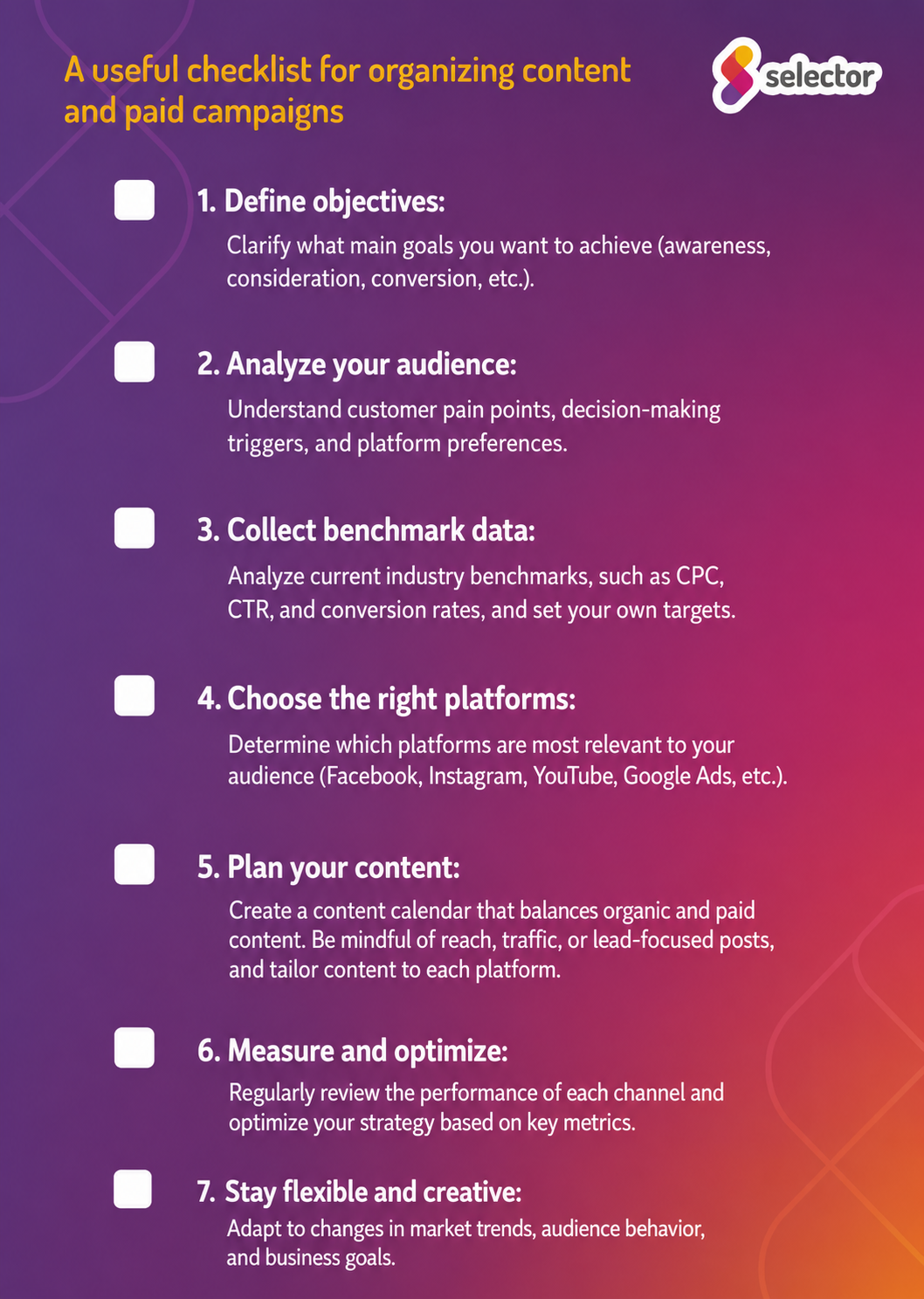
- Define Objectives: Clarify your main goals (e.g., awareness, engagement, sales).
- Analyze Target Audience: Understand consumer habits, interests, and platform preferences.
- Gather Benchmark Data: Examine current industry metrics, such as CPC, CTR, and conversion rates, and set your own targets.
- Platform Selection: Determine which platforms your target audience is most active on (Facebook, Instagram, YouTube, Google Ads, etc.).
- Content Scheduling: Create a mixed content calendar where organic and paid appearances are harmoniously integrated and build upon each other. Pay attention to whether you're using a reach, traffic, or lead-focused post, and carefully select the appropriate platform.
- Measurement and Optimization: Regularly analyze the performance of both methods and fine-tune your strategy based on current KPIs.
- Flexibility and Creativity: Don't get stuck on rigid structures; experiment with new approaches and adapt to changes in business goals and the market.)
When measuring performance, it's important to remember that paid advertisements will naturally show better numerical results, providing measurable and impressive outcomes. The results of organic content are less directly quantifiable, yet they play a crucial role in audience interaction and relationship building.
Summary
Both organic and paid content have their place in every strategy – the key is to combine them smartly. Finding the right balance requires continuous testing and fine-tuning, so it's important to always pay attention to data, listen to feedback, and dare to make changes when necessary. Use this guide to plan the future of your communication – monitor industry benchmarks, measure KPIs, and align your plans with your goals. This way, your brand will not only be more visible but you can also build a stable audience around it in the long term, even in dynamically changing markets.
#promobox-en#Would you rather entrust the creation of your strategy, combining organic content and paid advertisements, to professionals?##






.jpg)
.png)