You can effectively increase your webshop's conversion rate by leveraging the power of psychology. In this article, we present scientifically proven practices that can encourage your visitors to make a purchase – and we'll also show you how to use them ethically to gain not just sales, but loyal customers in the long run.
.png)
The Importance of Perfect UX and UI Design
The world of online commerce is no longer just about products. A successful webshop not only meets consumer needs but also subtly guides interested parties through the purchasing process with brand-appropriate UX (User Experience – user experience) and UI (User Interface).
The foundation of a good user interface and experience design is human psychology, because with a website, our goal is for people to navigate the site easily and intuitively, reaching conversions without obstacles, whether that's a subscription, a purchase, or a download.
To achieve this, we can even employ sales-boosting tricks during the customer journey, which can increase our website's conversion rate – specifically, the number of purchases.
However, as a marketing agency that advocates ethical marketing, we must ask ourselves:
How far can we go with psychological tricks? What constitutes effective marketing, and what crosses the line into manipulation?
In this blog post, we'll take a closer look at this dilemma: illustrated with good and bad examples we present the tools with which you can ethically increase your traffic.

The mysteries of behavioral economics
Behavioral economics examines how people make decisions in real-world conditions . That is, not in the laboratory environment used in economic models, but amidst everyday, often uncertain or distorting factors.
This field of study has shown that consumers do not always make rational decisions, but rather are influenced by emotional and cognitive biases. This is particularly relevant in the world of online shopping, where decisions must be made in seconds, often information overload and visual clutter .
#m1-y#By understanding these decision-making mechanisms, we can design our webshop's interface and communication more consciously and responsibly.##
Let's look at the psychological effects that can come into play during the customer journey, and how you can integrate them into your website's user interface!
Sales incentives based on psychological effects
Scientific research shows that people exhibit loss-averse behavior . Many sales-boosting tools leverage this very predisposition to encourage faster customer engagement.
In their 1992 prospect theory, Nobel laureates Daniel Kahneman and Amos Nathan Tversky demonstrated that:
‘ A given amount of loss hurts about twice as much as gaining the same amount.’
This theory can be extended to most human decisions, meaning people generally make decisions in a loss-averse way. This is why various missing out, scarcity emphasizing methods are effective. Let's look at a few of them:
1. The Allure of Scarcity
Research shows that:
‘ The less there is of a given product or service, the more we desire it, because we think that if it's so popular, it must be a good choice.’
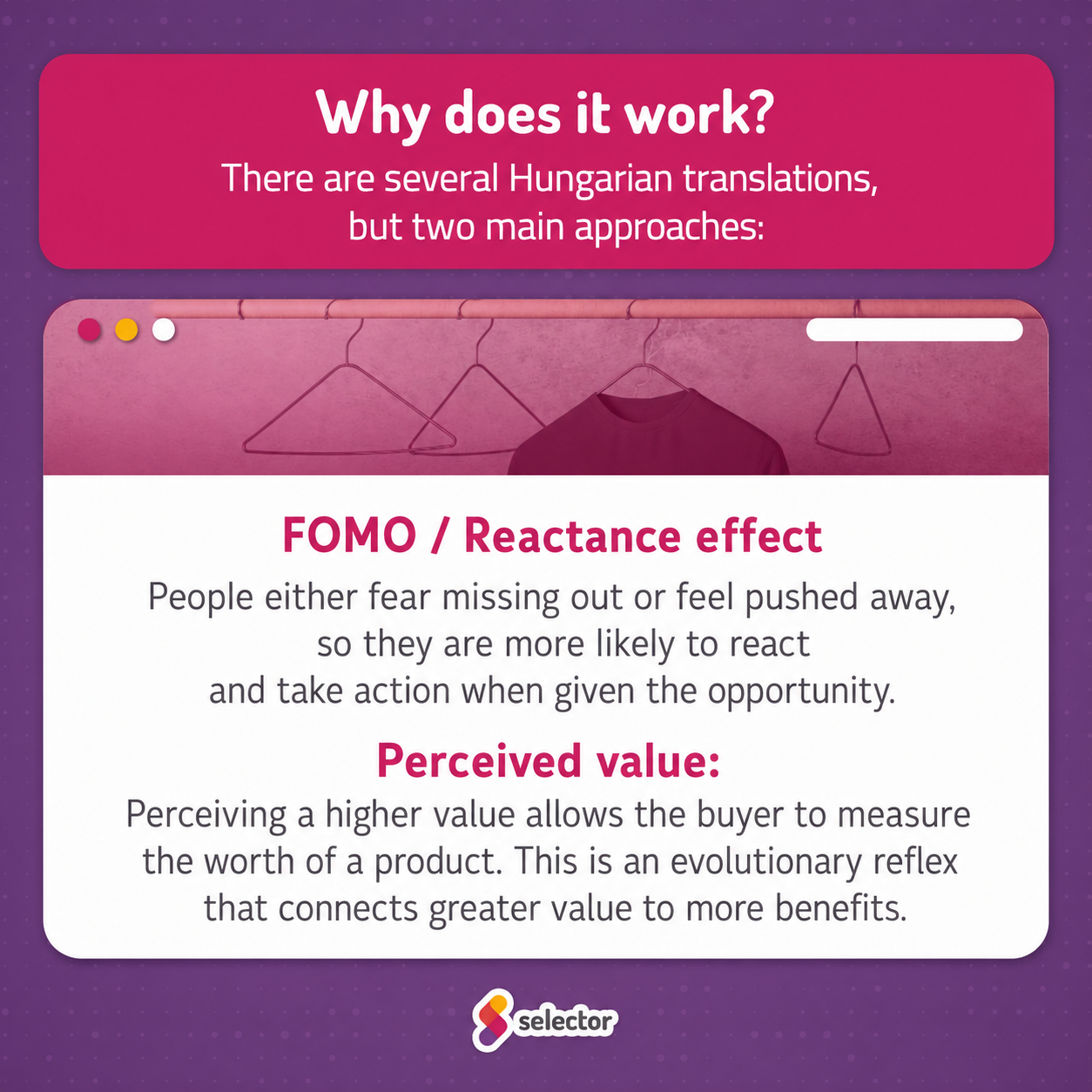
In an offline environment, for example, the stock level on shelves can also be an indicator of a product's popularity: the sparser the supply of a given product, the more we assume many people are buying it.
#m1-p#In the online space, this effect can be achieved with scarcity messages.##
"Today only!", "Only 3 left in stock!" and “70% of tickets already sold!” - Sound familiar, right?
Such scarcity messages trigger people's FOMO, i.e., their fear of missing out . This causes them to make decisions faster and associate a more positive value with the given product or service.
How can you use this phenomenon?
Ethical application:
- With time-limited promotions, which you can indicate with a countdown timer
- For limited edition products, when your stock is truly finite
- For fast-selling stock, if demand is high
Manipulative application:
- You always indicate the product is scarce, but in reality, it never sells out
- Constantly creating a "last item" feeling for every product
- Using countdown timers that never expire, meaning the promotion never actually ends
2. Social Proof: Do what others do!
This tool is based on the principle of social reinforcement .
If you go on holiday to an unfamiliar place and want to eat, would you rather eat where there's already a queue, or in a place that's almost empty? Probably the former, right?
#m1-y#People tend to imitate others, especially when they are uncertain.##
This is a kind of inherited evolutionary instinct, which we carry with us and can be transferred to the online world. If we're not very familiar with the offerings or don't want to get bogged down in deep comparisons when making a choice, we often opt for options recommended and validated by others.
How can you use this phenomenon?
Ethical application:
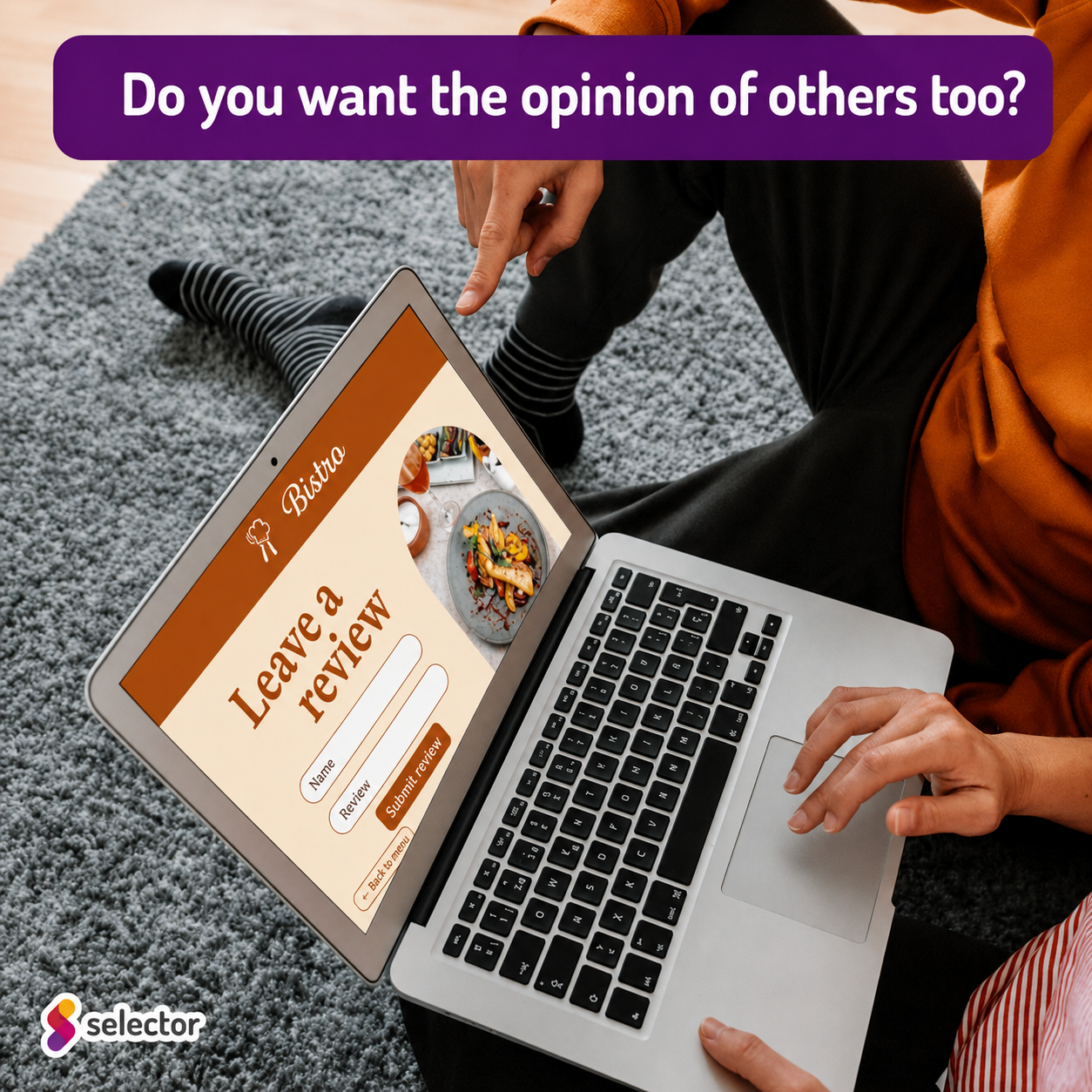
- Displaying authentic customer reviews and feedback
- Integrating user-generated social content about the product or service (e.g., Instagram feed)
- Introducing "best seller" products
Manipulative application:
- "Just bought" pop-ups not based on real data
- Fake or purchased reviews
- Counters showing "X others are viewing this besides you"
These tools used to be widespread in many places, but since then the Hungarian Competition Authority (GVH) scrutinizes more strictly the origin of this data, and if you cannot clearly prove its veracity, you could easily face a penalty.
#m1-p#Therefore, we do not recommend sales incentive tools based on demand measurement.##
#promobox-newsletter###
3. Anchoring: creating a reference point
If you go into a restaurant or visit an online store, the first few prices you see play a decisive role. These will be the certain anchors, or reference points, based on which you assess the price level of the given offer.
From then on, if you browse or scroll further on the page, you will compare prices to these.
If someone is browsing in a more expensive place, they will consider cheaper offers even more favorable compared to the initial high reference point, even though they might not have originally spent that much on that particular product or service.
However, thanks to the anchor prices, the budget they are willing to spend has increased in their mind.
The same phenomenon applies to displaying prices before a discount period. If we see the original price and how much more favorably we can buy now in comparison, we are more willing to make a purchase sooner.
How can you use this phenomenon?
Ethical application:
- Consider which products and prices your customer encounters first
- Always display the original prices for promotions.
- The discount should only be valid for a specific period.
Manipulative practice:
- The “discounted” prices are actually permanent; you're just presenting them as a sale.
- You determine the original price based on the discounted price, and it has no real basis.
4. Recommended Options, Package Deals, and Guidance
The purchase decision-making is fundamentally a tiring process for our brain. From the moment a need arises, the information gathering, comparing alternatives, and making the final decision requires a lot of energy.
This is precisely why, when we buy things where there isn't a high riskthat we'll regret a bad decision, our brain tends to make decisions based on heuristics (rules of thumb) or emotions .
#m1-y#Such a heuristic could be: choosing the cheapest, fastest, currently available, or merchant-recommended option.##
If there are too many options, we make it harder for our customers to decide, which can lead to them not purchasing anything at all because they become fatigued by the decision-making process.
How can you leverage this phenomenon?
Ethical application:
- Offer a maximum of 5-6 variations (e.g., different colors) for a product
- Recommend products: best sellers, month's favorites, etc.
- Create bundles from your best-selling products
Manipulative application:
- You recommend products not based on demand
- You create bundles from products you currently have a large stock of
- The products do not match the package name (e.g., 'best value for money,' even if they aren't in reality)
5. Give something to your customer!
We have already discussed that your customers are loss-averse make decisions. Scarcity messages are also based on this, as customers don't want to miss out on a good deal.
We can also activate this phenomenon in another way: by giving something to the customer.
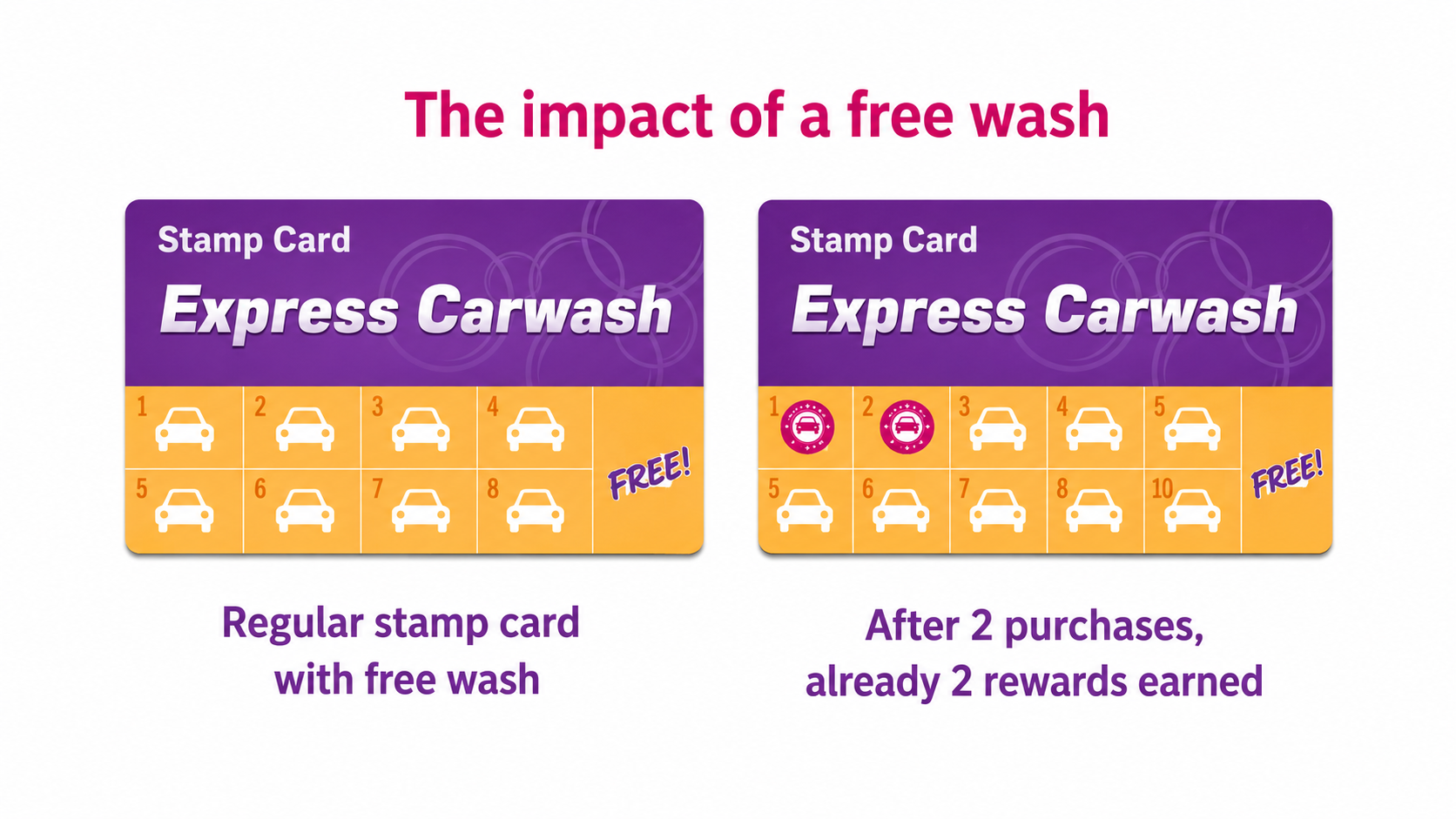
A study examined the consumer behavior of a car wash's returning customers. Two types of loyalty cards were given to customers, where after 6 washes, the next one was free was.
On both cards, 8 washes had to be collected, but one started from 0, while on the other card, two points out of 10 were already pre-filled (meaning eight still had to be collected there too).
The research showed that people redeemed the ten-point card more frequently because they had already received two points, which they didn't want to lose.
How can you use this phenomenon?
- Offer a small, symbolic item with the order: product sample, free shipping, gift product
- Implement your own points collection campaign, either with a paper-based card or by introducing a more sophisticated loyalty program.
Closing Remarks
Tools based on psychology can therefore be effectively used to increase webshop conversion rates. However, it is important to do this ethically, as manipulative tools can, on the one hand, lead to legal consequences, and on the other hand, unlike short-term gains, they can have a negative impact on the brand, which can hinder the success of the business in the long run.
#promobox-en#Let's optimize your webshop's customer journey together!##






.jpg)
.png)