What if we gave you a tool that helps you make well-informed decisions on all business matters? A good business plan does exactly that: it assists the company leader in every decision-making situation. But what exactly does it contain, and in what situations can it help? What are the most common mistakes we can make when preparing one? Read our blog post, fill out our business plan template, and you'll get answers to all your questions!
.png)
When should you create a business plan?
Every business can benefit from a business plan, whether it's in the pre-launch phase or has been operating for several years. A business plan helps at every stage of a business to clearly see our own position and goals. This also applies to the growing number of webshops, for which there are specific questions worth considering when preparing a business plan. In this blog post, we'll show you the ins and outs of successful business plan creation, and we'll also cover the specific characteristics relevant to webshops, so you can successfully operate your business in the online space.
What does a business plan help with?
Perhaps it would be easier to ask what it *doesn't* help with?
A business plan is the best tool for thoroughly thinking through the operation of a business from start to finish, and for developing a mature, interconnected concept from our various ideas and visions. By the end of the process, we will be able to present the operation of our business comprehensively and understandably even to a complete outsider.
Furthermore, it's also a significant factor that a business plan helps define organizational goals, thereby aligning employees within the company so that everyone acts according to the same principles and a common understanding.
A good business plan also reveals our business's strengths and areas for development. If we prepare it thoroughly, it allows us to understand our market position, competitors, and the opportunities that can give us a competitive advantage. Furthermore, it helps us prepare for anticipated challenges and tasks that need to be solved, so we don't encounter them for the first time during operation.
#m1-p#A business plan can therefore be a versatile crutch in the hands of a company leader, which they can turn to anytime they face a decision. ##
By using it, we can effectively define achievable goals and associated metrics, which allow us to track whether the company is progressing towards them.
Who do we write the business plan for?
Since a business plan is to businesses what a resume is to employees, it's worth being aware of who will ultimately read it – because we need to highlight different things for an investor than for a newly joined colleague.
Essentially, a business plan can have three target audiences:
- Investors: This category includes anyone from whom we want to acquire financial or intellectual capital. This could be a venture capitalist, a grant evaluator, or an external consultant. For them, the goal is to fully understand the internal objectives and results.
- Colleagues: Whether it's a co-owner, a new team member, or a business partner. For them, beyond understanding the internal processes, it's crucial that the company's goals and current situation are transparent and clear to everyone. Everyone should be aware of their role in the operation and what they need to do for successful management.
- Company Leader: It might be surprising, but the company leader is also an audience, even though they are the one writing the business plan. After writing a good business plan, the unorganized thoughts that were previously only in our heads take on a more structured form, allowing us to see our company's current situation and future goals more clearly.
What points are needed in a business plan?
You might encounter different lists in various professional literature, but if we examine the topic comprehensively, it's definitely worth including these main topics in your business plan:
1. Executive Summary
If others will also read our business plan, it's advisable to start with an executive summary, which has two main purposes. Firstly, it presents the most important elements of our business plan – because an investor doesn't always have time to read our entire business plan; they need to be brought up to speed with the executive summary so they know what the investment opportunity is about. The second purpose is to pique the reader's interest and encourage them to continue reading our plan.
In an executive summary, we can present:
- The core concept of our business, what consumer problem it solves, and how it fits into the current market environment.
- What products or services we offer to solve the aforementioned consumer need.
- Who are our target audience, and why our product or service would be beneficial for them.
- Also, let's not forget the basic financial data, such as expected return on investment, revenue, and profit, which might make an investor interested in reading further.
2. Business Description
In this section, you can introduce what your business does, where the idea came from to pursue it, what market you target, what industry your company operates in, or what kind of unique selling proposition (USP) sets you apart from competitors. For webshops, such a characteristic could be faster delivery, responsive customer service, some kind of unique web design or unique product development.
In this section, it's worth considering your vision and mission, as well as the corporate values that play an important role in the successful operation of your business.
The mission explains the organization's role in the world and the values by which the company operates. When creating your vision or future outlook, you should set a goal, an achievable state, which you can continuously approach with your short-term and long-term strategies.
Let's look at this through an example using Amazon:
- Mission: "Serving consumers through online and physical stores, focusing on selection, price, and convenience."
- Vision: "Our vision is to be Earth's most customer-centric company, where customers can find and discover anything they might want to buy online, and we strive to offer our customers the lowest possible prices."
Did something similar come to mind for you regarding Amazon? A mission and vision are effective if they are authentic and if we genuinely strive to guide the company according to these values and goals – whether for smaller webshops or giants, as in the previous example.

3. Industry Situation Analysis
It's important to assess the macro-environment in which our business will operate, as well as the current market situation, to ensure that the product or service we intend to sell will have viability and a future. To do this, thorough research should be conducted, within which we determine, among other things, the potential market size, as it's important for us to know approximately how many people might need our service and who our competitors are.
Speaking of competitors: in the industry analysis, it's important to understand the specific market's main players, identify competitorswith whom we are vying for the same target audience. It's also worth analyzing whether the industry is dominated primarily by larger companies, or if smaller providers also get a piece of the pie.
It's useful to analyze the services of different players, their operating principles, industry trends, and to consider what we can incorporate into our own operations from these, or how we want to be different and become more competitive.
4. Product or Service Presentation
In this section, you need to as detailed as possible present your product or service.
What consumer problem do you solve? Is this a unique solution, or are there already alternatives on the market? It's okay if there are, but then it's worth differentiating yourself from others, whether by price, by offering a better customer experience, or perhaps with some special design.
In this section, explain whether you offer a warranty for a product, for example, what materials it will be made from, its size, its packaging, and if there will be one or more versions. The more comprehensively and in-depth you can present it, the better. The goal of this chapter is for a complete outsider to be able to imagine what you intend to sell.
5. Marketing Plan
As a marketing agency, naturally, this is our favorite and most exciting chapter, aiming to help you plan how to reach your customers.
Unlike a physical store, people can't just wander into webshops if they happen to be passing by. Therefore, it's crucial to consider who your target audience is, who might find your product or service useful, and to consciously plan what channels and tools you'll use to reach them, encouraging them to make a purchase.
There's also an advantage to your business operating online: thanks to today's technology, we can track in detail how many people a specific online advertising campaign reached, and how many visited your site or made a purchase as a result.
Let's see what marketing opportunities can help make a webshop successful
- Content marketing: You can publish blog posts, e-books, videos, and other content on your website and other online platforms (social media, newsletters, apps) that contain relevant and valuable information for your target audience.
- Social media: Presence on social media also builds trust among customers. Furthermore, it's an excellent opportunity to simultaneously build a loyal follower base for your brand and webshop. On various social media platforms, you can reach people both organically and through paid advertisements.
- Paid online advertisements: Today, you can advertise targetedly on multiple platforms, allowing you to reach precisely those people for whom your product or service is relevant and valuable.
- SEO: When we search for a specific product or service, we want our site to appear as high as possible in the results. This is exactly what SEO provides a solution for, supporting the growth of your website's organic (i.e., unpaid) appearances with various keywords, tags, and other tools.
- E-mail marketing: It's one of the best communication tools with your current and potential customers, and also a content marketing tool (see above: content marketing). You can inform your customers about your current offers, new products, or any other news, and thereby encourage them to visit your website.
- Affiliate marketing: Are you familiar with how, in various videos, posts, and blog entries, we know exactly what brands of tools a content creator uses or what store their clothes come from? This is no coincidence; it presents a great opportunity for webshops if an individual (influencer) or company with a large reach recommends their product in their own content, in exchange for a commission.

6. Operational Plan
This question can be useful for any business at any stage of development, whether it's a startup or a company that has been operating for years. Rethinking your operations provides an opportunity to run your business with the most efficient production and daily processes. When it comes to operations, you should consider the following questions:
- Production: If you sell products, will you manufacture them "in-house," or might contract manufacturing be more favorable? Should the entire process be outsourced to contract manufacturing, or just a specific stage, with you finishing the semi-finished products?
- Technology, Software: What software do you need for sales? Will you build your website yourself, or will you seek expert help? How will customers pay? What technology is needed for the production of your products?
- Logistics: How and from where will your (semi-)finished products arrive? How long does it take for products or raw materials to arrive from the supplier? Do you need a warehouse to store them? How can the products be shipped, what kind of packaging do they require? How will ordered products get from you to the customer? What return options should be available?
7. Organizational Structure
#m1-y#"If you want to go fast, go alone! If you want to go far, go together with others!"##
A webshop can initially be started alone or within the family, but after a while, especially if it operates successfully, it is essential for the team to grow.
In a business plan, it is important to consider what competencies and knowledgeable people we might need for the successful operation of the business. In addition, it's important to clarify how these individuals in what organizational structure should work: who has what tasks and responsibilities, for what they can be held accountable, and what their feedback obligations are. Do you want to handle everything in-house, or outsource tasks, for example, to agencies?
If there are multiple owners in the business, it's advisable to clarify whether there's a hierarchy among you or if you operate as equal partners. Who makes the final decisions? Who has signing authority? What percentage of the company do you own?
If an investor reviews the business plan, this chapter is also useful because it allows you to introduce your team and highlight each member's competencies and prior experience in the field. The goal is to convince the reader that your team is truly capable of making this venture a success, making it worth investing in.
8. Financial Plan
If we launch a webshop, our clear goal is for it to operate profitably. However, this should be supported by financial data and calculations. While it might seem difficult at first to provide accurate estimates regarding the webshop's expected operation, it's worth putting in the effort, as it's better to uncover the business's weak points now rather than during operation.
For a startup, it's especially important to consider how much demand is expected, what our revenue streams will be, and how we will finance the business's daily operations until these revenues arrive. How many products or services need to be sold for our initial investment to pay off?
On the expenditure side, examine what startup costs can be expected. How high will your operating costs be?
Once that's done, also estimate your expected revenues. How much demand do you forecast for your products or services? What percentage of potential users can you reach? How many people will buy from you, and how often? At what price will you sell your products and services? How much profit can you make from this? How regularly do these revenues and costs occur?
Once you've considered all these questions, you can prepare a cash flow statement or income statement, or even a budget, to see all your financial data in one place.

9. Investment Needs
This chapter is only necessary if you need some form of investment or a loan, and your business plan will be read by an investor or a lending institution. Here, you can detail how much capital you need, what percentage of the business you are willing to give up for it, and by when you can repay it if we are talking about a loan.
Here you can also show how you would use the received amount and how it would contribute to the development of the business.
Common mistakes when preparing a business plan
Superficial research: Comprehensive research is essential for a good business plan, as it allows us to make informed decisions and more accurate estimations. Therefore, it's not worth cutting corners on this, even if it requires a lot of time and effort.
Unrealistic expectations: A business plan can only help if we realistically assess our business and our own potential. It is especially important not to be overly optimistic when defining financial data or market position, because just because a number looks good on paper doesn't mean it will be easily achievable, especially in the initial stages of a business.
Hiding weaknesses: Of course, we always want to present our best form, but an important part of a business plan is also to be aware of our weaknesses, because once we are aware of them, the next step can be to develop them. Mentioning weaknesses can also build trust with investors: it's a much better solution to discuss them briefly than to hide them.
Leaving it on the shelf: If we have written such a plan, then and utilize it for company management, and consider it when developing various short-term and long-term strategies!
#m1-p#It's worth updating certain details of your business plan periodically.##
Especially if any changes occur in the life of your business, so you can always be prepared for current challenges.
How to get started?
At first, it might seem daunting how multifaceted a business plan is, but that's precisely why it can be so helpful.
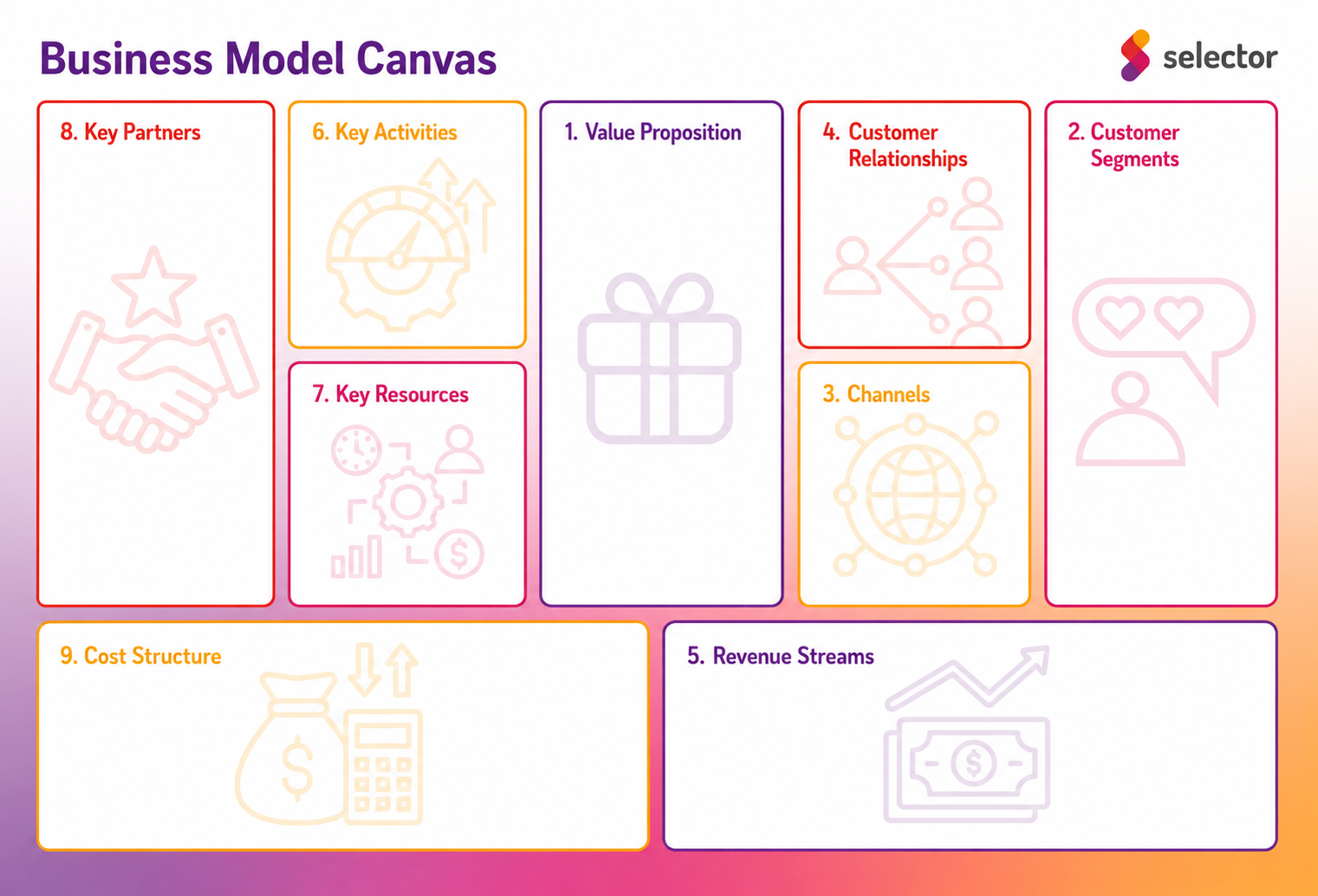
Today, simpler tools also exist for this purpose, such as the business model canvas, which is similar in structure to a business plan and can serve as a good starting point for a successful business plan.
Start thinking this way too: fill out each section based on the numbering, and then the more detailed work will also be easier!
Summary
Creating a business plan is therefore a complex process that requires time and energy, but it's a worthwhile long-term investment, as it can help prevent many difficulties during the planning phase. Furthermore, it can serve as a guide that you can refer to at any stage of your business. A good business plan greatly helps in credibly presenting your company to an external party, whether it's a new team member or an investor.
#promobox-en#Is your business plan ready? We'd be happy to help you plan and effectively execute your online marketing!##






.jpg)
.png)