
Just like on a first date, you might have more doubts than certainties during your first professional consultation—and that’s perfectly natural. That’s exactly why it’s important to arrive prepared with the right questions, so you can immediately determine whether there’s a future in the business relationship or if you should make a run for it before it’s too late.
.png)
Your first meeting with a marketing agency
The moment has arrived: you’ve decided to look for a new partner to handle your online marketing tasks and to hand over your brand’s presence—at least in part—to someone else.
It’s time to choose your future business partner—and no matter how many promising success stories you read about how much a marketing agency can boost your company’s success, this can still feel like a daunting milestone.
The first consultation with a marketing agency brings with it many questions, doubts, and uncertainties—which is why we want to help. By understanding both sides of the table, you can arrive at this meeting with questions that will help you choose the marketing team that’s the best fit for you.
You might feel like you’re on a first date
No matter how many times we’ve heard in Hollywood movies (and beyond) that you shouldn’t mix business with pleasure, it’s inevitable to draw parallels between a half-exciting, half-awkward first date and an initial consultation with an online marketing agency. Why?
#m1-p#We usually go on a serious date not for a fling, but with the goal of a long-term commitment.##
Because of this, there is a lot of pressure on both parties during that all-important first meeting. Some react by subconsciously tearing apart every word and gesture of the other person in self-defense, searching for potential red flags or bad omens. The other extreme is someone blinded by excitement, floating on cloud nine, where the "start of something new" suppresses all sense of caution.
It’s difficult to remain completely rational at such a meeting, no matter which way you tend to lean.
Fortunately, however, our feelings—alongside rational arguments—can be our greatest allies. That’s why our first and most important piece of advice, as cliché as it may sound, is to trust your gut before you start evaluating an agency based on any logical framework.

Since we’re talking about feelings, your physical symptoms and mood are pretty good indicators. Beyond the perfectly natural, minimal stress-induced racing heart, it can be telling if you notice the following during your first meeting:
- How does the professional or team you’re speaking with make you feel? Do they cheer you up, inspire you, and give you a fresh boost of energy? Or, on the contrary, do they drain you, leaving you feeling worried, pessimistic, and overly critical? Perhaps they make you feel like you’re a burden or that you "don't know anything about anything" (unlike them)? Unfortunately, there are agencies that treat clients like cash cows rather than equal partners—and where you aren't respected, you should make your exit as quickly as possible!
- Is communication easy and smooth? (Or, in other words, is there "good chemistry"?) If so, you’ll likely feel like the time just flew by during the conversation. However, if the collaboration starts off with a struggle, constant misunderstandings, awkward silences, or even immediate conflict, it’s worth considering whether you want to give the team another chance or if you should start looking for a new marketing agency.
Come prepared! Bring your goals, ideas, and questions so you can get the most out of the conversation.
Once you’ve explored the emotional side, it’s time to move on to the hard, rational arguments.
Just as with the previous point, it’s important to know yourself and your company: be clear about your realistic, quantifiable goals, your brand’s ethos, values, mission, target market, and the qualities that matter most to you in an agency.

If you are completely clear on these points yourself, you’ll be better able to assess how a marketing agency can think within your framework and identify with the values your brand represents. Don’t hesitate to write down a few test questions before the consultation to help you figure this out! In the following chapters, we’ll give you some tips on what might be worth asking during your first meeting.
Compatibility – the cornerstone of a successful partnership
Just like in dating, it happens in the business world that two parties, while excellent in their own right and field, simply don’t click—and if these differences aren’t identified early on, it leads to pointless finger-pointing later.
There are obvious differences like company size (a startup solopreneur probably won’t be a good fit for the largest international agency, and vice versa), location, and language barriers—but beyond these, there are many areas where it is crucial that your brand and the agency are a good match.
When choosing an agency, it can be very helpful to keep in mind the 8K model we’ve put together —but once you’ve selected your potential partner and the time for your first meeting has arrived, here is what you should find out first!
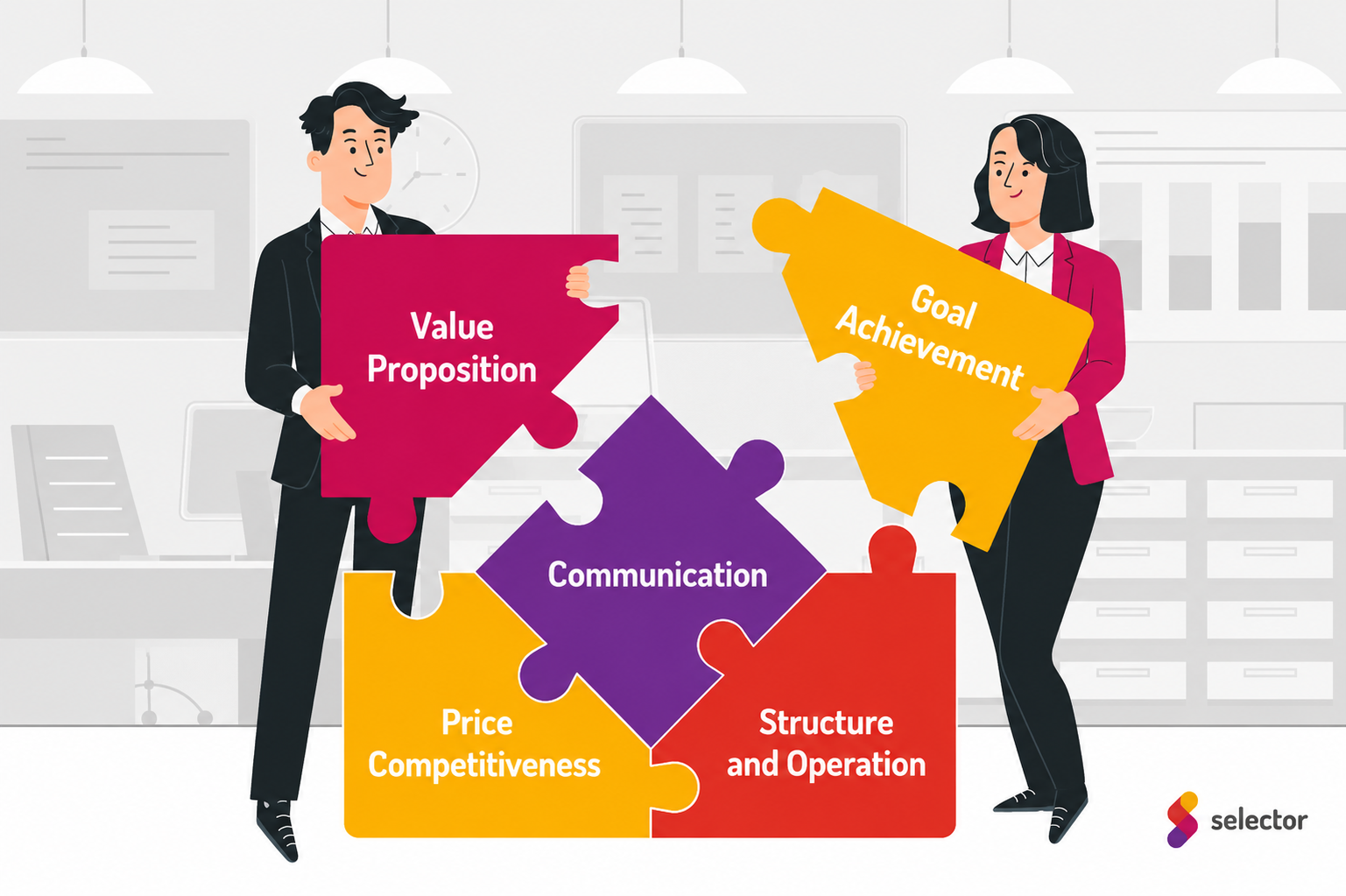
What are the agency’s core values, and how well do they align with your brand?
For example, if sustainable fashion is a cause close to your heart, you probably won’t find what you’re looking for in an agency that manages ads for a thousand fast-fashion brands. While it would be unrealistic to expect an online marketing professional’s worldview to match 100% of the core beliefs of every company they manage, it is also not ideal if there is a massive gap between the brand itself and the perspective of the person creating posts, ads, and other materials on the brand’s behalf.
#m1-y#If at least your fundamental values align, it’s guaranteed that the collaboration will be much smoother, as your differences in values won’t generate unnecessary tension.##
Beyond this, it’s good if an agency lists values like mutual respect, honesty, assertiveness, and a solution-oriented mindset among their most important principles.
#promobox-newsletter###
What do they prioritize in communication?
We already mentioned smooth communication above as an essential factor in choosing the right agency.
During your first consultation, don't hesitate to ask about the principles the agency follows in its internal communication and its interactions with clients.
To give you a few examples of questions you might ask:
- What channels and platforms do they use? It’s a good sign if they emphasize using traceable, official channels. Messenger chats (or heaven forbid, phone calls) are not only unprofessional but also make it impossible to verify what was or wasn't agreed upon—so it's best to avoid those who prefer these informal methods for communication.
- When are they (not) available?
- What is their typical response time?
- How do they handle potential disagreements?
Organizational structure and workflow: when and how do they work?
Related to the above is how a marketing agency organizes its daily operations and ensures a smooth flow of information.
You should be suspicious if there seems to be no tangible system in place, or if they operate in a "winging it" kind of way.
Conversely, it’s a promising sign if they already have a concrete plan during the proposal stage regarding who you will be working with, how, and within what framework.
You can ask questions such as:
- How many people will be working on your brand? What will their specific roles be?
- Who is your primary point of contact, when can you reach them, and through which channels?
- How do they handle coverage or substitutions?

How does the agency set goals and measure their achievement?
It’s a good idea to share your business goals for the upcoming period during the first meeting and ask for their feedback on whether these goals are realistic and how they would approach achieving them.
This not only helps you gauge how well the agency understands your market and the realistic results you can expect, but also reveals the tools and expertise they bring to a project.
It isn't necessarily a bad sign if they don't promise specific results during the very first meeting—in fact, it’s quite encouraging if they don't pretend to know everything about your market's current situation without having done proper research.
At the same time, it’s not a good sign if they sit across from you completely clueless and just shrug their shoulders—a good agency will always conduct at least some preliminary background research on a potential client.
#m1-p#When discussing how to achieve your goals, pay attention to the specific metrics they suggest tracking, how frequently they report, and how well-versed they seem to be regarding your brand, your competitors, and current trends in your target market.##
Value for money: what monthly budget do they recommend, and how does the agency's fee compare based on that?
Sole proprietors, SMEs, and multinational corporations all have different needs, which significantly impacts the type of agency they can work with effectively.
As a small business owner, a smaller agency or even a freelancer might be the most cost-effective choice for you, whereas for larger, more complex brands, it is worth working with a team that can cover multiple different areas in-house.
Regarding whether you should work with an agency or a freelancer, in a previous article we have already listed several factors that can help you make your choice.
Whoever you ultimately turn to, it is worth clarifying during the very first consultation how much you intend to spend on your online marketing activities for a given period—including ad spend as well as the fees for any services you wish to order from the agency.
#m1-y#List in advance the services you definitely need based on your current knowledge, and what you are unable or unwilling to spend on for the time being.##
This is beneficial because a good agency usually has a holistic approach and thinks in terms of connections within the complex field of online marketing—so it may come up during the consultation that even if you approached them for PPC ad management, it would be a profitable decision to also optimize your website for search engines, for example.
Do not immediately dismiss it as a hard sell or a rip-off if an otherwise likable agency suggests marketing services other than what you requested a quote for—the reason for this is not that they are mindlessly trying to squeeze as much money out of you as possible, but that they have recognized how you could be even more effective with a more complex strategy that is more rewarding not just in the short term, but in the long run as well.
Of course, the advice to trust your gut applies here too: if it really seems like they are only after your money, run!
Regarding financial planning, it is worth clarifying the following:
- What budget do they recommend for achieving your goals?
- What is the agency's pricing structure, and what makes up the monthly fee or the price of individual packages?
- What is the basis for billing, and how transparent is the process?
- What extra costs might arise?
- What discounts are available to you?
#promobox-en#Need help choosing? Send us your questions!##
Online marketing tools: the agency's arsenal
Once you have mapped out the agency's core values and practices, it's time to get into the specifics!
By asking the right questions, you can shed light on the agency's expertise: what tools they can handle, what areas the team has specialists in, and so on. As a first step, taking a look at the agency's professional blog is also worth your time, as it reveals whether they keep up with current industry trends through regularly published, relevant articles.
References and testimonials - Can they mention relevant client success stories for you?
A real success story is worth more than a thousand words - let alone more than one!
Browse the website, check out the agency's online marketing portfolio, and during your first meeting, ask about the types, sizes, and industries of the companies they work with.
#m1-y#During this process, it may also be important to find out if they are actively working with any of your direct competitors.##
Although truly ethical agencies will disclose this in advance, you can save yourself a lot of confusion by asking directly.
Needless to say, if the agency cannot show you any relevant client success stories - or has no references at all - it is better to be skeptical of their promises and look for a team that can prove their expertise.

Project management, organization, deadlines - What can you find out during the first meeting?
Actions speak much louder than words when it comes to how an agency works. From the very first email exchange and later during the consultation, observe how well-organized they seem! Here are a few important points to consider:
- Do they arrive on time for the first meeting, or are they late without a good reason?
- Do they introduce themselves and politely allow both you and each other to speak?
- Does the consultation have a structured format, or do they expect you to lead the meeting?
- Do they speak in an organized manner, with roles clearly defined among themselves?
- Do they proactively suggest a roadmap for the next steps and a time for a follow-up meeting, or do they rush off without properly concluding the discussion?
- Do they send a summary of the action items agreed upon during the consultation?
- Do they send all the promised information and materials by the agreed-upon deadline after the consultation?
By observing these things, you can learn a great deal about how well they operate within an organized framework, whether they are capable of working independently while keeping you appropriately involved, and whether they respect you and your time by preparing thoroughly and planning future steps professionally.
#m1-p#Excellent expertise alone is not enough for an agency: if it is not paired with organized workflows, your marketing strategy will be the one to suffer.##
What kind of ideas do they bring up during the first meeting?
Although an agency is in a difficult position during an initial meeting because they don't know your brand as deeply as you do, this shouldn't stop them from showcasing their creativity right from the start.
#m1-y#The best sign is if they can turn their disadvantage into an advantage by looking at your company with fresh eyes, helping you see your own opportunities in a new light!##
We already mentioned regarding chemistry that it's a good sign if communication flows smoothly—and it's even better if you can get on the same wavelength during brainstorming sessions.
Since an online marketing agency already possesses an extensive toolkit, they will likely have numerous ideas that could make your company even more successful.

It reveals a lot about an agency's expertise whether they only bring ideas related to specific areas or approach your brand with a holistic perspective, mentioning several different online marketing channels, including social media management, paid advertising, SEO, UX design, and the list goes on.
At the same time, it is also important that they can justify why they do (or do not) recommend certain solutions—feel free to ask about this regarding any of their ideas!
What areas do they specialize in?
Even during the brainstorming phase, you can get a comprehensive picture of the areas in which the agency seems proficient.
#m1-p#Ask how many teams or how many different types of specialists work at the company, and don't hesitate to ask for references for these as well!##
Since the range of online marketing solutions is very broad, it is worth choosing a partner who can reliably cover as many areas as possible in-house, as it is unlikely that your marketing strategy will be successful in the long run if it only touches on a few isolated areas.
#m1-y#Why is it so beneficial to have specialists in various fields within a single online marketing agency?##
Although the services of a complex agency composed of multiple specialized teams might seem more expensive at first glance, it significantly boosts the pace, effectiveness, and even the atmosphere of the collaboration when you don't have to coordinate the operations of several different companies day after day, week after week, and month after month. Instead, everything from creative conceptualization to billing stays within one company, and you only need to maintain contact with them.

This way, experts in individual fields can also organize their collaborative work much more easily under the guidance of a dedicated project manager, ensuring that your company's online marketing strategy does not fall victim to misunderstandings, delayed communication, or potential conflicts.
We often encounter marketing experts who claim to be masters of everything, from graphic design and web analytics to ad management—and while polymaths do exist, it is important to keep in mind that online marketing is a field where trends, regulations, and platforms change daily. As a mere mortal, keeping up with even one sub-field is a significant challenge, let alone several.
Summary
Whether you are sitting down to consult with a smaller or a larger agency for the first time, it is important not to be afraid to ask about the most important things right from the start!
Just like in personal relationships, it is true in business that the candidate who seems most attractive at first glance is not necessarily the right choice—compatibility (or the lack thereof) can override everything else. If you keep your eyes open and notice potential red flags in time, you can save yourself and your company a lot of grief.
We hope our article will be of help to you in this!
#promobox#Would you like to brainstorm with an experienced marketing team about achieving your business goals?##






.jpg)
.png)