
PR is one of the most important tools for building trust and reputation. Fewer people know that in today's digital environment, it's also essential to integrate PR into your SEO strategy. Here's how!
.png)
PR and SEO, or the two colleagues - how do they help each other?
If you've ever been to a city where "lure people" try to approach you in front of restaurants, then the following situation might be familiar:
Imagine it's dinner time, and you're strolling aimlessly through a charming old town. Suddenly, a confident, charismatic young man steps in front of you, holding photos of mouth-watering dishes, and smilingly asks if he can recommend a special restaurant. He tells you it's a local favorite, and what's more, several renowned local critics have praised it. As proof, he even hands you a newspaper article featuring the restaurant on the front page, honored with a Golden Chicken Leg Award.
He would be PR: reaching the right target audience (that is, you, who probably want to have dinner), with the right message (an attractive presentation of the restaurant and credible reviews), helping to spark your interest right at the beginning of the decision-making process. Of course, the goal of PR is not only to attract attention as in our example, but also to build brand credibility and customer trust, which also supports a brand's success in its target market in the long term.
Let's say you like his offer, and you decide to have dinner there that evening.
As you enter the restaurant, an elegant waiter greets you, leads you to your table, brings a considerably long menu, and then readily answers which dishes you can choose from, what the freshest daily special is, and helps you find the dish that best suits your taste and mood, while also drawing your attention to any dinner menu promotions available. Soon you lean back contentedly, as with his help, you've quickly chosen what your dinner will be that day.
He and the menu he presented are none other than SEO, or search engine optimization: he might not convince you to dine at a restaurant at all, but if you're already interested in the offerings, he helps you navigate the information. Its goal is to show you the most relevant content first and make your choice simple, while striving to lead you to the right decision as quickly as possible. SEO not only helps in making choices easier but also ensures that, for example, the restaurant (or any service) is easily discoverable during your search, and that you might even become a returning customer at the end of your visit.
#m1-y#SEO can also help in directly increasing traffic, but we'll need something else to build reputation.##
Building on the example above, we can best illustrate this with the analogy that the menu itself helps with orientation: if we want to "objectively inform ourselves" about the best restaurants for us, we can easily do so with the help of the menu displayed at the entrance, listing dishes and prices. However, only the "stopper" (PR) will be able to tell us what heavenly delicacies can be eaten here and how special this place is.
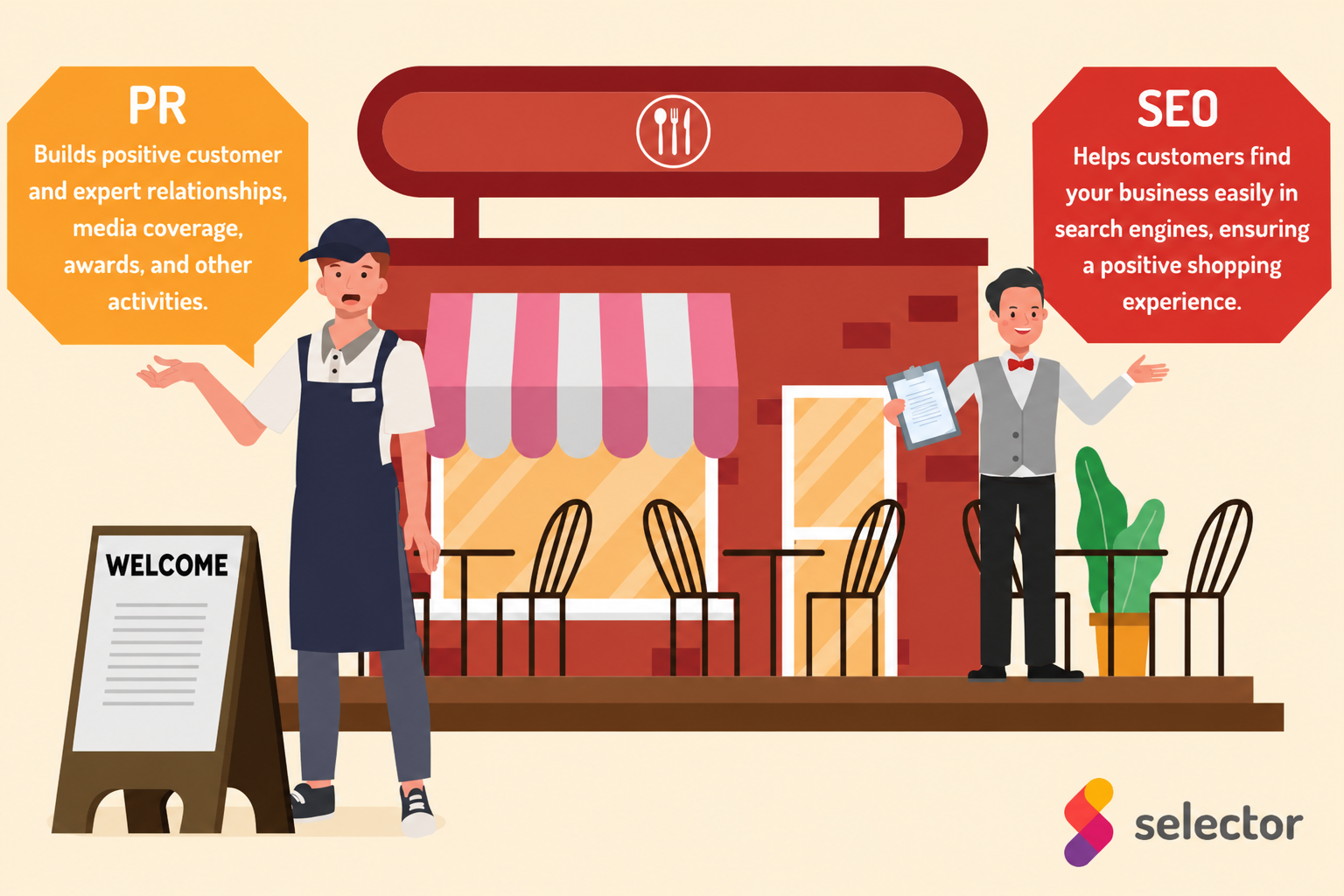
We could refine their analogy forever, as both areas have many additional strengths and tasks, and the exact role and toolkit of SEO and PR can differ for every industry and company, but one thing is certain: the two areas can greatly help each other. SEO can assist PR with its own tools, and vice versa, to boost your company's awareness and traffic as high as possible. This synergy works best when these two areas of marketing are integrated from the very beginning of a campaign or project.
However, not everyone, even among PR and SEO professionals, realizes that the two areas go very much hand in hand - as evidenced by a 2023 survey, which shows that barely 5% of SEO professionals prioritized strengthening their PR strategy during their SEO activities.
Here are some examples of how you can combine your SEO and PR strategies to leverage their synergy, making any marketing campaign much more effective and successful!
How to Combine SEO and PR – Best Practices
The Most Important Google Ranking Factors and Criteria , we examined point by point the SEO techniques you can use to achieve increasingly higher rankings in search results. These include some that can indirectly support your PR strategy (such as improving loading speed related to technical SEO, creating a mobile-optimized view, and so on), but also others that you can directly integrate with your PR activities. Here are some examples!
Better Search Rankings: SEO-Optimized PR Content, or Killing Two Birds with One Stone
Our first tip sounds simple at first glance, yet many forget to apply it: use your SEO keywords in your PR materials!
Review the results of your SEO keyword research and incorporate those into your brand's press releases, interviews, and other PR content, specifically the keywordsthat you want your business to rank for in organic, i.e., unpaid, search results, such as on Google's search results page. You can also use this strategy to strengthen your brand name! Furthermore, it's worth striving not only to focus on commercial keywords but also to link your landing page with varied anchor texts in press materials. This creates a connection between your brand, product, service, and the relevant keywords for your target audience (and search engines), which will form a strong foundation for future sales.
For instance, there might be immense competition for the keyword "best sports shoe," making it difficult to rank your online shoe store among the top results. Instead, you can use phrases like "unique sports shoe" or "quality sports shoe" in your PR campaign if these are part of your SEO strategy. Since your SEO team has already optimized your website for these keywords, you are highly likely to appear among the first results on the search page, further strengthening the connection between your brand and the keyword in your target audience's minds – who are much more likely to click on your site if they have already heard about you through your PR campaigns.

At the same time, remember: SEO and PR are two distinct fields for a reason. SEO requires a slightly different approach than creating PR-focused content.
While search engine algorithms have become very adept at recognizing keyword stuffing and unnatural-sounding content, the world of PR and media still places more emphasis on exciting, dynamic, well-styled content, storytelling and outstanding news value.
You don't have to sacrifice the style of your PR materials for the sake of SEO optimization! In well-crafted press releases and other PR content, you can easily embed important keywords without them sounding forced.
As publications pick up a brand's story, PR can increase the number, quality, and variety of backlinks generated for your brand. This brings us to the next intersection of SEO and PR: links pointing to your website.
In summary: identify which keywords are worth optimizing your website for, then incorporate them into your PR content to reinforce the connection between your keywords and your brand name in your audience's minds, ensuring your website appears among the top results on search pages.
PR Relationship Building and SEO Link Building in Service of Your Brand's Reputation
In SEO, off-page optimization techniques, or those performed outside your website, include link building is essential for success: the more reliable, high-quality sites that link to your company's website from their own pages, the more trustworthy and popular you will become in the eyes of search engines. This will lead to higher rankings for your content, increasing your website's traffic and ultimately your company's revenue.
#m1-p#But how can you acquire such valuable links?##
There are several answers to this. Link building is generally a slow process, requiring significant diligence and perseverance – but PR can significantly boost your effectiveness in this area.

The logic is simple: the more effective your PR team, the more people will hear about your brand, the more people will try your product or service, and consequently, the more people will write blog posts, social media posts, reviews, opinion pieces, or any other type of online content about you – leading to even more people hearing about you.
And all these online contents can contain links (often with relevant keywords) that point to your website.
The Google Alerts allows you to automatically track which sites have mentioned your brand without linking to your website. This enables your PR team to immediately spring into action and secure those valuable links for your SEO team.
Local SEO and PR – focus on local events and searches!
We've already provided a detailed introduction to the power of local SEO in a previous article: Boost your business's visibility by optimizing your Google Business Profile!
Combining PR and local SEO can yield excellent results for entrepreneurs who operate their business in a specific location – such as a shop, restaurant, or gym – and aim to reach a geographically relevant target audience (for instance, those specifically searching for a female hairdresser in Kiskunmajsa).
In our example at the beginning of the article, the colleague enticing customers in front of the restaurant (PR) was responsible for using various tools (critics' opinions, newspaper articles, local opinions, brand positioning) to persuade you to choose their restaurant. However, it was a matter of luck who approached you first on the street: them, or another equally talented salesperson.
The power of local SEO lies precisely in this: it helps, with the right tools (such as the readily available Google Business Profile) mentioned in our article, to effectively deliver your carefully crafted, persuasive message to as many potential customers as possible who are currently near you, putting you ahead of your competitors.

#m1-y#How can you integrate local SEO with PR?##
Let's take a simple example: if, as part of your PR strategy, you participate in as many local events as possible or even organize them yourself, the more content you can use to strengthen your local SEO strategy: you will appear in local online newspapers, blogs, new reviews will come in for your Google Business Profile, and so on. All of these will increase your website's and brand's visibility online and attract potential customers in your vicinity.
Analyzing PR and SEO metrics - here's how to stay focused on what matters!
The effectiveness of combining PR and SEO will only truly be visible if you measure and analyze properly. Use analytical tools - such as Google Analytics or Google Search Console reports - to track your website's and brand's performance in both search engines and media channels. Analyzing the data will help you refine your strategy over time and get the most out of the PR and SEO combination!
Conclusion
The combined application of PR and SEO is not just an option, but a necessity in the digital space: their symbiosis can be key to increasing your effectiveness and visibility. This requires continuously monitoring changes in both areas and flexibly adapting to the dynamic online environment.
Both areas have countless sub-areas and tools, but not all are suitable or necessary for every company, so we encourage you to find out which combination of tools can create the most value for your business! We'd be happy to help you with this - ask us for a free consultation!
#promobox-en#Do you feel your SEO strategy could be more effective? We'd be happy to help you move forward with our targeted audit containing concrete steps or our comprehensive SEO management service!##






.jpg)
.png)